All species › Gannets and cormorants › Anhinga and darters › Australasian Darter
Australasian Darter | Anhinga novaehollandiae
Australische slangehalsvogel | Anhinga australiana
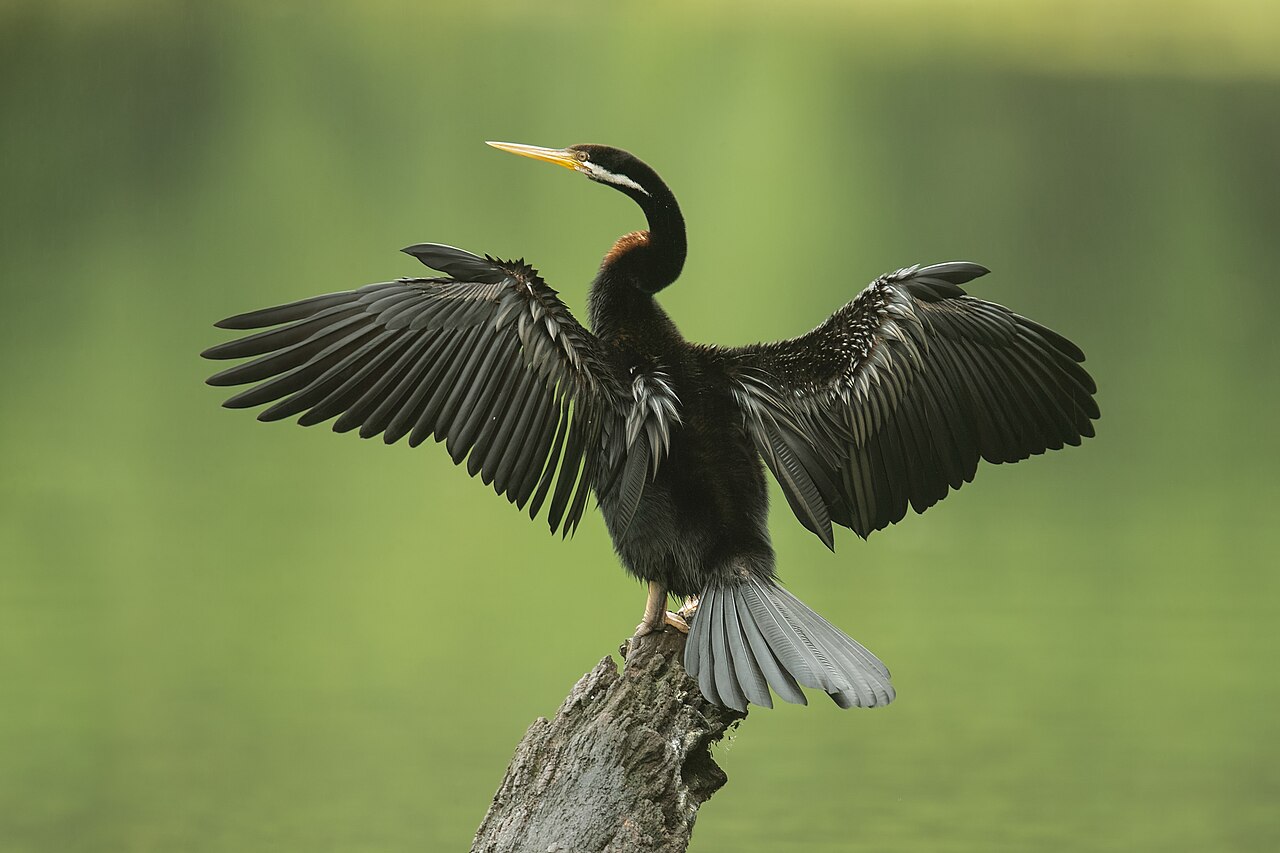
The Australasian Darter swims with its body under water and only the thin, kinked neck above it, which at a distance reads as a swimming snake. It spears its fish with a straight dagger of a bill rather than seizing it, and because its plumage wets through it must dry off with spread wings after every bout of fishing.
Voice
Away from the colony it is all but silent; what you hear at most is a dry clicking as it takes off. At the nest it is noisier: a run of grating kaa-kaa calls, hisses and rattling clicks passed between the pair. Young beg with a persistent rasping wheeze that carries well from under an occupied colony tree. Watch a darter fish in silence and you may not hear the species all season.
No freely licensed recording has been found for this species yet; what to listen for is described below.
Identification
A slender waterbird of 85 to 90 centimetres with a strikingly long thin neck carrying a sharp kink halfway along, a straight pointed bill without a hook, and a long broad fanned tail. The male is brownish-black with glossy black upperwings streaked and spotted white, silver-grey and brown, a white to pale brown stripe running from the bill along the side of the neck, and a chestnut breast. Female and juvenile are grey-brown above and pale grey to white below, with a much fainter neck stripe. In flight the cross shape stands out: long neck ahead, long tail behind, and it soars readily in circles on flat wings. Perched, it hangs open-winged in a dead tree over the water.
Confusion species
The cormorants are the only real confusion: Great Cormorant (Phalacrocorax carbo) and Australian Pied Cormorant (Phalacrocorax varius) have a thicker neck without a kink, a hooked bill and a short tail. Little Black Cormorant (Phalacrocorax sulcirostris) is smaller, all black, and swims with the whole back above water. Oriental Darter (Anhinga melanogaster) does not occur in the region. A swimming darter showing only head and neck is also taken for a snake or a floating stick on a large sheet of water.
Habitat
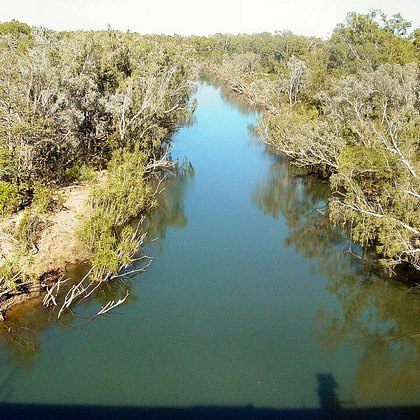
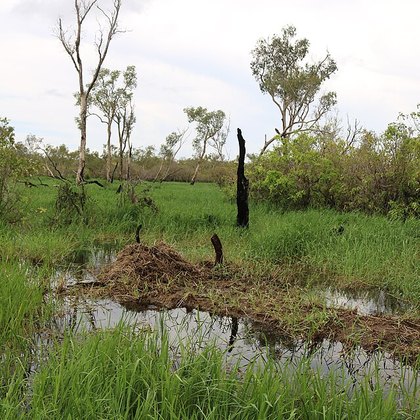
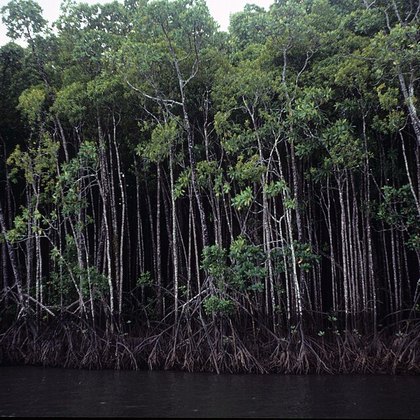
Fresh and slightly brackish waters with an open surface at least half a metre deep and trees along the edge: reservoirs, stock dams, slow rivers, swamps and sheltered coastal lagoons. The trees are not incidental; without overhanging dead branches to dry on and nest in, it will not use a water at all. It avoids fast mountain streams and the open surf coast.
Where the bird is most often found, arranged by main group and formation.



Range and movements
Across virtually all of mainland Australia, from Adelaide in South Australia to Broome in Western Australia and with a separate core in the southwest, and on into New Guinea. It is absent from Tasmania and is no more than an exceptional vagrant to New Zealand. It does not migrate but follows the water: as inland lakes and stock dams fill it spreads out, and in drought it falls back on the permanent waters of the coast and the big rivers. Breeding is correspondingly irregular and hangs on water level rather than on the calendar.
- Resident
- dark = core range, pale = thinly spread
Where and when to look
Look for it early in the morning on a dead branch over the water, standing in the sun with wings spread wide; that is the posture in which the species is most easily picked up. On the water itself the kink in the neck gives it away, as does the way it sinks from view without a splash. Check the tail of every soaring waterbird over an inland lake: no cormorant carries that long fan.
Conservation
Least Concern (LC) and rated secure in every Australian state. The species profits from stock dams, reservoirs and irrigation works inland, which have brought permanent open water to country that once dried out. Drowning in gill nets and the loss of old dead trees along the shoreline are the local costs.
Scientific name
Anhinga novaehollandiae | (Gould, 1847)
Gould described the bird in 1847 as Plotus Novae Hollandiae; because it was later moved to another genus, author and year stand in parentheses. The genus Anhinga was introduced by Brisson in 1760 and goes back to anhinga, the name the Tupi of Brazil gave the bird. novaehollandiae means 'of New Holland', the old name for Australia. The type locality is given as the rivers of the whole southern coast of Australia; Mathews restricted it to New South Wales in 1913.