All species › Gannets and cormorants › Cormorants and shags › Imperial Shag
Imperial Shag | Leucocarbo atriceps
Keizeraalscholver | Cormorán imperial
The Imperial Shag is the largest of the blue-eyed shags and the only one not tied to New Zealand: it breeds right around the subantarctic ring, from Tierra del Fuego and South Georgia to the Antarctic Peninsula, and within this guide's map window on Australia's Macquarie Island. It is boldly pied, with a bright blue eye ring and orange knobs above the base of the bill.

Voice
At sea it is silent. At the colony the male barks and ticks in display, bill tilted up and crest raised, while the female hisses. On a crowded rock that comes over as a continuous low murmur of barking, hissing and bill-clattering, with the endless squealing of chicks above it.
No freely licensed recording has been found for this species yet; what to listen for is described below.
Identification
A heavy marine shag of seventy to nearly eighty centimetres and up to over three kilos, glossy black above with a white throat, breast and belly; how much white runs onto the cheek and ear-coverts varies between subspecies. A white bar crosses the wing. Breeding birds carry an erectile black crest, a ring of bare blue skin round the eye and one or two orange to orange-yellow knobs above the bill base — the caruncles that give this group its name. The facial skin is brownish orange, the feet pink to purplish grey. Young birds are brown where the adults are black, without crest or knobs.
Confusion species
Within the map window the breeding island decides it: this species breeds only on Macquarie and the Bishop and Clerk rocks, and no other blue-eyed shag breeds there. Of the New Zealand relatives, Auckland Shag (Leucocarbo colensoi), Campbell Shag (Leucocarbo campbelli) and Bounty Shag (Leucocarbo ranfurlyi) all lack knobs above the bill and are smaller. New Zealand King Shag (Leucocarbo carunculatus) does carry caruncles, but yellow rather than orange, with a cobalt-blue eye ring, and it breeds four thousand kilometres to the north in the Marlborough Sounds. Chatham Shag (Leucocarbo onslowi) has orange-red caruncles but dark purple facial skin and sits in the Chathams; Otago Shag (Leucocarbo chalconotus) has a bronze morph and sits along the Otago coast. Pitt Shag (Phalacrocorax featherstoni) is grey, slim and in another genus.
Habitat
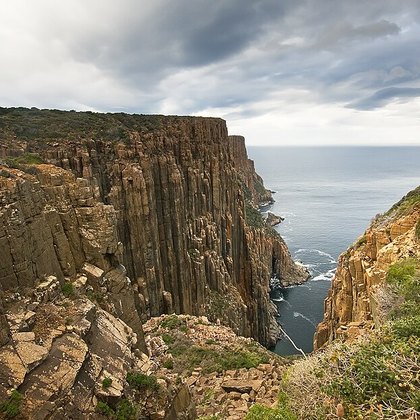
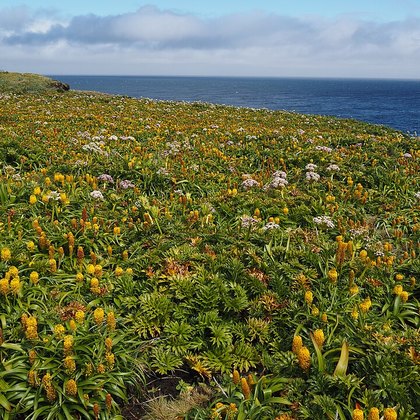
Cold, shallow coastal water and the shelf around the breeding islands, where it dives to the bottom for fish in parties, often deeper than fifty metres. It breeds in colonies on exposed rocky shores and low clifftops, on low cone-shaped nests of vegetation, mud and guano. In South America it also uses inland lakes, but in the subantarctic part of its range it is strictly a coastal bird.
Where the bird is most often found, arranged by main group and formation.

Range and movements
Within this guide's map window, Macquarie Island and the Bishop and Clerk rocks only, about fifteen hundred kilometres southeast of Tasmania — Australian territory, and the only place in Australia where a blue-eyed shag breeds. To New Zealand proper it is a vagrant. Beyond the map its range runs from southern South America through the Falklands, South Georgia and the South Orkney and South Shetland Islands to the Antarctic Peninsula.
- Resident
- dark = core range, pale = thinly spread
Where and when to look
On Macquarie Island the colonies along the east coast and near Sandy Bay are the easiest: look for the low nest cones on rock platforms just above the tide line, often beside King Penguins. Put the scope on the bill base first — two orange knobs and a blue eye ring make a blue-eyed shag here this species at once. At sea it hunts in loose parties that dive and surface together.
Conservation
Least Concern (LC) across a very large range, but the birds inside this map window form a small, isolated population: on Macquarie counts fell from about 660 breeding pairs at nineteen sites in the 1970s to 472 pairs at eleven sites in October 2003, with about a hundred more pairs on Bishop and Clerk. Heavy storms are the main killer — a prolonged blow can take ninety per cent of the chicks, partly through chilling and partly through starvation when the adults cannot fish. Subantarctic Skuas take eggs and chicks; the eradication of feral cats and ship rats on Macquarie has eased that pressure.
Scientific name
Leucocarbo atriceps | (King, 1828)
Phillip Parker King described the species in 1828 as Phalacrocorax atriceps, from birds he collected while surveying the Strait of Magellan; the move to Leucocarbo puts author and year in parentheses. atriceps means 'black-headed', from Latin ater, 'black', and -ceps, 'headed'. The genus Leucocarbo (Bonaparte, 1857) means 'white cormorant', from Greek leukos and Latin carbo. The type locality is the Strait of Magellan; the Macquarie birds belong to the subspecies purpurascens (Brandt, 1837), 'purplish', after the gloss of the plumage.