All species › Passerines › Logrunners › Australian Logrunner
Australian Logrunner | Orthonyx temminckii
Australische stronkloper | Colaespina de temminck
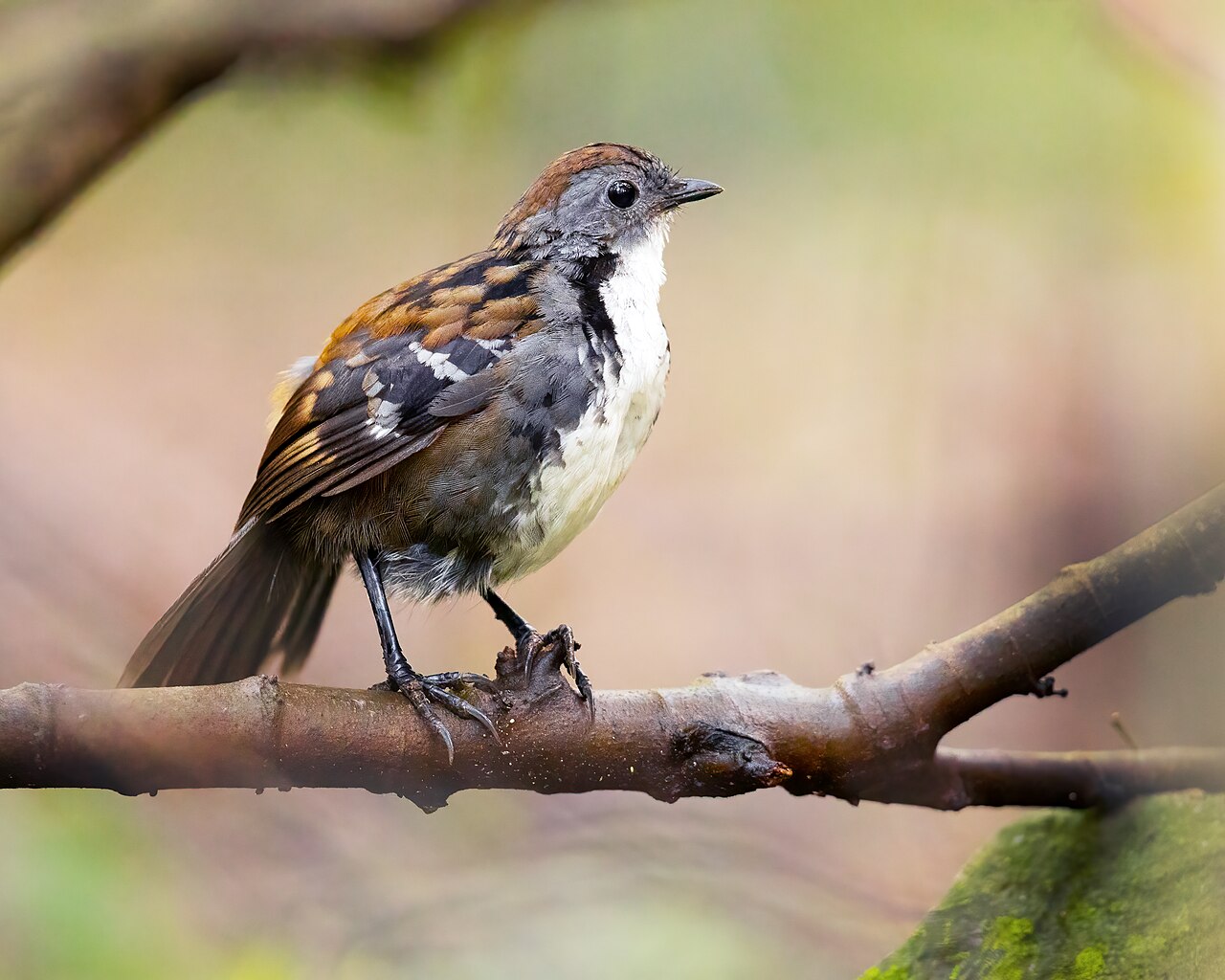
The Australian Logrunner is a compact ground bird of subtropical rainforest that does not scratch the litter backwards like a fowl, but sweeps it sideways with one foot while bracing on its tail. That tail ends in bare, projecting shafts that grip the ground like spines. Where it has worked, round patches swept clean the size of a soup plate are left behind.
Voice
A loud, far-carrying call sounding like be-kweek-kweek-kweek, the first note lower and the rest in a fast, even series; it comes from the ground and is far bigger than the bird. Groups call mostly in the first hours after sunrise, several birds joining in. There is also a soft, churring contact note between two birds working close together in the leaves, and a short, sharp alarm. Calling goes on all year, loudest in winter, when the pairs are nesting.
No freely licensed recording has been found for this species yet; what to listen for is described below.
Identification
Eighteen to twenty centimetres: a rounded bird with short broad wings, heavy legs and a short tail carried angled down. The upperparts are olive-brown, the wings black barred with grey and rufous, and the sides of head and breast grey. The male has a pure white throat and breast, the female orange-rufous in the same place — one of the few clear sex differences among Australian forest birds. The tail feathers end in bare, stiff shafts without barbs, which the bird uses as a prop. It hardly flies, and vanishes on foot behind a fallen log.
Confusion species
Orthonyx spaldingii, the logrunner of the Wet Tropics, does the same work in the same way, but is much larger, darker and far noisier; the two never meet, for fifteen hundred kilometres lie between their ranges. Eastern Whipbird (Psophodes olivaceus) shares the forest, but has a crest, a long tail and an entirely different, whipcracking call. Scrubwrens and thornbills are half the size and work higher in the shrub layer. A brown bird clearing a circle on the forest floor with sideways sweeps is this species.
Habitat
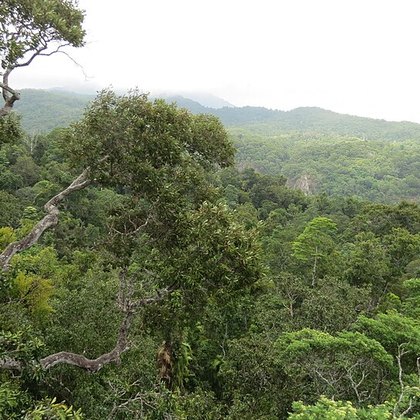
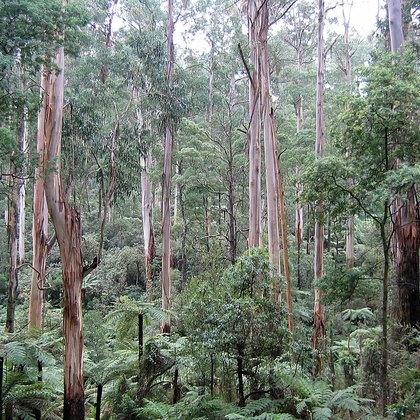
The floor of subtropical and warm-temperate rainforest and of moist eucalypt forest with a rainforest understorey, with a deep layer of leaves, fallen logs, ferns and vines. It needs an unbroken litter layer that stays damp; on dry or trampled ground it disappears. Altitude matters less than moisture: it occurs from near sea level to the highest plateaus. Open forest, plantations and forest edges without an understorey are avoided.
Where the bird is most often found, arranged by main group and formation.
Range and movements
The east coast of Australia, from the Illawarra district south of Sydney north to the Bunya Mountains and the ranges north of Brisbane, in the rainforest remnants along the Great Dividing Range. It is resident in the strict sense: a pair with the young of the previous year holds a small territory all year and never leaves it. Through the nineteenth and twentieth centuries the range was broken up by the clearing of lowland rainforest, the Big Scrub in northern New South Wales being the greatest loss. In southern New South Wales it is scarce.
- Resident
- dark = core range, pale = thinly spread
Where and when to look
Look for the sign before the bird: round patches cleared of leaves, fifteen centimetres across, mean it is there. Then sit down ten metres away and wait; it works slowly and comes back of its own accord. The breeding season falls in winter, June to September, and that is when the call is loudest — one of the few Australian songbirds that nests in the cold months. With a good view, check the throat: white is the male, orange the female.
Conservation
Not threatened (LC) and locally common within its range, but that range is small and wholly dependent on rainforest. The historical clearing of lowland rainforest has left the population in separate blocks, and a bird that does not fly will not cross a paddock. Feral pigs turn over the litter layer it lives from, and feral cats and dogs reach the floor of every forest fragment. Where the forest stands and the ground is left alone, it holds on well.
Scientific name
Orthonyx temminckii | Ranzani, 1822
Ranzani described the species in 1822 as Orthonyx temminckii, the name it still bears; author and year therefore stand without parentheses. Temminck had introduced the genus Orthonyx two years earlier, from Greek orthos (straight) and onyx (claw), after the long straight hind claw with which the bird braces itself on the ground. The species name honours that same Coenraad Jacob Temminck, then director of the museum at Leiden. The type locality first read no more than 'Oceanica' and was later restricted to Hat Hill near Nowra, New South Wales.