All species › Passerines › Australasian babblers › Hall's Babbler
Hall's Babbler | Pomatostomus halli
Halls babbelaar | Gárrulo de Hall
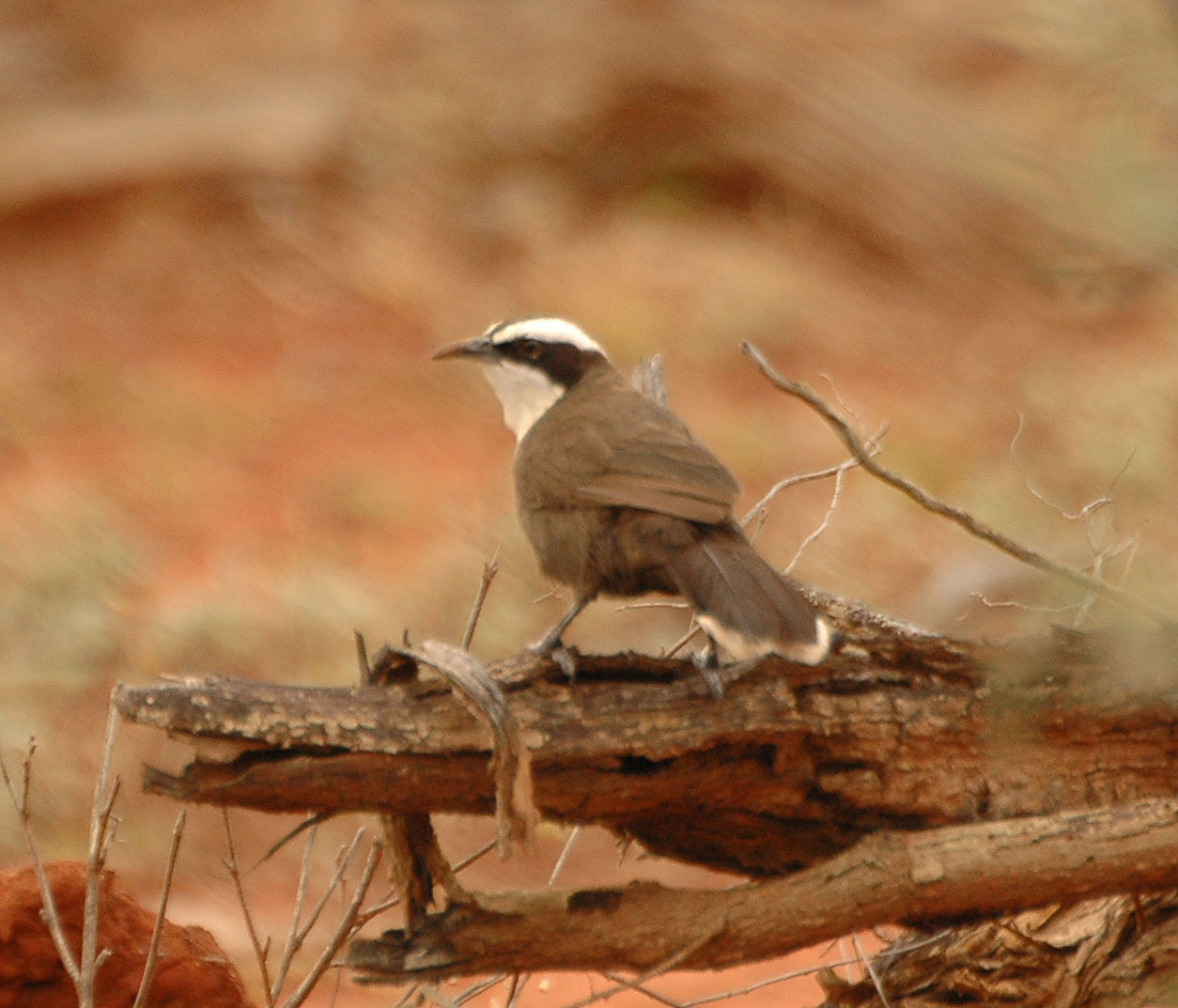
Hall's Babbler is the babbler of the mulga of the dry interior on the Queensland–New South Wales border. It is a dark brown, long-tailed flock bird with a heavy, downcurved bill, a broad white eyebrow and a sharply cut white bib. It lives in noisy family parties that bundle one after another through the acacia scrub. It was only described as a species in 1964 — one of the last new bird species of the Australian mainland.
Voice
A sustained, babbling chatter produced by the whole party at once: short, rather plaintive mewing notes, grating rattles and squeaks, without clear beginning or end. It is less loud and less song-like than in the Grey-crowned Babbler (Pomatostomus temporalis), which shares the region and delivers a harsh, paired ya-hoo between two birds. The sound of this species usually betrays the party before you see the birds, because it runs on continuously while they forage.
No freely licensed recording has been found for this species yet; what to listen for is described below.
Identification
Twenty-one to twenty-three centimetres. The upperparts are dark sooty brown, the crown dark, and above it runs a broad, pure white eyebrow that continues well behind the eye. Throat and breast are white and end in a sharp, straight line against the dark brown belly — that is the decisive mark. The bill is long, heavy and clearly downcurved, the tail long, dark and broadly white-tipped. It feeds on the ground and on the trunks and bark of acacias, tail held high, moving forward in hops.
Confusion species
White-browed Babbler (Pomatostomus superciliosus) is the real problem and the species this babbler was not separated from until 1964. What decides it is the boundary between the white bib and the belly: in Hall's Babbler the white of the breast meets dark brown along a sharp, straight edge, while in White-browed Babbler the white fades gradually into dull greyish brown. Hall's Babbler is also darker above, its eyebrow broader and purer white, and it averages slightly larger. Grey-crowned Babbler (Pomatostomus temporalis) is clearly bigger, has a greyish crown with a pale central stripe and shows a large rufous wing patch in flight that this species lacks. Chestnut-crowned Babbler (Pomatostomus ruficeps) has a chestnut crown and two white wing bars. A second hold is range: this is the babbler of the mulga of south-western Queensland and the far north-west of New South Wales and occurs nowhere else.
Habitat
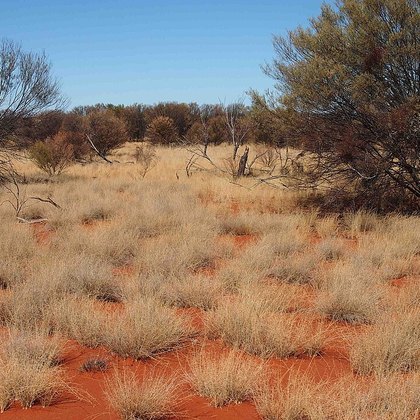
Mulga: the open acacia scrub of Acacia aneura on stony ridges and red sand plains, with scattered eucalypts among it in places. It is more tied to this one vegetation type than the other babblers and disappears where the mulga has been cleared for grazing. Parties usually hold four to twelve birds and breed cooperatively: one pair lays, the rest help feed and defend. The group builds large domed stick nests with a side entrance, both to breed in and to roost in; several often stand in the same territory. Food is insects taken from the ground, from fallen timber and from under loose bark.
Where the bird is most often found, arranged by main group and formation.
Range and movements
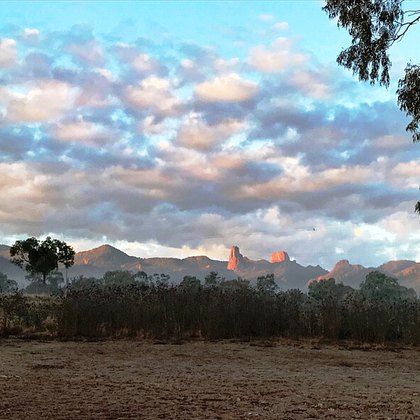
A small, continuous range in the interior of eastern Australia: south-western Queensland — the country around Charleville, Quilpie and Cunnamulla — south to the far north-west of New South Wales. Within that it is locally common where mulga still stands continuous, but nowhere numerous, and its range is the smallest of the three babblers in this round. It is sedentary and parties hold the same ground all year.
- Resident
- Winter
- dark = core range, pale = thinly spread
Where and when to look
Find the party by sound and then judge the breast. Drive a mulga road in the Charleville–Quilpie country, stop where you hear chatter, and wait for the birds to cross the track one after another. At that moment look at the change from white to brown on the underside: a knife-sharp border means this species, a fading one White-browed Babbler. Note too that the eyebrow is broad and pure white. Do not make that call against the light — that is exactly the mark the glare removes.
Conservation
Least Concern (LC). The range is small but continuous and lies largely in thinly settled grazing country. The risk is not shooting or poison but the loss of the mulga itself: clearing acacia scrub for pasture and heavy grazing that strips the understorey and the fallen timber it feeds in. Parties that grow too small also lose the helpers that cooperative breeding depends on, so a thinned district recovers more slowly than the numbers suggest.
Scientific name
Pomatostomus halli | Cowles, 1964
Cowles described the species in 1964 in The Emu, from material collected on the Harold Hall expeditions of the British Museum to Australia. The specific name halli and the Dutch and English names honour Harold Wesley Hall, the Australian businessman who paid for those expeditions. Pomatostomus is formed from Greek poma (lid) and stoma (mouth), after the build of the bill. Until that description these birds were taken for White-browed Babblers; it is thus one of the last bird species of the Australian mainland to be named new to science.