All species › Waders, gulls and terns › Painted-snipes › Australian Painted-snipe
Australian Painted-snipe | Rostratula australis
Australische goudsnip | Aguatero australiano
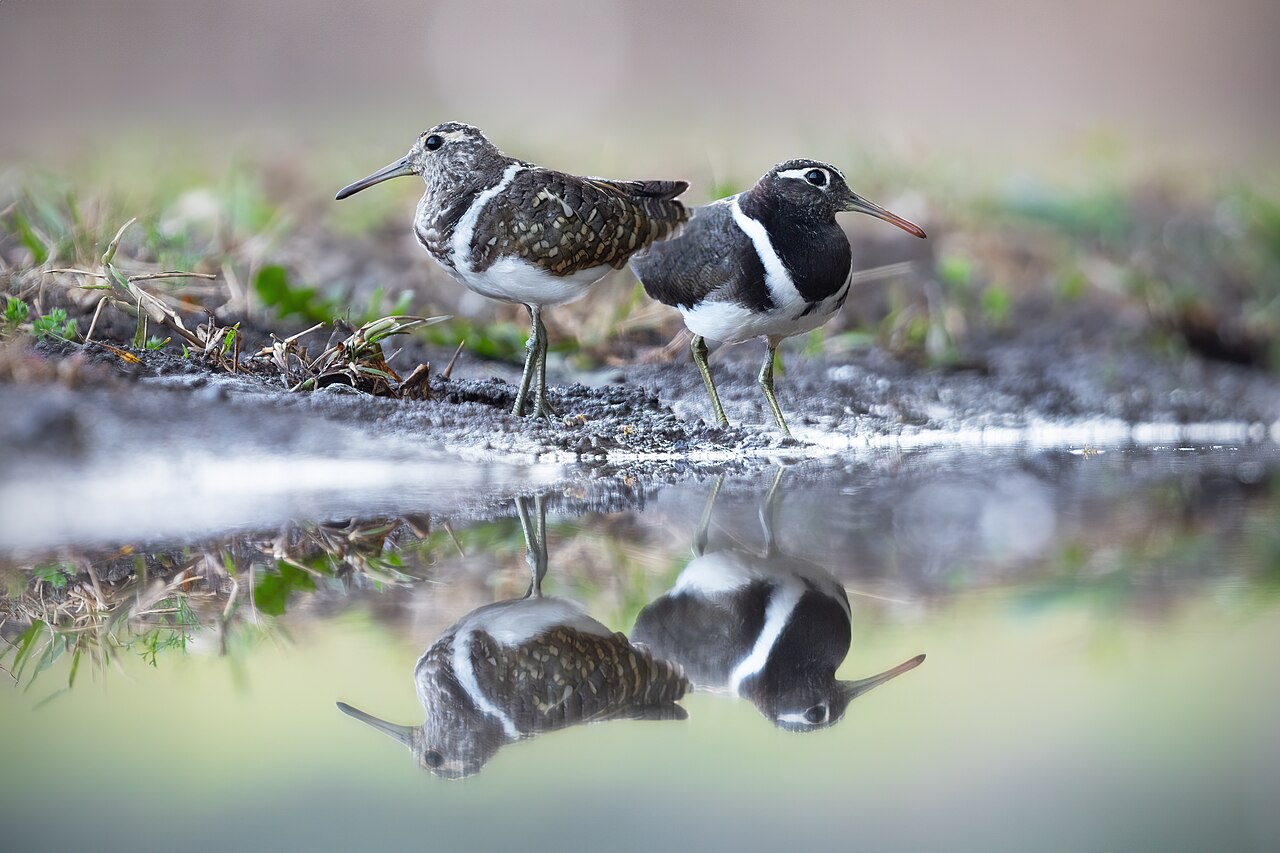
The Australian Painted-snipe is a crepuscular bird of shallow swamps that most Australian birdwatchers never see: a few hundred remain, and they rarely sit two years in the same place. The female is the brighter of the pair, with a chestnut head and a broad white eye-mark, and the male incubates the eggs. It walks through the mud in a rocking, half-crouched posture and flushes only when almost trodden on.
Voice
The voice is poorly documented, which for an Australian bird is unusual: many observers have only ever watched the species flush in silence. From the female a soft, low, repeated oo-oo-oo has been described, given in the dark and mostly in the breeding season, spreading across the water without betraying a direction. On disturbance there is at most a short hissing or grunting note as the bird claps away. Anyone looking for it must therefore trust the eye and not the ear.
No freely licensed recording has been found for this species yet; what to listen for is described below.
Identification
A squat, snipe-like bird of 24 to 30 centimetres with a long bill that broadens slightly and droops at the tip, short legs and a strikingly broad, round wing. The female is the more strongly marked: chestnut head and neck, a white stripe running round the eye like a spectacle, a green-black mantle with a metallic sheen and a white band running over the shoulder to the breast. The male is duller and grey-brown, with cream spots across the wing coverts and a yellower head. In flight the broad rounded wings stand out, patterned with cream eyes on the primaries, along with the dangling legs and the slow, owl-like beat. Young birds resemble the male.
Confusion species
Latham's Snipe (Gallinago hardwickii) shares the same swamps: it is longer and slimmer, has a much longer straight bill, lacks the white shoulder band and flushes explosively in a fast, high zigzag. Australasian Bittern and the rails of the same reedbeds are either larger or far darker and do not walk with the rocking, half-crouched gait of the painted-snipe. Greater Painted-snipe (Rostratula benghalensis) does not occur in Australia; anything of the kind seen in the north is the Australian species. At range the slow flight with dangling legs can suggest a young Nankeen Night Heron (Nycticorax caledonicus), but the round wing with its pale eyes rules that out.
Habitat
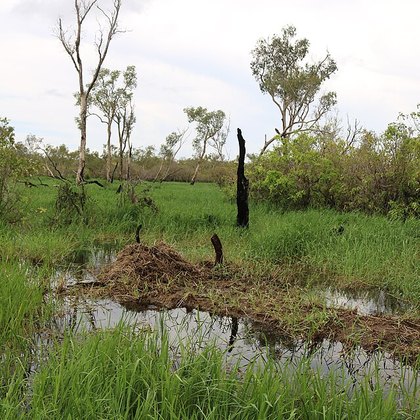
Shallow freshwater swamps with dense low cover and plenty of edge: muddy margins with rush and sedge, pools among fallen timber, farm dams and the tails of flooded plains. What it wants is the transition between bare mud and cover, for it feeds in the open and vanishes into the vegetation at the least alarm. Deep open water and saltmarsh it barely uses. In the north it also works the fringes of paperbark swamps and inundated pasture.
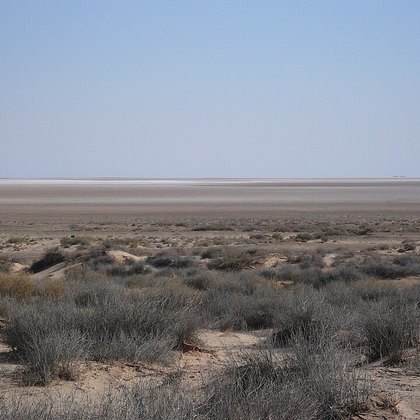
Where the bird is most often found, arranged by main group and formation.


Range and movements
Scattered across mainland Australia, with most records in the Murray-Darling basin and further along the east coast and in the north; it occurs nowhere outside Australia. It is nomadic and follows flooding: wetlands filling after years of drought suddenly produce a handful of birds, then stand empty again for years. Numbers fell steeply through the twentieth century, and the share of records from the southeast has dropped hardest of all. Records now come in throughout the year, with an emphasis on the months after rain.
- Resident
- Breeding (summer)
- dark = core range, pale = thinly spread
Where and when to look
Look for it in the hour before sunset along the muddy edge of a newly filled swamp, and do not walk: sit down and let the place settle, because it comes out of cover once things are quiet. Work the join between bare mud and low rush with the telescope, metre by metre; on a motionless bird the white shoulder band is often the only thing that gives it away. Report every sighting to a national database — with this species every record counts.
Conservation
Endangered (EN), with an estimate of between two hundred and seventy and four hundred and ten mature individuals and a declining trend. The cause is the loss of shallow temporary wetlands: extraction of water from the Murray and the Darling, dams and drainage, and the trampling and grazing of swamp margins by stock. Because the species is nomadic and seldom seen, every count lags behind the truth, which makes managing individual sites difficult.
Scientific name
Rostratula australis | (Gould, 1838)
Gould described the bird in 1838 as Rhynchaea australis; because it was later moved to another genus, author and year stand in parentheses. Rostratula is a diminutive of Latin rostratus, 'beaked', after the long bill; australis means 'southern'. The type locality is New South Wales. The species was long treated as a subspecies of the Asian bird and has been carried again as a species since the start of this century, on the strength of differences in measurements and of genetic work.