All species › Waders, gulls and terns › Plains-wanderer › Plains-wanderer
Plains-wanderer | Pedionomus torquatus
Trapvechtkwartel | Llanero
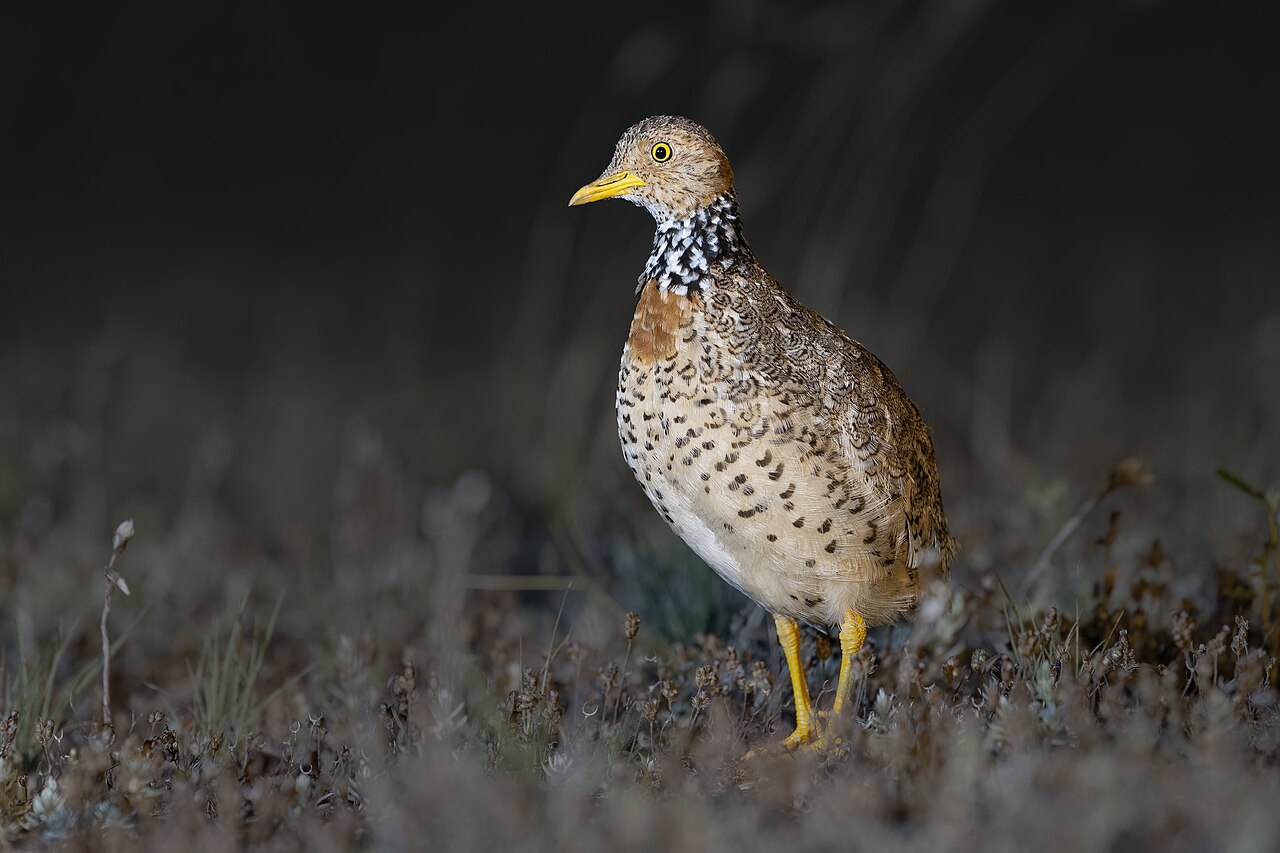
The Plains-wanderer is the only member of its family and the bird on which the grasslands of inland Australia stand or fall: a small, long-legged shorebird that looks like a quail and is not one. The female wears a black collar spotted with white and a chestnut breast patch; the male is dull and does the incubating. Of all the birds of the Australian grasslands this is the most endangered.
Voice
The voice is almost always the female's and almost always heard in the dark: a low, dull boom that seems to rise out of the ground, oomp, with several seconds between notes and audible over hundreds of metres. The sound is hard to place — it appears to come from every direction at once and readily sends a searcher the wrong way. The male gives a softer, shorter grunt, usually only at the nest. Disturbed birds run off in silence; anyone working by ear will hear nothing but that single boom.
No freely licensed recording has been found for this species yet; what to listen for is described below.
Identification
A small, slender bird of fifteen to nineteen centimetres, buff with fine black scaling and with strikingly long yellow legs. The female is larger and carries a broad black collar spotted with white and a rufous breast patch below it; the male lacks both and is more evenly buff. The stance is diagnostic: it stands upright on its toes with the neck stretched to see over the grass, and flattens itself to the ground at any alarm. It flies unwillingly — flushed, it flutters low and weakly with legs dangling and drops back in after some tens of metres. Young birds resemble the male and show no collar at all.
Confusion species
The quails it shares a name with are the real confusion: Brown Quail (Synoicus ypsilophorus) and Stubble Quail (Coturnix pectoralis) are more compact, far shorter in the leg and whirr away straight when flushed, where the Plains-wanderer runs. Buttonquail of the genus Turnix are smaller and darker, lack the collar and show a pale panel in the wing. Inland Dotterel (Peltohyas australis) turns up in the same spotlight beam on inland plains, but is short-legged and carries black markings across crown and breast. Where a bird sits still and upright on a bare patch in the grass, the long yellow leg settles it.
Habitat
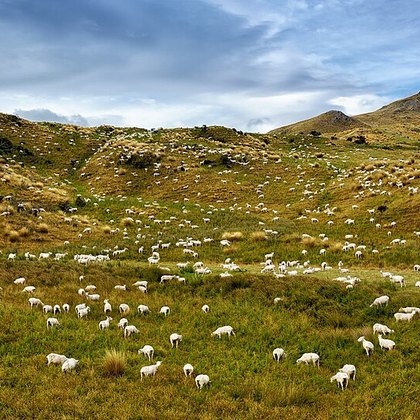
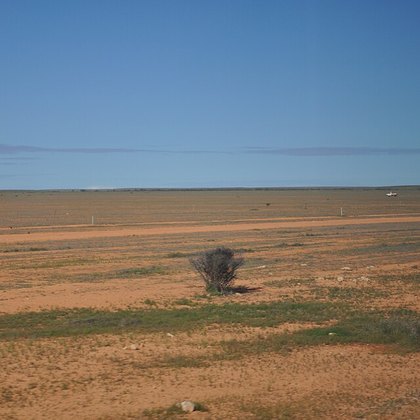
Sparse, low native grassland of a very particular structure: roughly half bare ground, with scattered tussocks and the occasional forb between, so the bird can walk through it and still have cover. If the grass grows too dense it leaves; if it is eaten out, it leaves as well. The habitat therefore appears and disappears with grazing pressure and rain, and the best country is grazed native plain that is neither hammered nor rested. It does not use cropland, nor sown pasture of exotic grasses.
Where the bird is most often found, arranged by main group and formation.

Range and movements
Australia only, and within it scattered across the southeastern interior: from southwestern Queensland through the Riverina of New South Wales to the northern plains of Victoria and eastern South Australia. The largest numbers have sat for a century on the plains around Hay and on the Mitchell grass downs further north. In dry years birds shift long distances and turn up where none have been seen for years; this is not regular migration. The range contracted sharply through the twentieth century as native grassland was converted to cropping on a large scale.
- Resident
- dark = core range, pale = thinly spread
Where and when to look
It is found almost exclusively at night, from a vehicle driven at walking pace with a spotlight over the plain; by day it sits tight and will not show at a few metres. Join an organised survey on the Riverina plains or the Patho Plains in Victoria: the country is private land and the surveys are the only proper way onto it. Look for a small upright silhouette that does not move, rather than for movement.
Conservation
Endangered (EN) on the world list and placed in the heaviest national category in Australia; estimates of the number of adult birds in the wild run from a few hundred to somewhat over a thousand. Numbers collapsed during the long drought early this century and recovery has been slow. The causes are conversion of native grassland to cropping, grazing that is either too heavy or too light, and predation by the fox. For some years now Australian zoos have bred the species and birds have been released on the plains of the Riverina and northern Victoria.
Scientific name
Pedionomus torquatus | Gould, 1840
Gould described the bird in 1840 as Pedionomus torquatus, and it has stayed in that genus, so author and year carry no parentheses. Pedionomus is formed from Greek pedion, 'plain', and nemo, 'to inhabit': the dweller of the plain. torquatus is Latin for 'collared', after the female's band. Gould gave the interior of South Australia as the type locality, later restricted to the plains near Adelaide. The family Pedionomidae has no other members; genetic work places the species among the shorebirds, beside the seedsnipes of South America.