All species › Waders, gulls and terns › Plovers and lapwings › Banded Lapwing
Banded Lapwing | Vanellus tricolor
Australische kievit | Avefría tricolor
The Banded Lapwing is the lapwing of the dry interior: a crisply marked bird with a black cap, a white throat and a broad black breast band, which unlike its larger cousin is not tied to water at all. You find it on closely grazed paddocks and saline herbfields, often kilometres from the nearest pool.

Voice
When uneasy it calls loudly and stridently, a plaintive three-note motif descending in pitch: a-chee-chee-chee, usually in flight above the paddock. Around the nest this runs into a sustained, quickly repeated alarm that keeps any passer-by at a distance. In a quietly feeding party it is all but silent.
No freely licensed recording has been found for this species yet; what to listen for is described below.
Identification
A lapwing of twenty-five to twenty-nine centimetres, grey-brown above and white below, with a black crown and black face and a broad black band across the breast. From the bill base a white stripe runs over the eye and down the side of the neck, which makes the sharp head pattern. The bill is pale yellow with a black tip, the iris bright yellow inside a yellow eye-ring, and above the bill sits a small red wattle — larger in the male than in the female, as is the spur at the bend of the wing. The legs are dark greyish-pink to purplish. It stands upright and flies with quick, clipped wingbeats.
Confusion species
Masked Lapwing (Vanellus miles) is the only other lapwing of this region and is clearly larger and paler, with big yellow wattles across the whole face and no black breast band; it also stands on wet lawns, playing fields and coastal pasture, while the Banded Lapwing seeks out the dry, closely grazed interior. Inland Dotterel (Peltohyas australis) shares the dry grassland but is far smaller, sandy, and carries a black Y on the breast instead of a straight band. Australian Pratincole (Glareola isabella) walks the same plains but is slimmer, with long pointed wings and a forked tail.
Habitat
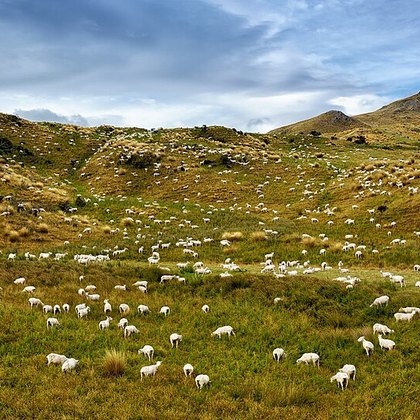
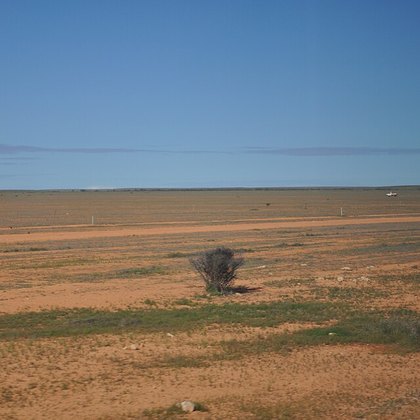
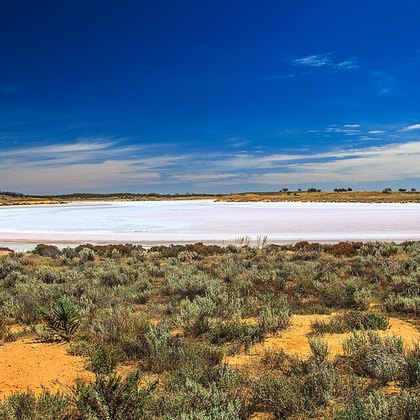
Open, closely grazed grassland: heavily stocked paddocks, crop margins, stubble, saline herbfield and saltbush plains in the dry and semi-arid zone, and equally bare airstrips and playing fields. It needs no swamp or shoreline and feeds in short runs and darts after insects, worms, spiders, slugs and snails; in dry spells it switches to seed. Short grass is the condition, not water.
Where the bird is most often found, arranged by main group and formation.


Range and movements
Endemic to Australia, concentrated in the east, south and west of the mainland plus Tasmania; in the tropical north it is rare and on the coast generally scarce. It is nomadic: outside the breeding season it forms parties that shift with the rainfall and travel long distances in doing so, often by night. In good years it turns up far outside its usual range, in poor years it vanishes from whole districts.
- Resident
- dark = core range, pale = thinly spread
Where and when to look
Drive past a heavily grazed paddock or a freshly harvested stubble field in early morning and look for the upright silhouettes standing spread out as a party; they let a car approach far closer than a walker. Go by the head pattern rather than by size, because size is hard to judge at range: the broad black breast band and the small red wattle above the bill decide.
Conservation
Least Concern (LC), with a population put at twenty-five thousand to a million birds and no specific threat identified. The conversion of scrub to grazed grassland has in fact helped it across much of the south, because closely grazed grass is exactly its habitat. It has, though, declined locally in parts of the southeast, where grassland has grown too dense and tall or has been turned over to cropping.
Scientific name
Vanellus tricolor | (Vieillot, 1818)
Vieillot described the species in 1818 as Charadrius tricolor in the Nouveau Dictionnaire d'Histoire Naturelle; because it now sits in another genus, author and year stand in parentheses. tricolor means 'three-coloured' and refers to the combination of black, white and grey-brown. Vieillot gave only 'Terres Australes' as the origin; Mathews fixed the type locality as New South Wales. The genus Vanellus goes back to Latin vannus, 'winnowing fan', after the flapping, fanning flight of the lapwings.