All species › Waders, gulls and terns › Plovers and lapwings › Masked Lapwing
Masked Lapwing | Vanellus miles
Maskerkievit | Avefría militar
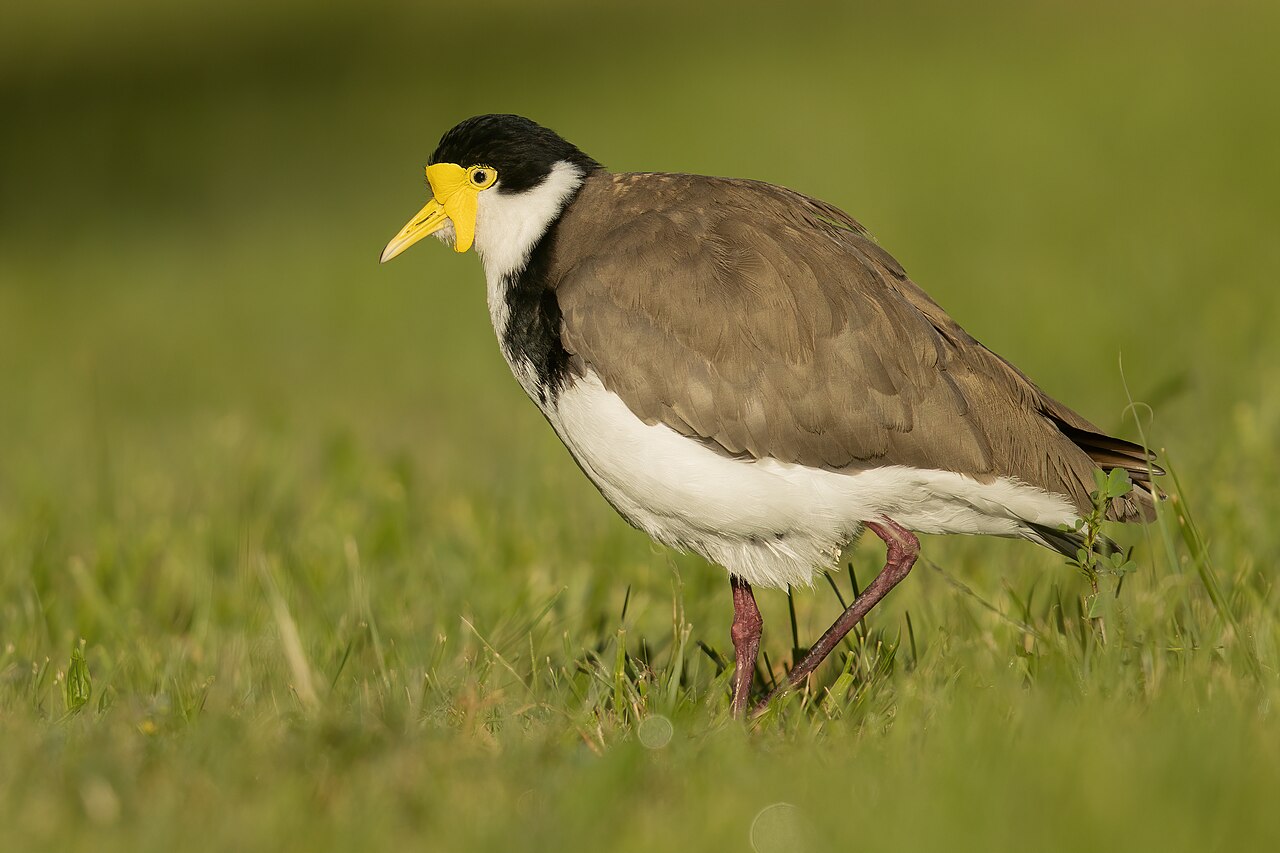
The Masked Lapwing is the plover that has taken over the lawn, the playing field and the road verge across Australia and New Zealand: a big, long-legged bird with a black crown, a yellow bill and yellow wattles hanging over the face like a mask. In the breeding season it defends the nest by swooping fast and low at passers-by, which has made it the best-known bird of the school ground.
Voice
A shrill, rattling kekekekekeke given as readily at night as by day and carrying the length of a playing field. Under threat it quickens and rises, running into a sustained scream as the bird stoops. A pair taking off calls in flight with short hard ticks. Outside the breeding season it is far quieter, though a party on wet pasture keeps up a low grating chatter among themselves.
No freely licensed recording has been found for this species yet; what to listen for is described below.
Identification
A large plover of just over thirty centimetres, standing tall on dull yellow legs, white below, grey-brown above, with a black crown. What fixes it are the big yellow wattles hanging from the bill base and face, and the yellow spur on the carpal joint, plain to see on a stooping bird. The northern race miles has an all-white neck and very large wattles; the southern novaehollandiae — the bird of Victoria, Tasmania and New Zealand — has a black stripe down the neck and breast side and smaller wattles. Juveniles are scaled above and have barely any wattle yet.
Confusion species
Banded Lapwing (Vanellus tricolor) is smaller and darker, has a black breast band and only a small red wattle, and prefers short dry inland grassland to wet lawns. Bush Stone-curlew (Burhinus grallarius) is larger, streaked grey-brown and nocturnal, with a big yellow eye and no wattles. At distance a party of Masked Lapwings on pasture can suggest Grey Plovers, but those are smaller, carry no yellow on the face and stay at the coast.
Habitat
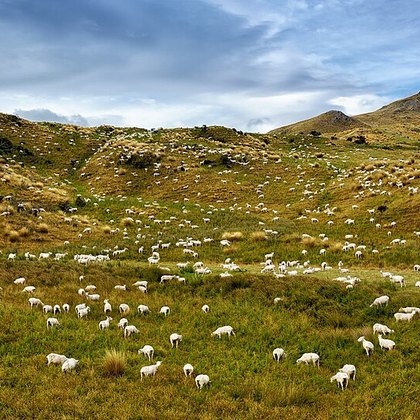
Short grass beside shallow water is the picture: grazed paddock, playing field, golf course, road verge, the edge of a stock dam. Beyond that, mudflats, estuaries and the low beach, and in New Zealand the shingle banks of the braided rivers of the South Island. It nests on bare ground, often out in the middle of a field or on a flat gravel roof, the nest no more than a scrape with a few pebbles.
Where the bird is most often found, arranged by main group and formation.




Range and movements
Across the whole of northern, central and eastern Australia, and along the south coast into Tasmania; it is absent from the driest parts of the western interior. Beyond that New Guinea, the Moluccas and New Caledonia. New Zealand is the striking chapter: first breeding near Invercargill in 1932, and in eighty years the bird has gone from newcomer to common resident of both islands. It does not migrate, but after the summer drought parties wander to wetter country.
- Resident
- dark = core range, pale = thinly spread
Where and when to look
In summer, from October to January, walk a playing field or golf course at the edge of a town; a pair that calls at you and comes in with spread wings has a nest there and gives itself away. Keep walking and watch the carpal joint, because the yellow spur is the detail nobody thinks to look for. On a mudflat go by the yellow wattles, the first thing to catch the light against the sun.
Conservation
Least Concern (LC) and increased in both countries, because grazed grassland, mown verges and sports fields have handed it more ground than it ever had. In New Zealand it was a protected native species from 1946, but that protection was removed in 2010 over aircraft strikes and farm damage, leaving it one of only two native species without legal protection. Nests lost to mowers, cats and traffic do not outweigh the gain.
Scientific name
Vanellus miles | (Boddaert, 1783)
Buffon described the bird in 1781; Boddaert supplied the name Tringa miles in 1783. Because it was later moved to another genus, author and year stand in parentheses. The genus Vanellus was introduced by Brisson in 1760 and is Modern Latin for a lapwing, a diminutive of vanus, 'winnowing' or 'fan', after the beating flight. miles is Latin for 'soldier', after the spur on the wing. The type locality was first given in error as Louisiana; Mathews moved it to the Tanimbar Islands in 1912.