All species › Waders, gulls and terns › Plovers and lapwings › Shore Plover
Shore Plover | Thinornis novaeseelandiae
Nieuw-zeelandse plevier | Chorlitejo de las chatham
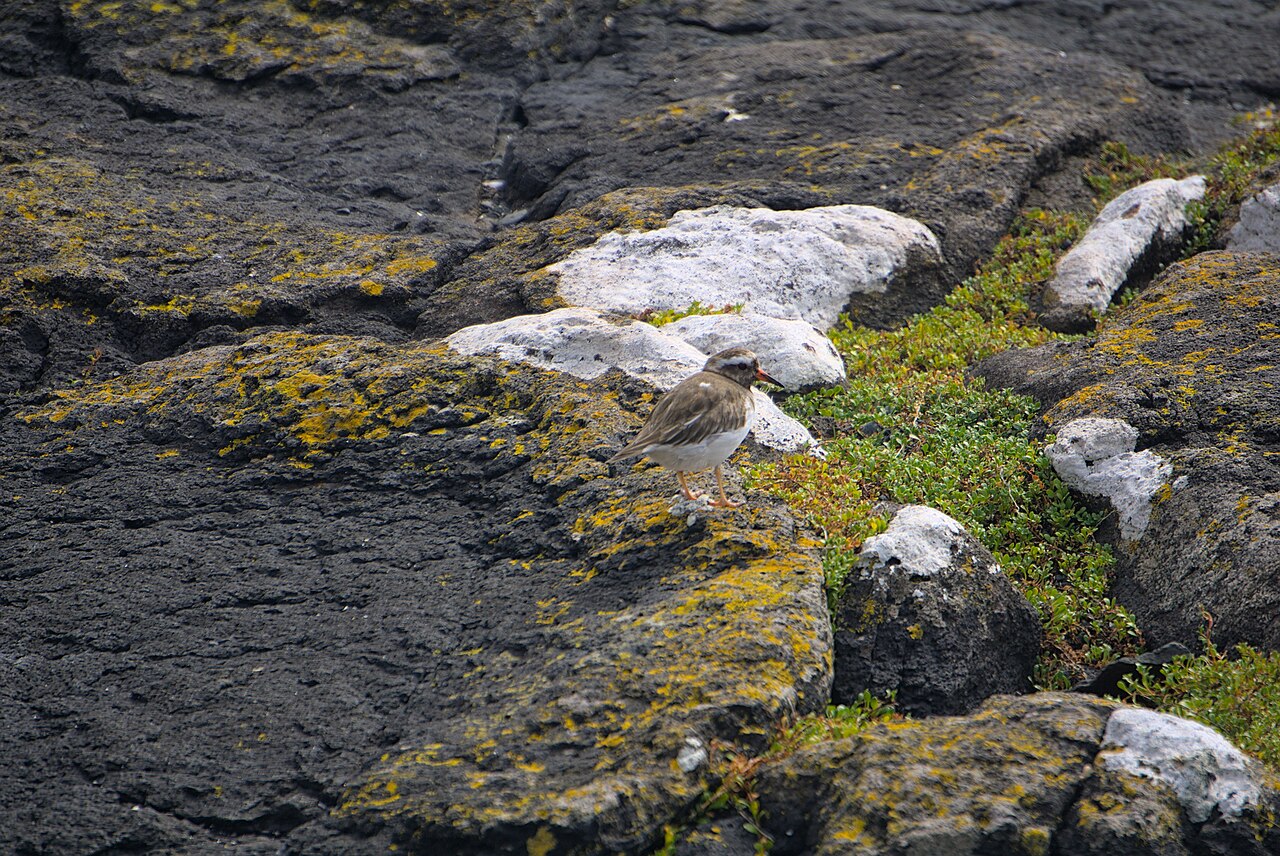
The Shore Plover is one of the rarest waders in the world: a compact, short-legged plover with a black mask, a white band round the head and orange-red legs, which once lived along the whole New Zealand coast and now survives on a handful of predator-free islands. About two hundred and fifty remain in all.
Voice
Its voice betrays it sooner than its plumage: a loud, rapid, ringing rattle that sounds like an oystercatcher's piping in miniature, used to mark territory and in excitement on the shore. Between the members of a pair comes a soft chip as a contact note. Chicks give a high, repeated squeaking when threatened, which grows louder with age.
No freely licensed recording has been found for this species yet; what to listen for is described below.
Identification
A compact plover of twenty centimetres, brown above and white below, with a grey-brown, darkly mottled crown. The male carries a black mask running from the forehead across the cheeks and on over the throat and neck; in the female that mask is dark brown rather than black. A broad white band separates mask and crown and runs like a hoop round the back of the head. The bill is orange with a dark tip, the eye-ring orange and the legs orange-red. Young birds still lack the mask and have a mostly dark bill.
Confusion species
Within the Thinornis trio it shares the black mask with Black-fronted Dotterel (Thinornis melanops), but in that species the black is confined to forehead and eye-stripe, there is a black V on the breast and a chestnut shoulder stripe, and the bird stands at fresh inland water. Hooded Plover (Thinornis cucullatus) has a wholly black hood with a white nape band and occurs only in Australia. On the shore it is above all the young bird that is confused with Double-banded Plover (Anarhynchus bicinctus), which is numerous here: Shore Plover then has a clearly longer bill with an orange base and orange-red rather than dull green legs. New Zealand Plover (Anarhynchus obscurus) is larger, longer-legged and rusty below, with no mask.
Habitat
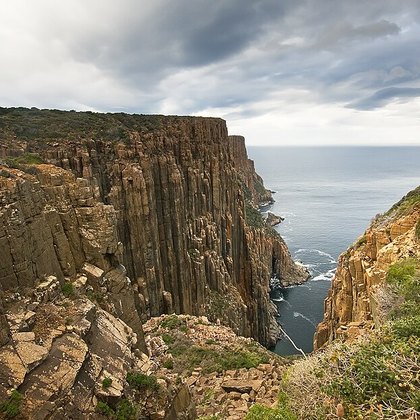
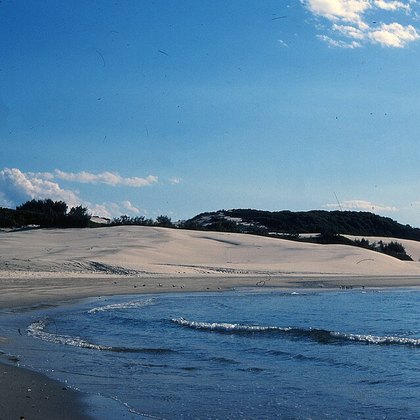
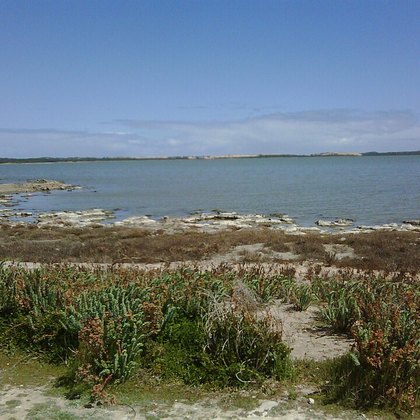
Rock platforms and weed banks along the shoreline, the soft papa rock of the Chathams, shell and shingle beaches, small salt meadows and the edges of tidal creeks. It feeds on the rock platform among the weed, picking invertebrates from the surface. The nest is unusual for a plover: not an open scrape in sand but a hidden cup under a tussock, among boulders or beneath driftwood, often with a genuine tunnel to the entrance.
Where the bird is most often found, arranged by main group and formation.

Range and movements
Endemic to New Zealand. Until about 1870 it bred around the mainland coast; feral cats and the Norway rat ended that within a few decades. The stronghold is now Rangatira in the Chatham Islands, with smaller groups on other predator-free Chatham islands; beyond that there are released populations on Waikawa (Portland Island) off Hawke's Bay, on Motutapu in the Hauraki Gulf and on Mana. In 2026 a chick fledged on Pitt Island for the first time in a hundred and fifty years.
- Resident
- dark = core range, pale = thinly spread
Where and when to look
You do not come across this species by chance: it sits on islands reached only by permit or organised boat trip. Once there, stand still on the rock platform and let the bird come to you — it is strikingly unafraid, and that very curiosity is what cost it the mainland. Find the pair by ear: the quick, ringing rattle carries the length of the platform.
Conservation
Endangered (EN), and ranked Nationally Critical in the New Zealand system, with some two hundred and fifty birds in the wild. A single rat reaching an island can wipe out a population: in earlier translocations more than eighty per cent of the birds were lost to a rat incursion. Recovery therefore rests on three legs: the biosecurity of every island, captive breeding at Pūkaha, the Isaac Conservation and Wildlife Trust and Cape Sanctuary, and translocation to new predator-free sites. More than five hundred young birds have been released since the 1990s; the goal is five or more sites holding two hundred and fifty or more mature birds between them.
Scientific name
Thinornis novaeseelandiae | (Gmelin, 1789)
Gmelin described the species in 1789 as Charadrius novae-Seelandiae in the thirteenth edition of the Systema Naturae, from a description and plate by Latham; because it was later moved to another genus, author and year stand in parentheses. The epithet simply means 'of New Zealand', and the type locality is Queen Charlotte Sound on the South Island, where Cook's second voyage put in — a place the species has not occupied for a century and a half. The genus Thinornis was introduced by Gray in 1844, from Greek thinos, 'beach or sand', and ornis, 'bird'. The Maori name is tuturuatu; in the Chathams it is tchuriwat'.