All species › Waders, gulls and terns › Plovers and lapwings › Black-fronted Dotterel
Black-fronted Dotterel | Thinornis melanops
Maskerplevier | Chorlitejo frentinegro
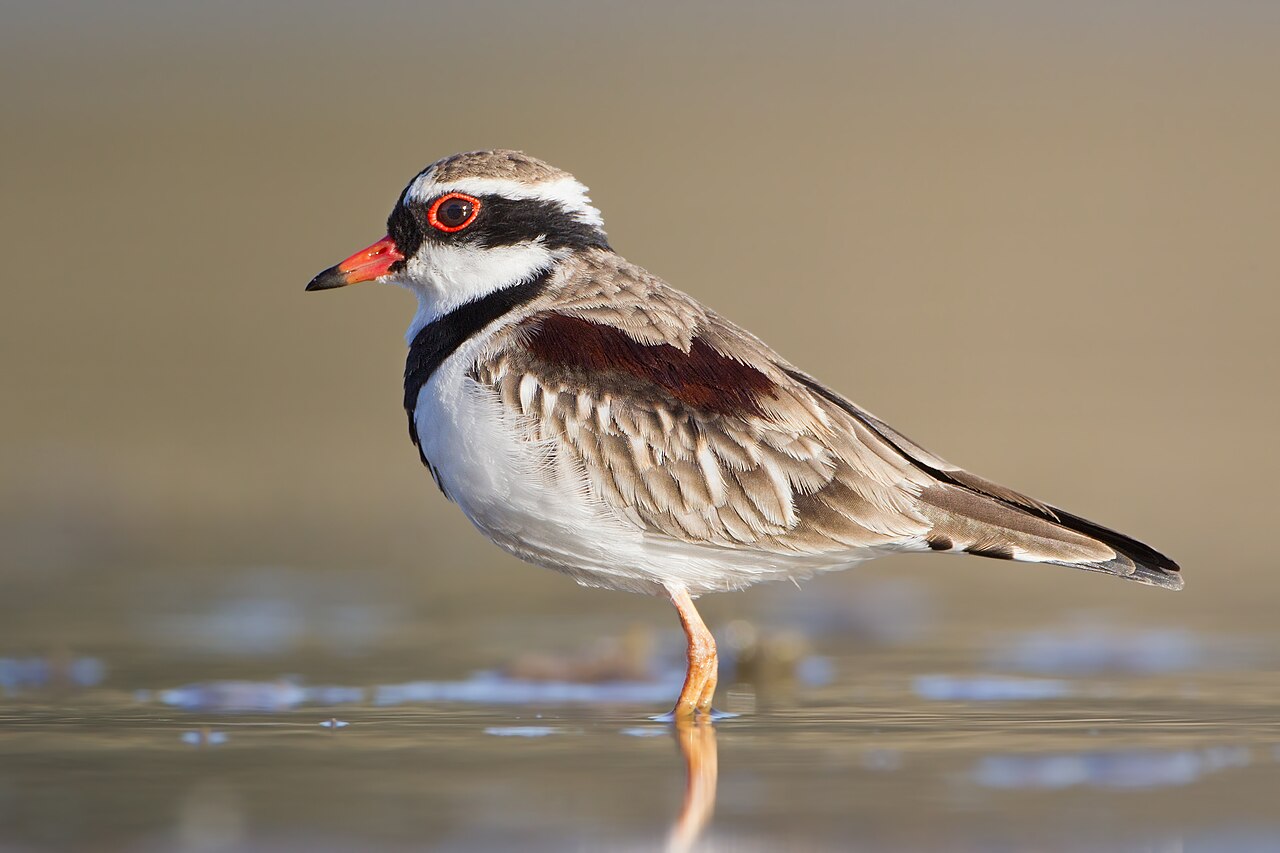
The Black-fronted Dotterel is the smallest of the three black-masked plovers of this region and the only one you find far from the sea: a miniature of freshwater margins, gravel banks and even sewage ponds, with a black mask, a black point on the breast and a chestnut stripe across the shoulder. It wears the same plumage all year, which is rare among waders.
Voice
The call is a sharp, metallic tip, given once or three or four times in quick succession, like two pebbles tapped together. On take-off it rises and quickens, and at the nest it runs into a steady ticking. Otherwise the bird is notably silent.
No freely licensed recording has been found for this species yet; what to listen for is described below.
Identification
A small plover of sixteen to eighteen centimetres with a low, horizontal carriage. The face carries a black forehead and a black mask through the eye, and across the breast runs a black band that points down in the middle as a sharp V. The back is mottled brown with a conspicuous chestnut stripe over the scapulars. The bill is short and red with a black tip, a red ring surrounds the dark eye and the legs are pale orange-pink. In flight it looks broad-winged and short-tailed, with a clear white wingbar. Young birds still lack the breast band and first acquire it in brown.
Confusion species
Within the Thinornis trio it is the smallest and the only one with a shoulder stripe. Hooded Plover (Thinornis cucullatus) is larger, has a wholly black head with a white nape band and stands in ocean surf, not at fresh water. Shore Plover (Thinornis novaeseelandiae) also wears a black mask, but that mask runs on across the throat and is bordered by a white band round the head; it is besides a coastal bird of New Zealand islands, so confusion cannot arise in Australia. From the Anarhynchus plovers it is told by the V-shaped breast band and the red bill base: Double-banded Plover (Anarhynchus bicinctus) carries two straight bands and an all-dark bill, and Red-capped Plover (Anarhynchus ruficapillus) is paler, has a rufous crown and stands on salt coast.
Habitat
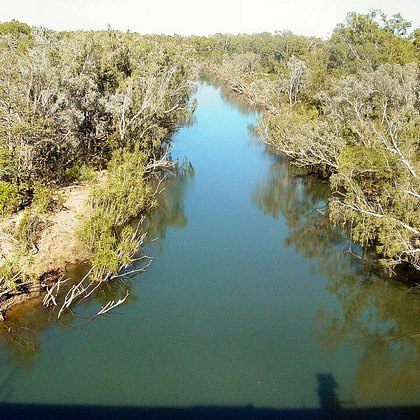
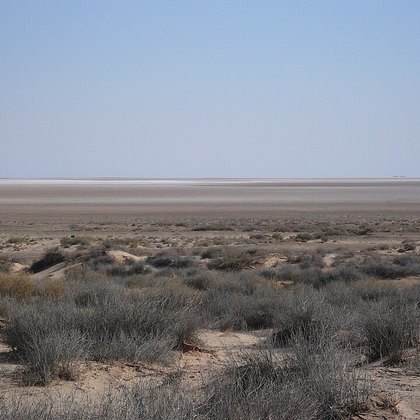
The shallow margins of fresh inland water: the gravel banks and sand ridges of rivers and creeks, the shores of reservoirs, farm dams and pools, claypans, marsh edges, and quite routinely the settling ponds of sewage works and urban stormwater basins. It avoids the coast almost entirely. Its food is aquatic insects, small molluscs and seeds, picked from the ground as it runs and stops, body held low and head bobbing.
Where the bird is most often found, arranged by main group and formation.



Range and movements
Widespread across mainland Australia and Tasmania, far into the dry interior wherever water stands; it is missing only from the most waterless country. In New Zealand it is a newcomer that crossed under its own power: the first pair was found in Hawke's Bay in 1954, and by the 1970s the species was on the South Island as well, where it has settled above all on the braided rivers. That makes it one of the few birds to have colonised across the Tasman Sea unaided in recent times.
- Resident
- dark = core range, pale = thinly spread
Where and when to look
Do not look for it at the sea but at the edge of any piece of fresh water: a stock dam, a sewage works, the gravel bank of a drying creek. Walk the shoreline slowly and watch for movement rather than colour, because the mottled back disappears completely among pebbles; the moment it runs a few paces, the black mask gives it away.
Conservation
Least Concern (LC), with a stable and even increasing population. It belongs to the small company of birds that profit from human water management: stock dams, reservoirs and wastewater ponds have extended rather than reduced its inland range, and that is part of why it was able to reach and hold New Zealand without help.
Scientific name
Thinornis melanops | (Vieillot, 1818)
Vieillot described the species in 1818 as Charadrius melanops in the Nouveau Dictionnaire d'Histoire Naturelle; because of the later move, author and year stand in parentheses. melanops is Greek for 'black-faced', from melas, 'black', and ops, 'face'. Vieillot gave only 'Terres Australes' as the origin; Mathews fixed that type locality as New South Wales. The species long stood alone in the genus Elseyornis, named for Joseph Ravenscroft Elsey, surgeon and naturalist on Gregory's North Australian Expedition; a molecular study in 2022 transferred it to Thinornis, which Gray introduced in 1844 from Greek thinos, 'beach or sand', and ornis, 'bird'.