All species › Waders, gulls and terns › Plovers and lapwings › Hooded Plover
Hooded Plover | Thinornis cucullatus
Zwartkopplevier | Chorlito encapuchado
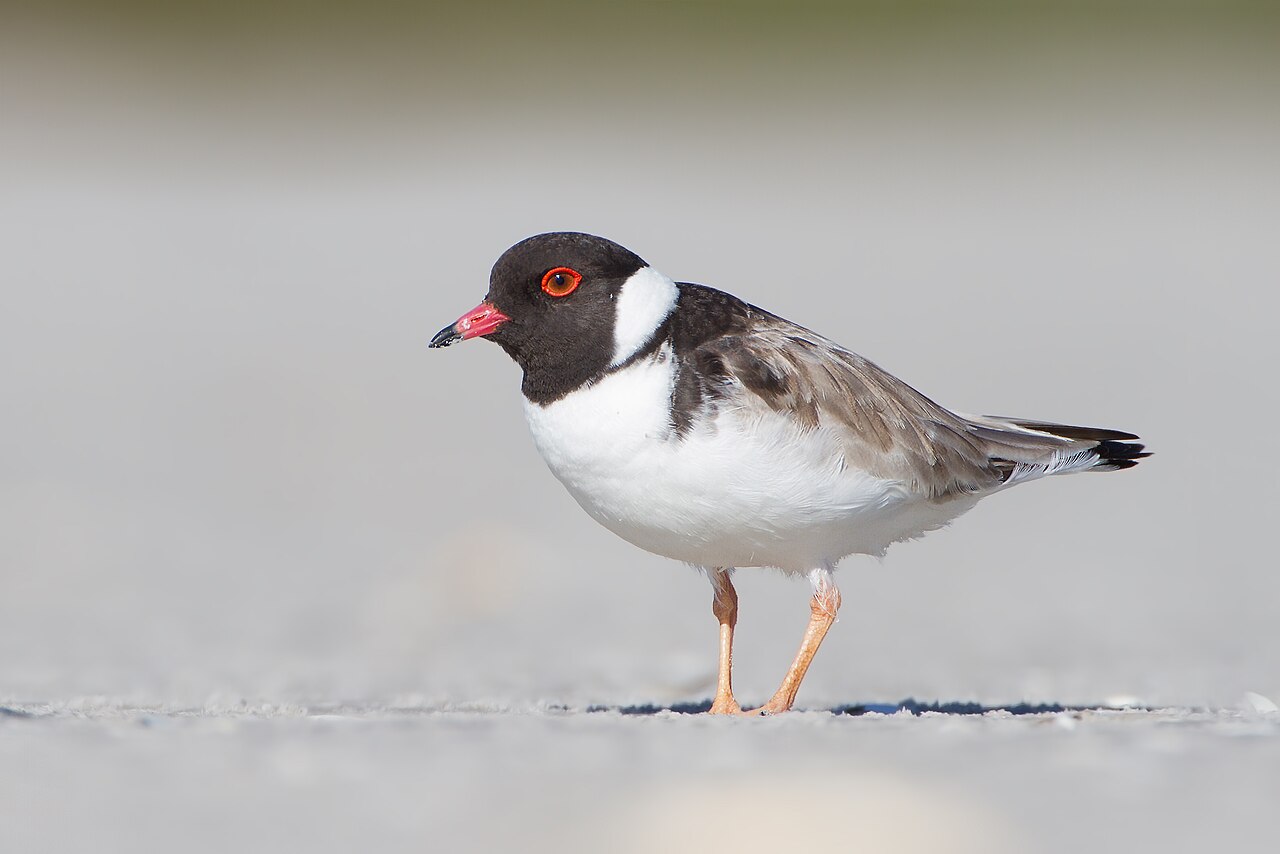
The Hooded Plover is the beach bird of southern Australia: a sandy plover with a jet-black head, a white nape band and a red bill tipped black, which spends its whole life on the same stretch of surf. It lays its eggs in a scrape in the dry sand above the tideline, and that is exactly where most people go in summer.
Voice
It is a quiet bird. The usual contact note is a soft, high piping that barely carries above the surf; in alarm at the nest it gives a deep, low chook-chook, easily recognised at short range. Otherwise a breeding pair gives itself away by behaviour — leading you off with a trailed wing — rather than by voice.
No freely licensed recording has been found for this species yet; what to listen for is described below.
Identification
A plover of nineteen to twenty-three centimetres, plain sandy brown above and white below, with the black head and broad white nape band setting the picture: the black hood runs on into a black collar that forks at the sides of the breast and ends there in two points. The bill is a striking red with a black tip, a red ring surrounds the eye and the legs are orange-pink — an unusual colour combination for a wader. Young birds lack all the black and are then plain sandy brown with a pale bill base, but already have the pale legs.
Confusion species
Among the three Thinornis species in this guide it is the only one with a wholly black head. Black-fronted Dotterel (Thinornis melanops) has no hood but a black mask and forehead, is clearly smaller, carries a chestnut shoulder stripe and stands at fresh inland water rather than in the surf. Shore Plover (Thinornis novaeseelandiae) also has a black mask with a white band around it, but a grey-brown crown and orange legs, and occurs only in New Zealand, so overlap is impossible. Beyond that, do not confuse it with the Anarhynchus plovers that may share the beach: Red-capped Plover (Anarhynchus ruficapillus) is smaller and paler with only a rufous crown, and Double-banded Plover (Anarhynchus bicinctus) is brown with bands across the breast but no black head.
Habitat
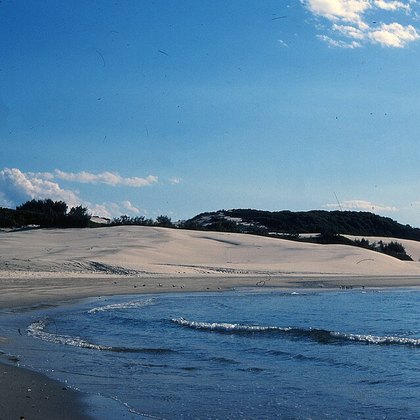
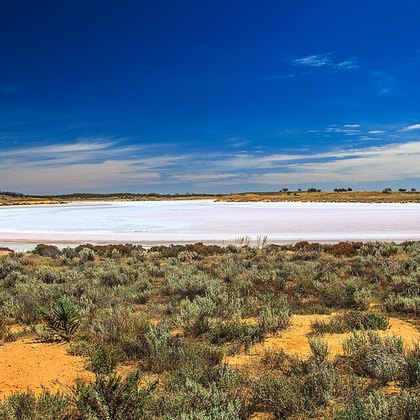
Wide ocean beaches with a good dune system behind them and plenty of beach-washed seaweed, in which it finds its food: insects, sandhoppers, small bivalves and soldier crabs. It avoids narrow, steep beaches without dunes, and beaches that carry heavy human traffic. In the southwest of Western Australia it also uses the shores of inland salt lakes, where it can breed well away from the sea.
Where the bird is most often found, arranged by main group and formation.

Range and movements
Two separate populations. The eastern one runs along the coast from Jervis Bay in New South Wales through Victoria to the Eyre Peninsula in South Australia, with the largest numbers in Tasmania and on the islands of Bass Strait. The western one lies between Esperance and Perth in southwestern Western Australia, on the coast and on the salt lakes behind it. Between the two lies the cliff-bound Great Australian Bight as a break. In Queensland it is a vagrant, and outside Australia it does not occur.
- Resident
- dark = core range, pale = thinly spread
Where and when to look
Walk the high-tide line of a wide, weed-rich beach in spring and look ahead rather than at your feet: a pair usually runs well in front of you and then stops. If a bird keeps the same distance and flutters ahead of you with a trailed wing, turn back — the nest or the chicks are close by and the risk is that you tread on them. Keep dogs on a lead and stay on the wet sand.
Conservation
Near Threatened (NT), and nationally listed as threatened in Australia. The estimate fell from some seven thousand mature birds around 2000 to five thousand three hundred and fifty to five thousand five hundred in 2025; South Australia holds five to eight hundred, and fewer than seventy remain on the beaches of Adelaide and the Fleurieu Peninsula. The cause is almost entirely the beach itself: nests are trodden on or disturbed by dogs and vehicles, and what is left is robbed by foxes and gulls. The remedy is just as simple — temporary fencing and signs around nests, small shelters for the chicks, and volunteers following every clutch, under BirdLife Australia's Beach-nesting Birds programme.
Scientific name
Thinornis cucullatus | (Vieillot, 1818)
Vieillot described the species in 1818 as Charadrius cucullatus in the Nouveau Dictionnaire d'Histoire Naturelle; because it now sits in another genus, author and year stand in parentheses. cucullatus is Latin for 'hooded', after the black head. The species long went under the name rubricollis, until Olson made that name unusable in 1998 by designating the lectotype, and cucullatus became the next available name. Vieillot gave no locality; Mathews pointed to New South Wales in 1913 and Jansen narrowed the type locality in 2018 to Bruny Island, Tasmania, where Baudin's expedition collected in early 1802. The genus Thinornis was introduced by Gray in 1844, from Greek thinos, 'beach or sand', and ornis, 'bird'.