All species › Gannets and cormorants › Cormorants and shags › Australian Pied Cormorant
Australian Pied Cormorant | Phalacrocorax varius
Australische aalscholver | Cormorán pío
The Australian Pied Cormorant is the large black-and-white cormorant of Australian and New Zealand coasts: black above, white below, with a long grey hooked bill and — the feature everything turns on — a patch of orange bare skin between bill and eye, ringed in blue, with a grass-green eye. It fishes alone or in loose groups and dries afterwards on a post or rock with its wings wide.

Voice
Away from the breeding colony it is practically silent. At the nest the female is known by a wheezy haa, while the male has a run of loud and varied calls written as aark, kerlick and whee-eh-eh-eh. At the nest changeover the two voices run together, and young birds beg with a persistent hoarse screech that gives a tree colony away from far off.
No freely licensed recording has been found for this species yet; what to listen for is described below.
Identification
A large pied cormorant of seventy to seventy-five centimetres, glossy black with a green sheen on crown, neck, back and wings, and pure white on cheek, throat, breast and belly, with a black patch on the thigh. The bill is long, grey and hooked at the tip, the legs and feet black. The face decides it: an orange to yellow-orange bare patch in front of the eye and on the throat, a blue eye-ring and a green eye. In breeding condition the orange brightens and white filoplumes appear on the head. The New Zealand form carries more white on the face, running up above the eye. Young birds are brown where adults are black, with dirty white underparts and a dull face.
Confusion species
Black-faced Cormorant (Phalacrocorax fuscescens) is the hard one: also black and white, but smaller, with a wholly black bare face without any orange and a dark grey bill, and it occurs only along the southern coast of Australia, never in New Zealand. Little Pied Cormorant (Microcarbo melanoleucos) is much smaller, with a short stubby yellow bill and a white face running up over the eye. Great Cormorant (Phalacrocorax carbo) is larger and all black, with only a white chin. New Zealand King Shag (Leucocarbo carunculatus) and Stewart Island Shag (Leucocarbo chalconotus) are also pied, but have a black head with a white throat patch and pink rather than black feet.
Habitat
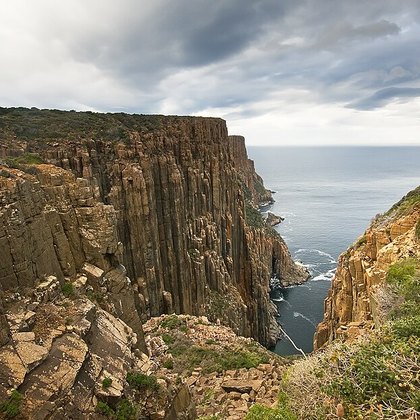
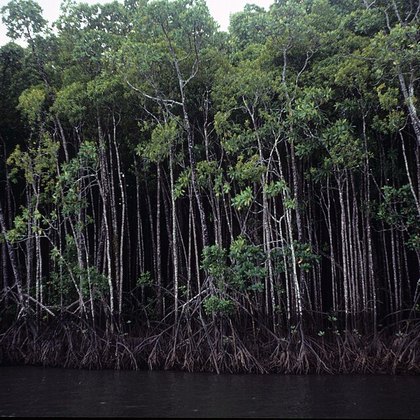
Mainly marine: estuaries, harbours, sheltered bays and shallow coastal seas, in Western Australia almost exclusively salt water. In eastern Australia it also uses inland lakes and flooded plains. It breeds colonially on coastal islands, in mangroves and in dead trees over flooded ground, and sometimes on structures such as jetties and beacons; the nest is a big mound of seaweed, twigs or sticks cemented with droppings.
Where the bird is most often found, arranged by main group and formation.


Range and movements
In Australia it is spread across the whole mainland, commonest in the south and along the coast of south-western Australia, and absent from the driest interior. In New Zealand it breeds in three separate coastal areas: the northern North Island from Northland to East Cape, the strip from Wellington to Banks Peninsula, and the southern South Island from Fiordland to Otago. It is absent from the Chathams and the subantarctic islands.
- Resident
- dark = core range, pale = thinly spread
Where and when to look
Look for it on jetty piles, harbour moles and buoys in sheltered bays — that is its standing roost, and at close range the orange face patch is unmistakable. In New Zealand the Hauraki Gulf and the Wellington coast repay a look; in Australia the harbours of Perth or Albany are a certainty. Check every pied cormorant twice in South Australia and Tasmania, because there it overlaps with Black-faced Cormorant.
Conservation
Least Concern (LC), with a large population spread over two countries. In New Zealand the species is classed as 'Recovering': after a steep decline in the nineteenth and early twentieth centuries, when cormorants were shot as competitors of the fisheries, the colonies are expanding again. Continuing concerns are nest trees blowing over or dying, disturbance of colonies by boats, drowning in gillnets and entanglement in discarded fishing line.
Scientific name
Phalacrocorax varius | (Gmelin, 1789)
Johann Friedrich Gmelin described the species in 1789 as Pelecanus varius, among the pelicans; because it has since been moved to another genus, author and year are in parentheses. The type locality is Queen Charlotte Sound on the South Island of New Zealand, where the bird was collected on one of Cook's voyages. varius is Latin for 'variegated' or 'pied', after the black-and-white plumage; the genus Phalacrocorax is Greek for 'bald raven'. The Dutch guide name stresses the range, the English and Spanish names the pied plumage. The Maori name is karuhiruhi.