All species › Kingfishers, bee-eaters and rollers › Kingfishers › Azure Kingfisher
Azure Kingfisher | Ceyx azureus
Azuurijsvogel | Martín pescador zafiro
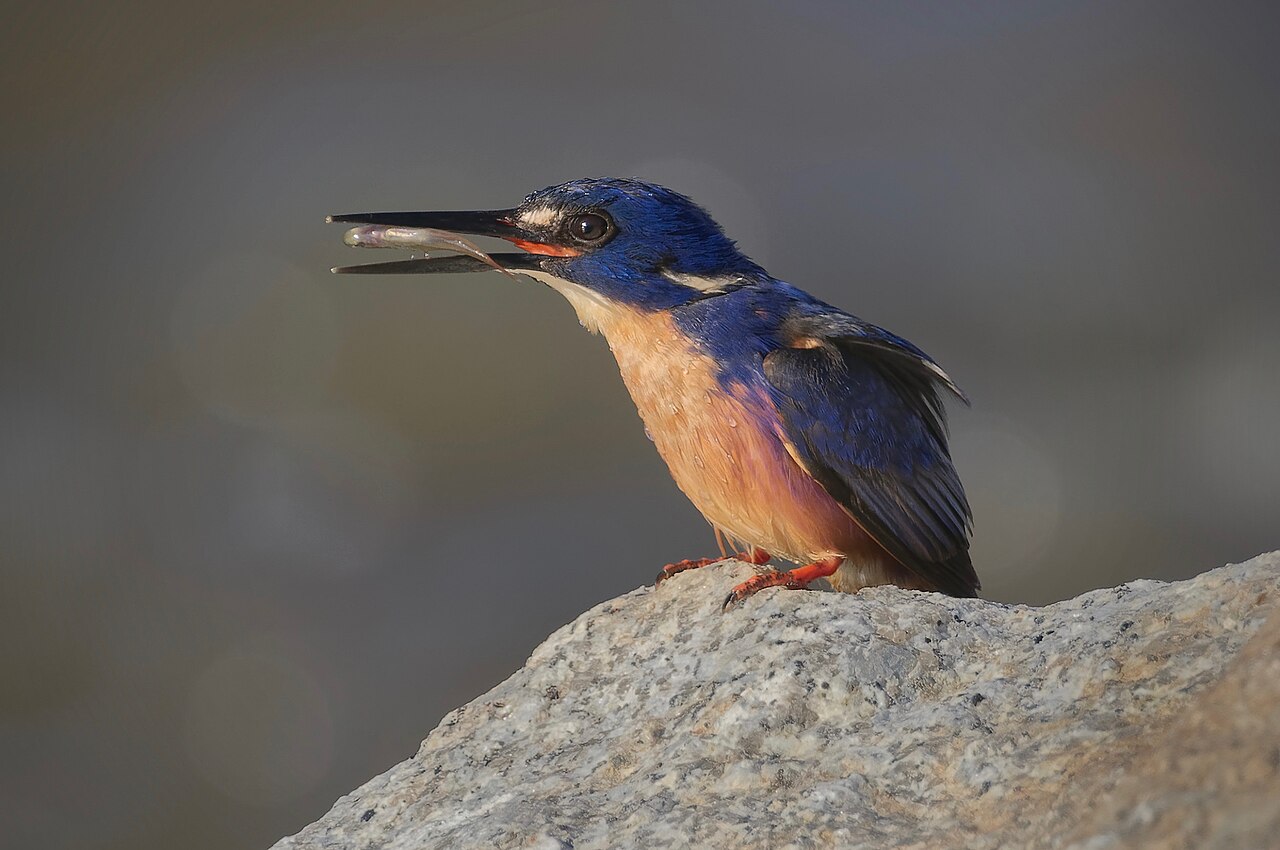
The Azure Kingfisher is the small, vividly coloured kingfisher of shaded creeks: deep azure blue with a violet gloss above, orange-rufous below, with a long black dagger of a bill and a tail that hardly counts. It sits hunched on a low overhanging branch above the water, bobbing its head, then vanishes with a splash.
Voice
It is usually silent; when you do hear it, it is a thin, shrill whistle dropped in flight as the bird shoots down the creek just above the water: pee-eet, pee-eet. In the breeding season it calls more often and more sharply from a perch. The sound is so slight that running water easily swallows it — often the splash of the dive is the first thing you register.
No freely licensed recording has been found for this species yet; what to listen for is described below.
Identification
A kingfisher of eighteen centimetres, so smaller than a starling but with an enormous bill: long, slender, straight and black. The upperparts are deep azure blue with a purplish sheen, the underparts orange-white on the throat and warm orange-red on belly and undertail coverts. An orange stripe runs up each side of the neck to a pale spot, and a small orange dot sits before each eye. The feet are strikingly red and carry only two toes forward. The tail is very short, which makes the bird read in flight as a blue bullet.
Confusion species
Little Kingfisher (Ceyx pusillus) is the only real confusion, and the difference is large once you look for it: at eleven to thirteen centimetres it is a third smaller again, has snow-white rather than orange underparts, and — the surest mark in poor light — dark brown to blackish feet instead of this species' red. Sacred Kingfisher (Todiramphus sanctus) is much bigger, turquoise-green rather than deep blue, cream-white below and wearing a black mask; it also hunts mostly on the ground rather than in water.
Habitat
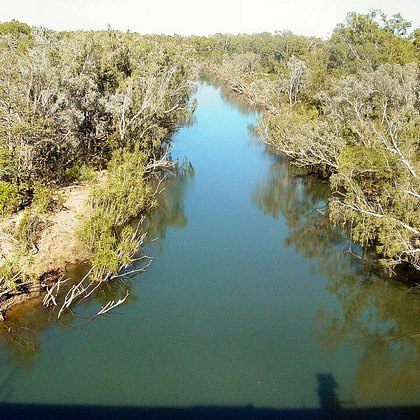
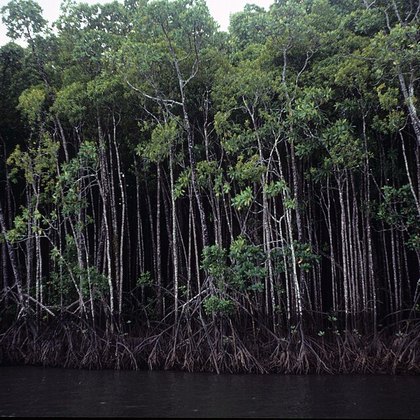
Fresh water with cover: rivers, creeks, billabongs, lakes, swamps and stock dams, nearly always with overhanging shady vegetation to sit under. Mangrove and tidal creeks belong to the picture too, and in towns it turns up in riverside parks and even at duck or goldfish ponds. It plunges from a low branch for fish, prawns, aquatic insects and sometimes frogs; the nest is a tunnel in a steep earth bank, dug by both birds.
Where the bird is most often found, arranged by main group and formation.


Range and movements
Northern and eastern Australia: from the Kimberley in Western Australia across the Top End to Queensland, and east of the Great Dividing Range south through New South Wales into Victoria. Tasmania holds a darker subspecies of its own. It is absent from the dry interior, because it is wholly tied to permanent water. It does not occur in New Zealand.
- Resident
- dark = core range, pale = thinly spread
Where and when to look
Sit at first light on a footbridge or in a canoe on a shaded creek and keep still; this bird returns to its regular perches. You will more often see it as a blue flash low over the water than sitting. On a perched bird check the foot colour at once — red — because that removes all doubt with Little Kingfisher.
Conservation
Least Concern (LC): the range is enormous and the bird is common along suitable watercourses. It falls back locally where riverside vegetation is cleared, where banks are trampled by stock or eroded by flow regulation, because without overhanging branches and a steep earth bank both its hunting perches and its nest sites go. The global trend is slightly downward, but nowhere is the species under pressure that touches its survival.
Scientific name
Ceyx azureus | (Latham, 1801)
John Latham described the bird in 1801 as Alcedo azurea (some works give 1802); since it now sits in Ceyx, author and year take parentheses. azureus is Mediaeval Latin for 'azure'. The genus Ceyx carries the name of Ceyx of Greek myth, who with his wife Alcyone was turned into a kingfisher. The type locality in the original description read Norfolk Island, but that rested on a mistake: it should have been New South Wales.