All species › Kingfishers, bee-eaters and rollers › Bee-eaters › Rainbow Bee-eater
Rainbow Bee-eater | Merops ornatus
Regenboogbijeneter | Abejaruco australiano
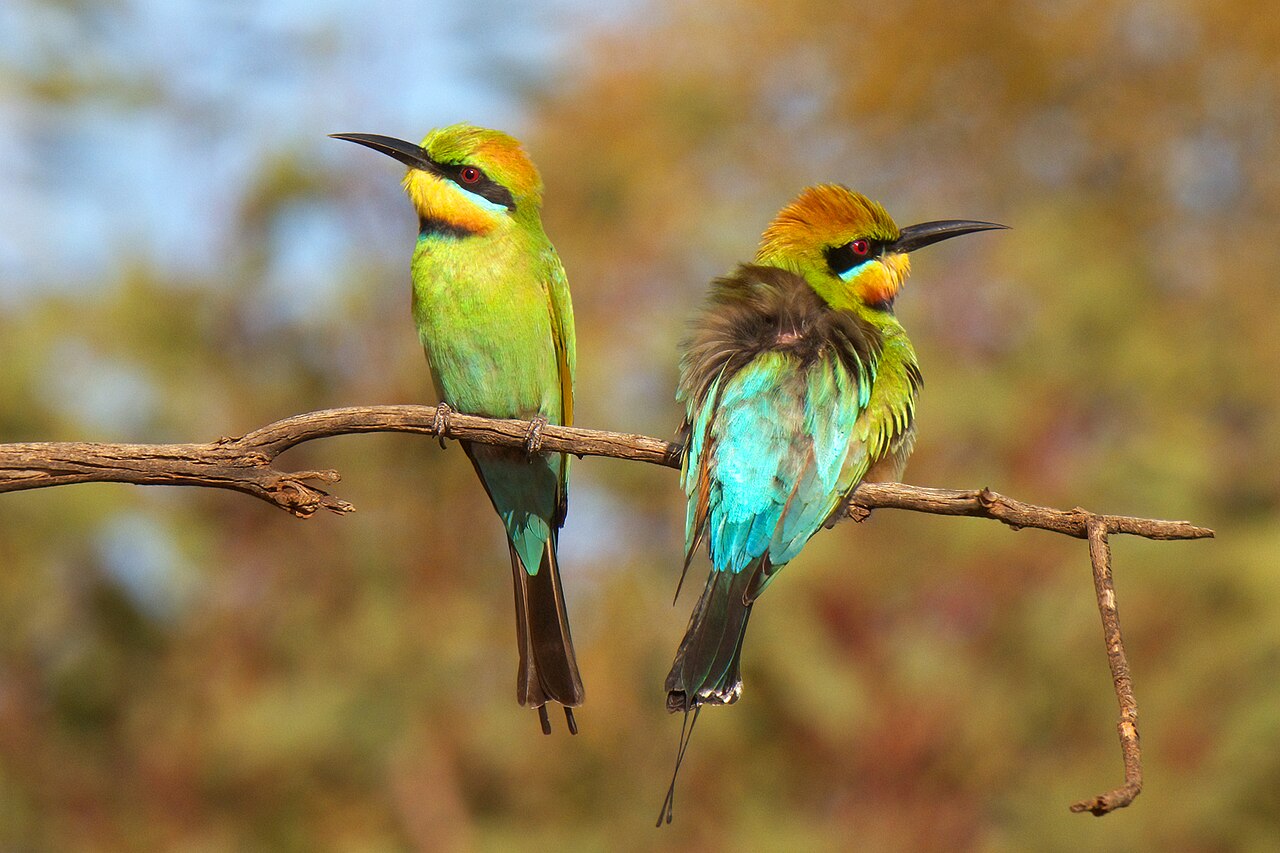
The Rainbow Bee-eater is the only bee-eater in Australia and the most highly coloured bird of open country: green, with a golden crown, an orange-yellow throat and a black band across the breast, and two black feathers trailing behind the tail like wires. It catches bees and wasps in the air, beats them dead on a perch and rubs out the sting and venom sac before swallowing them. It breeds in a tunnel it digs itself in sandy ground, often with dozens of pairs together.
Voice
The sound is a liquid, rolling prrp prrp, almost always given in flight and the first sign that bee-eaters are passing; it carries far and arrives over open country out of nowhere. At a colony it runs together into a light, continuous chattering of birds coming and going. Danger at the nest brings a sharper, repeated tship, after which every bird lifts at once. Migrating flocks call constantly and can be counted by ear even when they are too high to see.
No freely licensed recording has been found for this species yet; what to listen for is described below.
Identification
A slim, sharp-lined bird with long pointed wings, a thin decurved bill and two greatly elongated central tail feathers. Crown and mantle are golden brown to green, back and wings green, the primaries coppery with black tips, and the underwing pale orange with a black trailing edge. The eye is red and set in a broad black stripe edged above and below by a thin blue line; the throat is orange-yellow and cut off from the green breast by a black band. Rump and lower belly are blue, the tail black with a blue sheen. The female has shorter and thicker tail streamers than the male. Young birds are duller and greener, lack the breast band and have no streamers yet.
Confusion species
There is no second bee-eater in the area, so confusion arises only at range or against the light. A flock hunting high can suggest swallows, but Welcome Swallow (Hirundo neoxena) is brown and dark blue, forktailed and endlessly banking, while the bee-eater glides long stretches on stiff wings between beats. Rainbow Lorikeet (Trichoglossus moluccanus) is as gaudy but stocky, screeching and fast in a straight line. A single bird on a wire can suggest a small falcon; the thin curved bill and the trailing streamers rule that out at once.
Habitat
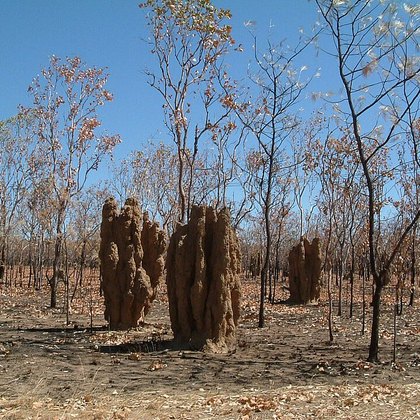
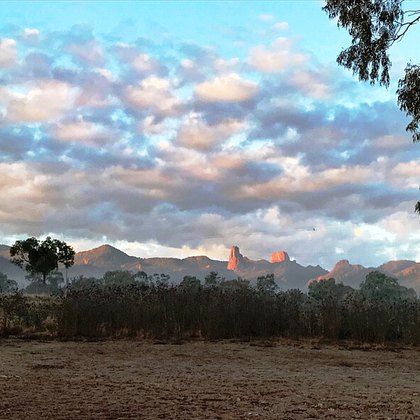
Open eucalypt forest, savanna, shrubland and cleared land, usually within reach of water, and beyond that farmland, orchard and vineyard with scattered trees and wires to perch on. The nest needs loose, well-drained sandy ground: a low bank, a dune, a flat patch of sand, and often ground made by people such as a road cutting, a quarry or a sand pit. Both birds of the pair dig the tunnel, on average ninety centimetres and up to nearly two metres deep, ending in a chamber that may be lined with grass. Closed forest and waterless desert interior are avoided.
Where the bird is most often found, arranged by main group and formation.




Range and movements
Across almost the whole of mainland Australia except the core of the deserts, and breeding as well on the islands of Torres Strait, on Rottnest and in eastern New Guinea. The seasons here stand on their head: in the south it is a summer bird, arriving in September and October, breeding from November to January and moving north in large flocks in winter, in June and July. Those winter quarters lie in northern Australia, in New Guinea and west into Wallacea; in the Solomon Islands it is rare. Only in the far north of Australia do the birds stay in one place all year.
- Resident
- Breeding (summer)
- dark = core range, pale = thinly spread
Where and when to look
Find a low sandy bank or an old road cutting in November and December and sit well back; the holes lie close together and the birds keep coming and going as long as you do not force them to hang about. Watch what a bird on a wire does with its prey: the beating and the wiping of the abdomen tip along the branch, five or six times over, follows well through binoculars. Never walk across a colony — the tunnels are shallow and collapse.
Conservation
Not threatened (LC) and common across the mainland, with a range that clearing has widened rather than narrowed. The heaviest burden is introduced animals at the nest: in a large study in the north nearly half of all attempts failed to cane toads and dingoes, the toad alone accounting for a third. Nests that escaped them fledged about one and a half young on average, with nearly half of the pairs assisted by a third bird. Beyond that, colonies are lost when a sand pit is taken back into use or a bank is stabilised.
Scientific name
Merops ornatus | Latham, 1801
Latham described the species in 1801 as Merops ornatus, and it stands in that genus still, so author and year carry no parentheses. The genus Merops was introduced by Linnaeus in 1758 and is the Greek word for bee-eater. The epithet ornatus means 'adorned'. The type locality is New South Wales. The Dutch name follows the English one and refers to the number of colours the bird carries at once.