All species › Kingfishers, bee-eaters and rollers › Rollers › Oriental Dollarbird
Oriental Dollarbird | Eurystomus orientalis
Dollarvogel | Carraca oriental
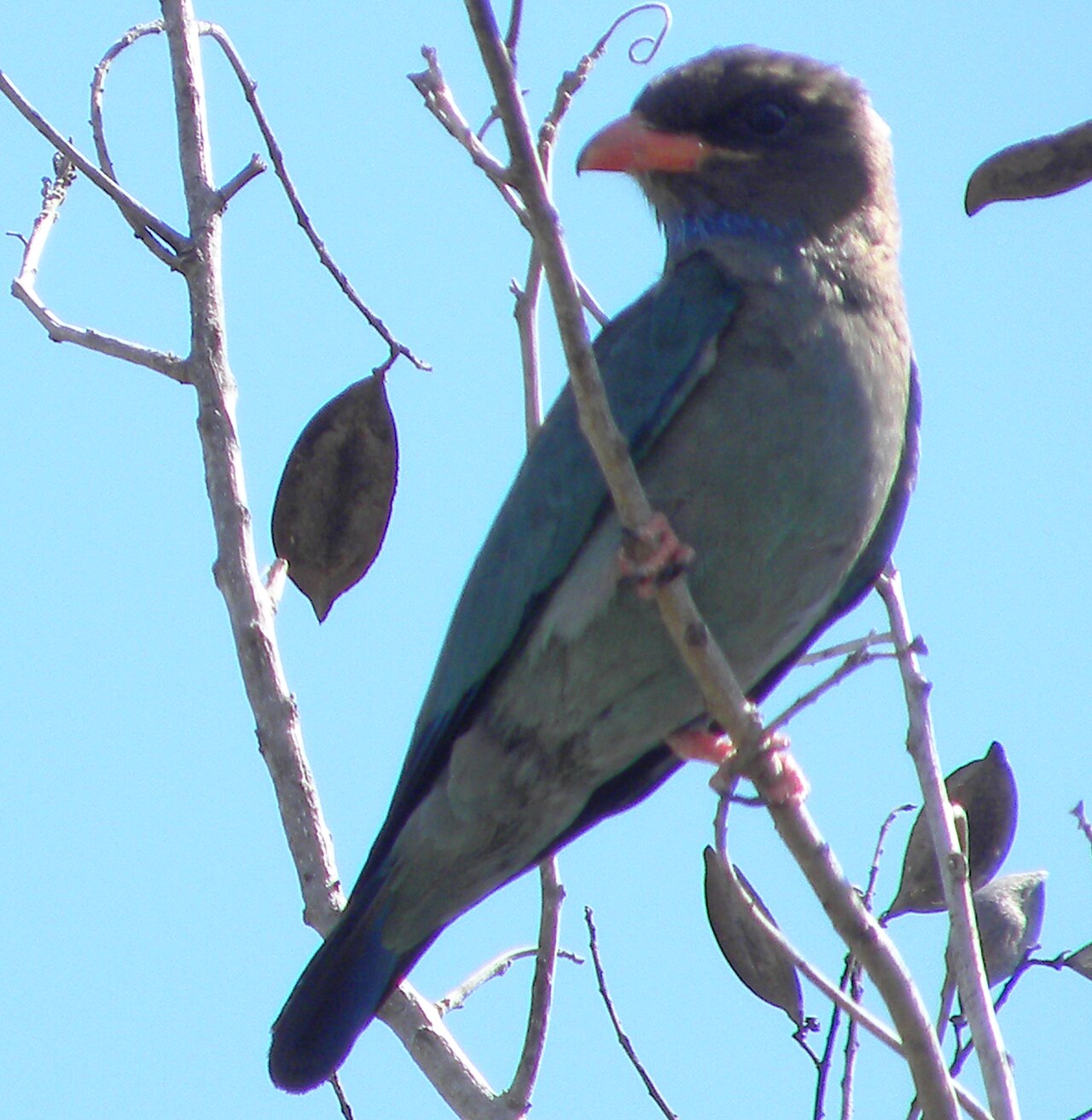
The Oriental Dollarbird is the only roller in Australia and New Zealand: a stocky, dark bird with a short red bill that sits against the evening sky on a bare branch and strikes insects out of the air from there. Its name comes from the pale blue coin-shaped patch on each wing, visible only in flight. It arrives from the north in September and is gone again by April.
Voice
The call is a hard, harsh kak-kak-kak, repeated several times over and usually given in flight. Chasing an intruder above the nest tree it becomes a sustained rattling screech, with the pair calling together. The sound belongs to the half-light: it comes most in the last half hour of daylight and again shortly before sunrise. Perched, the bird is silent.
No freely licensed recording has been found for this species yet; what to listen for is described below.
Identification
A stocky bird with a large head, a short tail and a short, broad, orange-red bill tipped black. The plumage is dark brown with a blue-green wash over back and wing coverts, the breast brown, the belly paler, and the throat and undertail coverts glossy bright blue. Flight feathers and tail are dark blue; midway along each hand lies a pale blue round patch that opens up the moment the bird flies. The female is slightly duller than the male. Young birds lack the blue gloss on the throat and have a brownish bill and brown feet instead of red. In flight it is broad and short-tailed, with quick beats broken by veering, bat-like sallies.
Confusion species
On a bare branch at dusk the outline suggests a Laughing Kookaburra (Dacelo novaeguineae), but that bird is much larger, with a long dagger bill and a pale head. Sacred Kingfisher (Todiramphus sanctus) is smaller, turquoise above and pale below, with a white collar. Hunting in the half-light it can recall a nightjar; Australian Owlet-nightjar (Aegotheles cristatus), though, is mottled grey, far smaller and has a soft, fluttering flight. Once the blue coins light up there is no other candidate.
Habitat
Open forest and woodland with tall old trees carrying hollows, and the margins of rainforest and monsoon forest. Beyond that, riverine forest along creeks, roadside plantings, parks, large gardens and the trees along playing fields and streets in coastal towns. What it needs is a bare high branch with a clear view to hunt from and an unlined hollow to breed in; closed, continuous canopy is avoided.
Where the bird is most often found, arranged by main group and formation.





Range and movements
A breeding bird of northern and eastern Australia, arriving in September and leaving in March or April for New Guinea and the islands around it. In the far north some birds stay longer, but the southeastern part of the range empties completely in winter. Outside the area of this guide the species breeds from India and Japan to the Solomon Islands; the Australian birds form the southern edge of that. In New Zealand it is no more than a great rarity.
- Breeding (summer)
- dark = core range, pale = thinly spread
Where and when to look
Look for it in the second half of December on a bare dead top above the forest or along a road, and stay put: it returns to the same branch again and again. Wait for it to fly and watch for the coins; perched, the bird is dark and inconspicuous. Two birds screeching in pursuit of each other around one dead tree point to an occupied nest hollow.
Conservation
Not threatened (LC) and common throughout its range, including towns and cities. The constraint is the supply of large old trees with hollows, for which it must compete with cockatoos, parrots and kookaburras; even-aged planted forest holds none. As a bird that chases insects low over roads it is also killed regularly by traffic.
Scientific name
Eurystomus orientalis | (Linnaeus, 1766)
Linnaeus described the species in 1766 as Coracias orientalis; because it was later moved to another genus, author and year stand in parentheses. The genus Eurystomus was introduced by Vieillot in 1816 and is formed from the Greek eurus, broad, and stoma, mouth, after the wide gape with which these birds take insects. The epithet orientalis means eastern. The type locality reads 'India orientali' in the original description and was later fixed to Java. The English and Dutch names both come from the coin-shaped wing patch, thought to resemble a silver dollar.