All species › Birds of prey › Kites, Old World vultures, eagles and hawks › Grey Goshawk
Grey Goshawk | Tachyspiza novaehollandiae
Grijze havik | Azor gris
The Grey Goshawk is the bulky forest bird of the Australian sparrowhawk and goshawk trio and the only one that comes in two colour morphs: a pale grey one and an entirely white one. That white morph is one of the very few wholly white raptors in the world, and in Tasmania every bird is white. The dark red iris and the yellow legs belong to both morphs.

Voice
The male gives a high, piercing kieek-kieek repeated ten to twenty times in a row; the female sounds slower and fuller, almost plaintive. You hear it almost only in the breeding season around the nest tree, and the call carries strikingly far through closed rainforest.
No freely licensed recording has been found for this species yet; what to listen for is described below.
Identification
Thirty-eight to fifty-five centimetres, with a wingspan of seventy to a hundred and ten; at about seven hundred and twenty grams the female is twice the weight of the male. In the grey morph head and upperparts are pale grey, the breast finely barred grey and the rest of the underside white, with dark primary tips and a barred tail. In the white morph the bird is spotless white from bill to tail tip, without a single marking. Both morphs have a dark red iris, yellow cere and heavy yellow legs. The wings are broad and rounded, the tail long and rounded; the flight is a few deep beats and a long glide.
Confusion species
The pale northern birds of the Brown Goshawk (Tachyspiza fasciata) are most often taken for it, but they carry a clear brown tone, a rufous collar on the nape, finely barred underparts and a bright yellow eye, where Grey Goshawk is plain and red-eyed. Collared Sparrowhawk (Tachyspiza cirrocephala) is far smaller and slimmer, also finely barred and yellow-eyed, with thin spindly legs. A white bird at range can suggest a cockatoo or a small egret, but the broad rounded wings, the raptor shape and the yellow legs rule that out. Grey Falcon (Falco hypoleucos) is pale grey too but has pointed, dark-tipped falcon wings and belongs to the dry interior.
Habitat
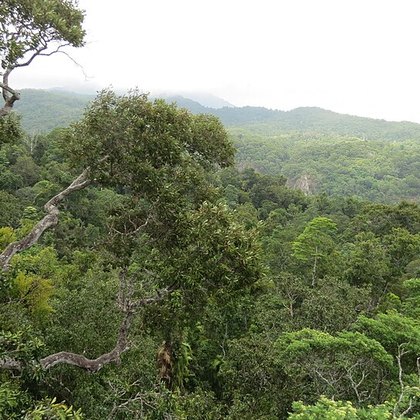
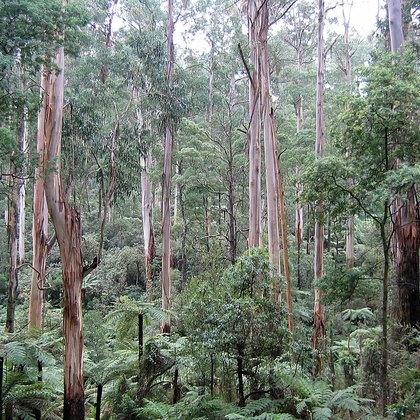
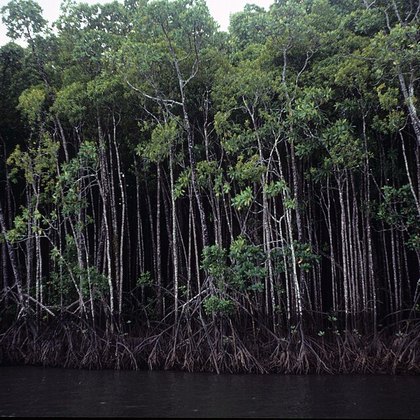
Tall closed forest: tropical rainforest, wet eucalypt forest, monsoon forest and vine thicket, riverine woodland along creeks and mangrove on the tropical coast. It hunts along forest edges, forest creeks and clearings, and for the nest it needs a tall old tree, usually beside running water.
Where the bird is most often found, arranged by main group and formation.


Range and movements
The coastal belt and hinterland of northern and eastern Australia, from the Kimberley across the Top End and Cape York down into Victoria, plus the whole of Tasmania. It does not occur in New Zealand. The morphs are distributed geographically: the white morph dominates in the northwest, along the Victorian coast and in Tasmania, where every bird is white, while the grey morph is commonest in the subtropical east coast forests.
- Resident
- dark = core range, pale = thinly spread
Where and when to look
Walk a rainforest track or a forest creek early in the day and watch for a bird crossing the dark understorey — a white raptor in that light is hard to miss. In Tasmania every white raptor is this species. On a grey bird the overall impression decides: plain and collarless, with a red rather than a yellow eye.
Conservation
Least Concern globally (LC), but pressed regionally: Tasmania lists it as endangered and Victoria as threatened. The Tasmanian population is down to a few hundred pairs and depends on tall old forest along creeks — exactly the forest that logging removes. Protection there turns on keeping buffers around known nest trees and on holding onto unbroken wet forest.
Scientific name
Tachyspiza novaehollandiae | (Gmelin, 1788)
Gmelin described the species in 1788 as Falco novaehollandiae; because it was later moved to another genus, author and year stand in parentheses. He went on Latham's 1781 account of the 'New Holland white eagle', and so on the white morph. novaehollandiae means 'of New Holland', the old name for Australia; in bird names it usually points to New South Wales, and there Mathews fixed the type locality in 1912. The genus Tachyspiza was introduced by Kaup in 1844 and brought back into use in 2024, when molecular work showed that Accipiter as formerly understood was not a natural group; the name is from Greek takhus, 'swift', and spizias, 'hawk'.