All species › Tubenoses › Petrels, shearwaters and diving petrels › Barau's Petrel
Barau's Petrel | Pterodroma baraui
Baraus stormvogel | Petrel de Barau
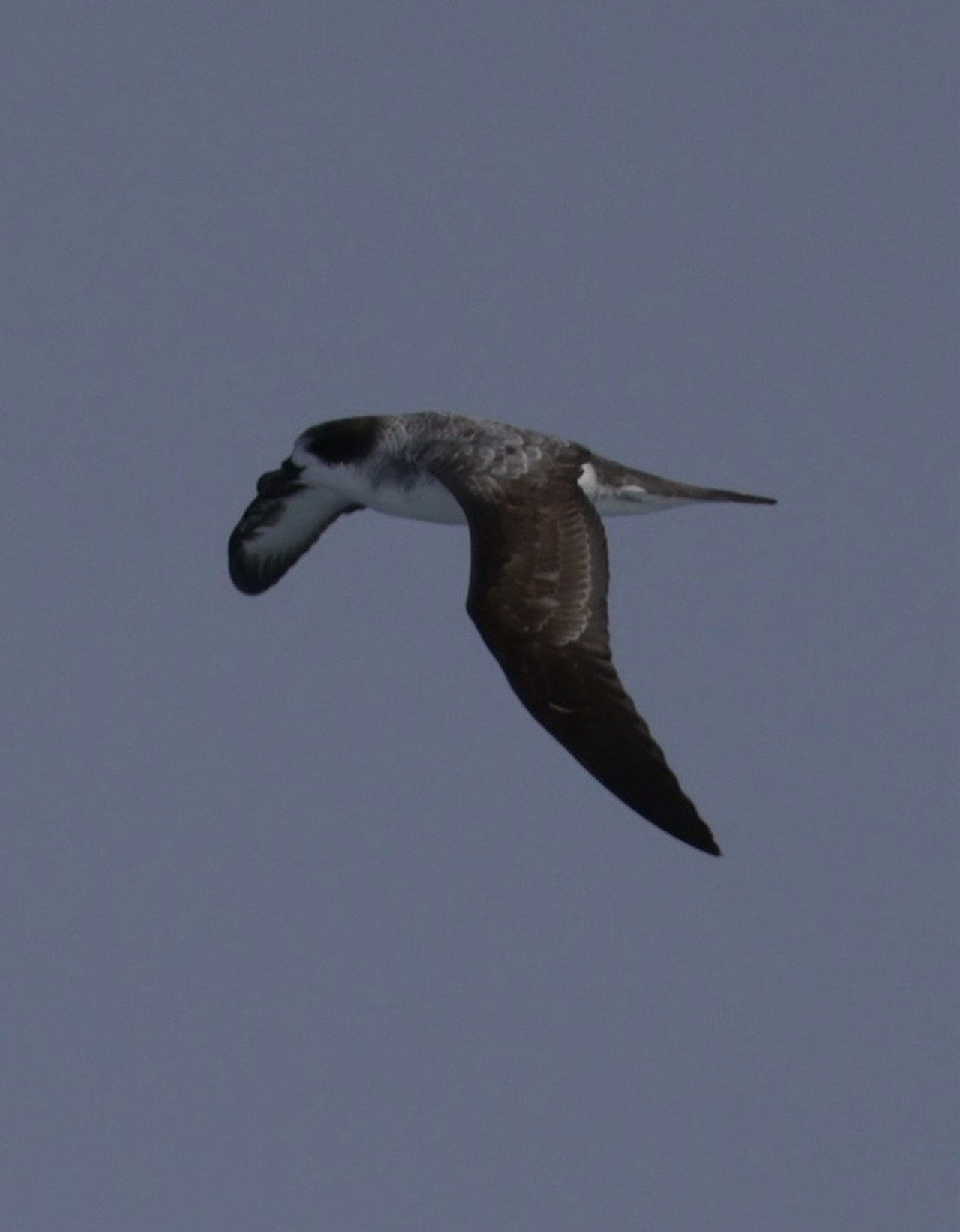
Barau's Petrel is a medium-sized gadfly petrel of the Indian Ocean that breeds only on Reunion, high in the mountains, and that reaches the waters of this region as an exceptional vagrant. White below, grey above, with a white forehead and a black diagonal bar across the underwing that fixes the species.
Voice
At sea it is silent, as almost all Pterodroma petrels are, and in this region it has never been heard calling. Over the colonies on Reunion it is noisy by night, with plaintive nasal wailing and high whistled notes that carry along the mountain walls; the Reunion name taillevent, 'wind-cutter', refers to the flight rather than the voice.
Recording: Daniel Danckwerts — CC BY-NC-SA 4.0 · Trois-Bassins, Saint-Paul, France · xeno-canto
Identification
A petrel of close to forty centimetres, ash-grey above with a dark M across the spread wings and back, and pure white below. Head and forehead are white with a dark cap reaching below the eye, giving a masked face; the bill is short, heavy and black. The decisive mark is on the underwing: a broad black band along the leading edge that turns inward halfway as a slanting bar towards the body, against an otherwise white underwing with a black tip. Male and female are alike. Flight is fast and high-arcing, in long bows on stiff, slightly swept-back wings.
Confusion species
The underwing pattern closely recalls that of the much smaller Black-winged Petrel (Pterodroma nigripennis), which carries the same black diagonal across a white underwing; the difference of more than a third in size is the first clue at sea, along with Barau's heavier bill and slower beat. White-necked Petrel (Pterodroma cervicalis) is larger still and shows a broad white band across the hindneck that Barau's Petrel lacks entirely — that very feature clinched the identification of the first Australian bird. Soft-plumaged Petrel (Pterodroma mollis) has an all-dark grey underwing with no white and a grey breast band. Cook's Petrel (Pterodroma cookii) and Gould's Petrel (Pterodroma leucoptera) are smaller and lighter in build, with far finer black markings on the underwing.
Habitat
Open ocean over deep water, well beyond the continental shelf; it does not follow ships and does not gather over fishing grounds. It breeds in an unusual place for a seabird: the high mountains of Reunion, in burrows and rock crevices between 2400 and 2800 metres, the birds coming and going by night.
Where the bird is most often found, arranged by main group and formation.

Range and movements
Within the map window of this guide a vagrant, on a handful of records. The first Australian bird was seen on 15 February 1987 about twelve and a half nautical miles south-west of Cape Bridgewater, Victoria, on a pelagic trip where seabirds had been drawn in with fish scraps; a few weeks later another was found far off Western Australia at about 32 degrees south. Its normal range runs from Reunion east into north-western Australian waters, so the best chance of a meeting lies in the Indian Ocean off Western Australia. It has not been recorded in New Zealand waters.
- Non-breeding visitor
- dark = core range, pale = thinly spread
Where and when to look
Do not count on it. Anyone hoping to find one must join a pelagic trip out of Western Australia or western Victoria, and photograph the underwing of every white-bellied gadfly petrel: only an image can carry the combination of size, white forehead, absent white neck band and broad black diagonal. Every claim needs photographs and assessment by a rarities committee.
Conservation
Endangered (EN). The species breeds in one mountain area on one island, which makes it vulnerable by definition. The heaviest drain is light pollution: fledglings leaving the colony are disoriented by street lighting and lit buildings and come down on land, and in bad years this affects up to about forty per cent of the fledged young. Feral cats and rats take their toll in the colonies as well, above all among adults. On Reunion grounded young are collected and released in large numbers by volunteers each year, and street lighting is switched off during the fledging period.
Scientific name
Pterodroma baraui | (Jouanin, 1964)
The French ornithologist Christian Jouanin described the species in 1964, and did so as Bulweria baraui; because it has since moved to another genus, author and year go in parentheses. The genus Pterodroma was introduced by Bonaparte in 1856, from the Greek for 'wing' and 'runner'. The epithet baraui honours Armand Barau, an agricultural engineer and ornithologist of Reunion who brought the bird to notice. The type locality is Saint-Denis on Reunion; the Dutch and English names carry the same man.