All species › Tubenoses › Petrels, shearwaters and diving petrels › Chatham Islands Petrel
Chatham Islands Petrel | Pterodroma axillaris
Chathamstormvogel | Petrel de las Chatham
The Chatham Islands Petrel is a small gadfly petrel that now breeds in numbers on just one small island of the Chatham group. Grey above and white below, it is fixed by a single feature: a black patch in the 'armpit' of the underwing, where the wing meets the body.
Voice
At sea it is silent. At the colony it is noisy by night: the male calls a high, rapidly repeated whis-whis-whis from the air and from the ground, the female answers with a deeper yap-yap-yap, and both sexes give a purring, churring call from inside the burrow.
No freely licensed recording has been found for this species yet; what to listen for is described below.
Identification
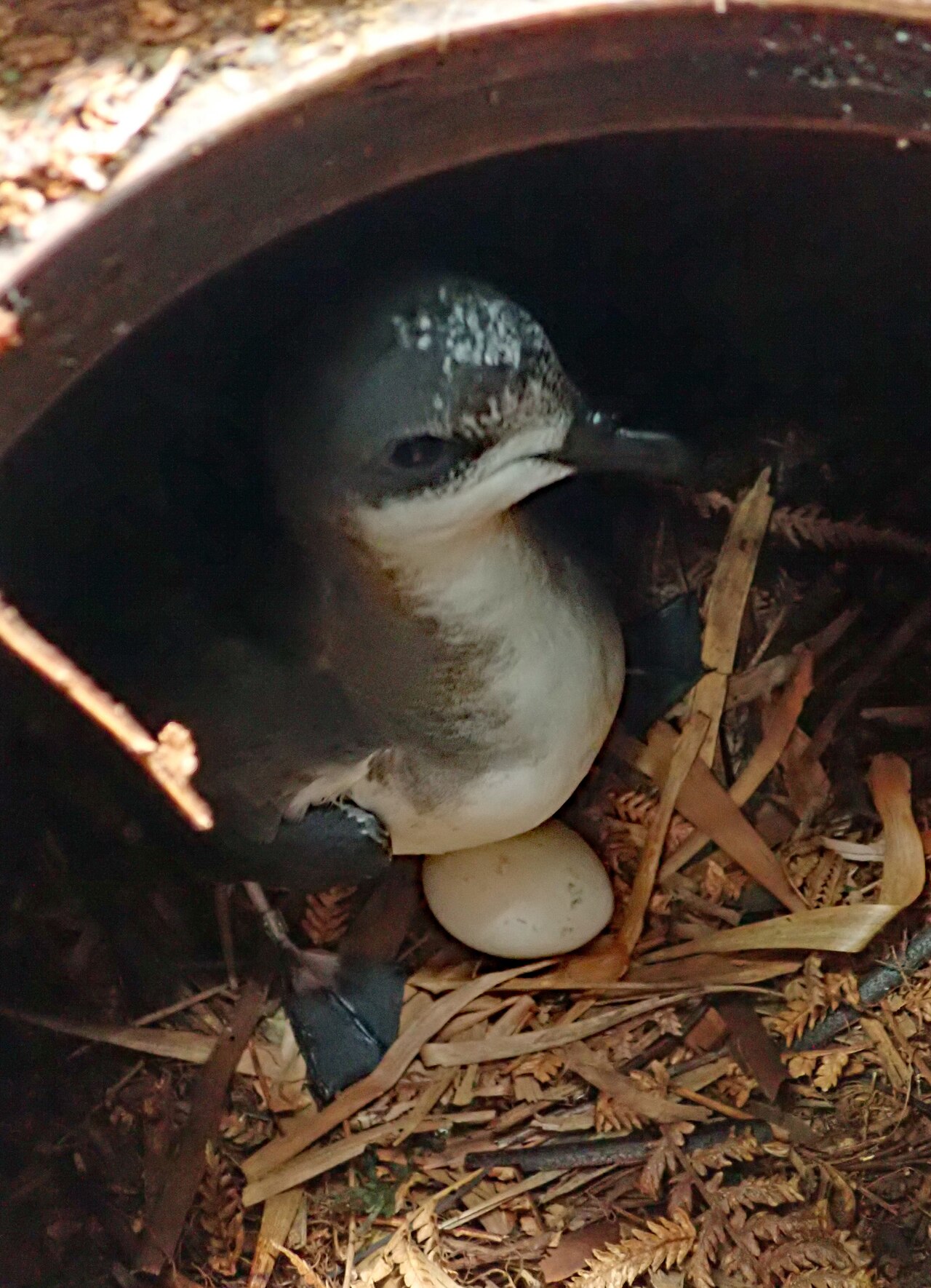
A petrel of thirty centimetres, dark grey above with a darker M across the wings, and white below. The forehead is mottled grey and white, so that at range the head seems to wear a vague, ill-defined cap. The bill is black with a strongly hooked tip, the eye dark, legs and feet pink. The underwing decides it: a black diagonal bar runs inward from the leading edge and ends in a conspicuous black axillary patch where the wing meets the body — a black armpit no other small petrel of this region carries in that form. Male, female and juvenile are alike.
Confusion species
This is the hardest corner of a hard genus. Black-winged Petrel (Pterodroma nigripennis), the same size and common in the same waters, shows the same black diagonal but much less black on the inner underwing and lacks the black axillary patch; that mark alone separates the two reliably at sea, and it needs good light and close range. Cook's Petrel (Pterodroma cookii) is slightly smaller and far paler grey above, with an almost wholly white underwing carrying only a thin dark line along the leading edge. Gould's Petrel (Pterodroma leucoptera) has a much darker, sharply drawn black hood reaching below the eye, against the vaguely speckled forehead of the Chatham Islands Petrel. Mottled Petrel (Pterodroma inexpectata) is larger, has a dark belly patch and a whiter underwing. Without a photograph of the armpit, a record is better left open.
Habitat
Open ocean over deep water beyond the continental shelf, where it takes mainly squid and small fish. It breeds in burrows it digs in forest soil, under low coastal forest and ferns on a predator-free island; the burrows sit among those of far more numerous other tubenoses, and that is precisely its problem.
Where the bird is most often found, arranged by main group and formation.


Range and movements
Endemic to the Chatham Islands and breeding nowhere else. The entire world population breeds on Rangatira, also called South East Island, 218 hectares in extent; chick transfers since 2002 have founded new colonies on Pitt Island and on main Chatham Island. Outside the breeding season it ranges far into the Pacific, as far as the Nazca Ridge west of Peru and Chile. At sea off the New Zealand mainland it is virtually never seen, so a meeting is in practice confined to the waters around the Chathams.
- Breeding (summer)
- dark = core range, pale = thinly spread
Where and when to look
This is not a bird you simply run into. The only realistic chance is a boat trip in the waters around the Chatham Islands between December and May, when the birds are at their burrows; look then for small, fast-arcing petrels and photograph the underwing of every one, because only the black armpit closes the identification. Ashore the colonies are reserves entered by permit.
Conservation
Vulnerable (VU), and Nationally Vulnerable by New Zealand reckoning: about two thousand birds, of which some two hundred burrows are monitored each year. The main threat is not a predator but a neighbour: Broad-billed Prions (Pachyptila vittata) enter the burrows looking for a nest site and kill the egg or chick in doing so. The remedy has proved simple and effective — an artificial burrow with a neoprene flap at the entrance, which keeps the much smaller prion out — and breeding success rose from about thirty per cent to seventy or eighty per cent, reaching 83 per cent in the 2005/06 season. Between 2002 and 2011 four hundred chicks were moved to new islands so that the species would no longer hang on one place; since 2003 a hundred to a hundred and fifty chicks have fledged each year and the population is growing.
Scientific name
Pterodroma axillaris | (Salvin, 1893)
The British ornithologist Osbert Salvin described the species in 1893 as Oestrelata axillaris; because it has since moved to another genus, author and year go in parentheses. The genus Pterodroma was introduced by Bonaparte in 1856, from the Greek for 'wing' and 'runner'. axillaris is Latin for 'of the armpit' and points exactly at the black axillary patch that separates the bird from all its look-alikes — one of the happier choices of name in this genus. The type locality is the Chatham Islands; the Maori name is ranguru.