All species › Birds of prey › Kites, Old World vultures, eagles and hawks › Black Kite
Black Kite | Milvus migrans
Zwarte wouw | Milano negro
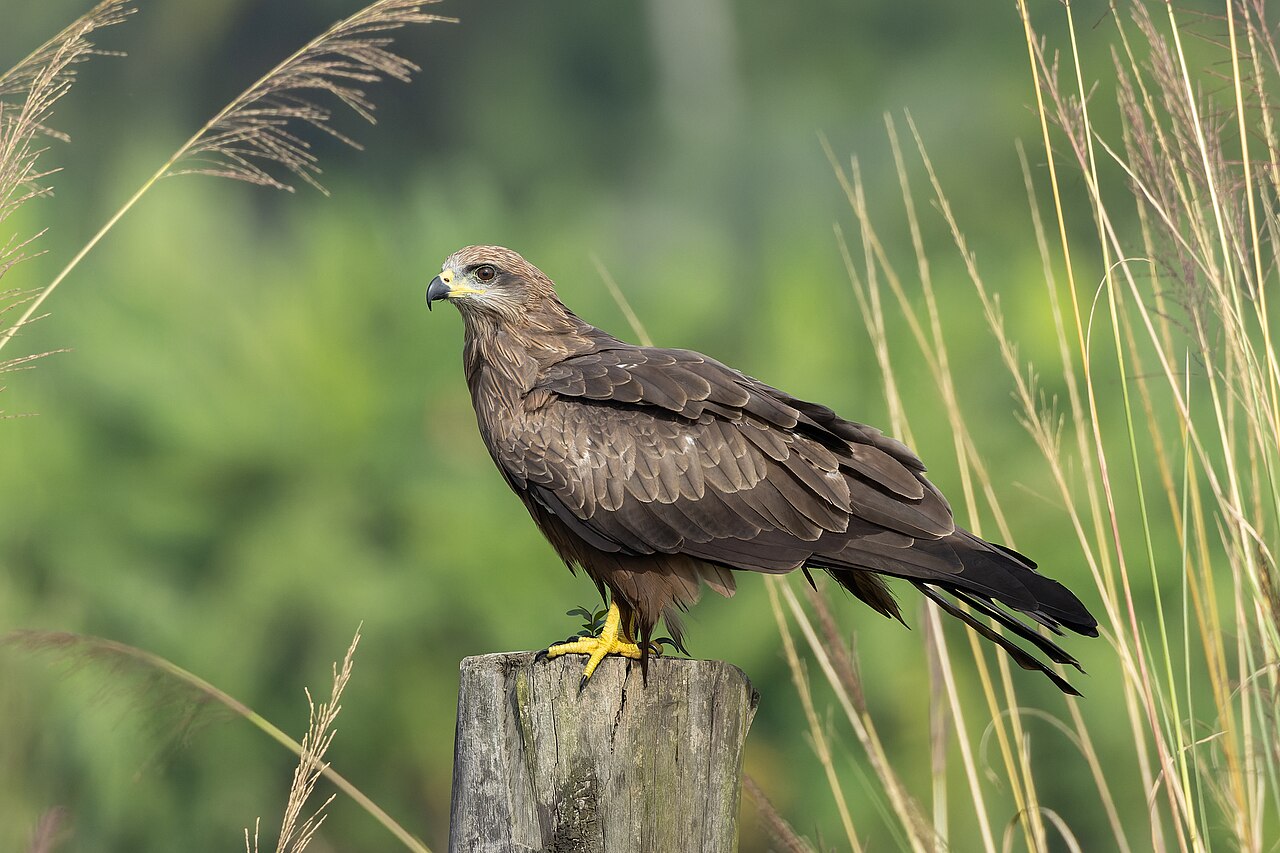
The Black Kite is probably the most numerous raptor in the world, and in Australia it is the bird that hangs in dark clouds over an outback town, a rubbish tip or a grass fire. At range it looks almost black, with a pale shoulder bar; the decisive mark is the forked tail, which it twists continuously while soaring.
Voice
A descending whistle followed by a staccato rattle: psee-err and then si-si-si-si-si, shriller and more nervous than the clear whistle of a Whistling Kite. With large flocks over a tip or a fire this builds into a sustained shrill chatter with dozens of birds calling across one another. It is loudest at the nest and around food.
No freely licensed recording has been found for this species yet; what to listen for is described below.
Identification
A medium-sized raptor of about half a metre, looking dark brown to almost black in the field, with lighter streaking on head, neck and underparts and a pale brown bar across the upperwing. The tail is shallowly forked and barred dark — while soaring the fork sometimes closes up, but the constant twisting of the tail still gives it away. The eye is dark brown, the bill black with a yellow cere. The flight is loose and rocking, with slack beats and much correcting. Young birds are lighter, with pale feather edges and a shallower fork.
Confusion species
Whistling Kite (Haliastur sphenurus) is the standing confusion and often shares the same company: paler and shaggier about the head, with a pale M on the underwing and a tail that ends rounded or wedge-shaped rather than notched. Square-tailed Kite (Lophoictinia isura) has a white face and a cut-off square tail. Black-breasted Buzzard (Hamirostra melanosternon) is far heavier, with a very short tail and white bull's-eyes in the primaries. Black Falcon (Falco subniger) is equally dark but has pointed falcon wings, a long straight tail and a fast powerful flight without the rocking.
Habitat
From timbered watercourses to open plains, with a strong preference for the company of people: the outskirts and streets of inland towns, abattoirs, stockyards, rubbish tips and sewage works. In the north it gathers in hundreds over grass fires, seizing insects and small vertebrates that flee ahead of the flames. The nest is a bulky stick cup in a tree fork, built alone or in loose colonies.
Where the bird is most often found, arranged by main group and formation.



Range and movements
Over most of the Australian mainland, most numerous in the north and the dry interior and scarcer along the south-east coast; it is all but absent from Tasmania. Its occurrence is nomadic: it follows mouse plagues, locust plagues, fires and stock, and a district can go from empty to crowded in a month. In New Zealand it is a vagrant with eight accepted records, scattered over both the North and South Islands, including one bird that stayed near Renwick in Marlborough from 2000 to 2015.
- Resident
- dark = core range, pale = thinly spread
Where and when to look
Drive into an inland town and look up over the abattoir, the stockyards or the tip: they hang there dozens at a time, low and slow, and you can study the twisting forked tail at leisure. A smoke column from a grass fire in the north is the other sure place. In any doubtful bird, watch the tail end as it turns — the fork disappears briefly when closed, but it always comes back.
Conservation
Not threatened (LC), and in Australia it counts as a beneficiary rather than a victim of human activity: grazing, waste and roadside carrion have made it more numerous in many places. Elsewhere in the world, poisoning by diclofenac and lead residues, and collisions with powerlines and wind turbines, weigh heavily. For Australia the main losses are secondary poisoning during mouse and rabbit control and collisions at carrion on the road.
Scientific name
Milvus migrans | (Boddaert, 1783)
Boddaert described the species in 1783 as Falco migrans, from a plate by Daubenton; the later move to another genus puts author and year in parentheses. The genus Milvus was introduced by Lacepede in 1799 and is the ordinary Latin word for kite. migrans means 'wandering, migrating' and refers to the long migration of the European birds. The type locality is restricted to France. The Australian birds belong to the subspecies affinis, which does not migrate out but wanders with food and rain; the English and Dutch names both describe the dark impression the bird makes in the field.