All species › Birds of prey › Kites, Old World vultures, eagles and hawks › Crested Honey Buzzard
Crested Honey Buzzard | Pernis ptilorhynchus
Aziatische wespendief | Abejero oriental
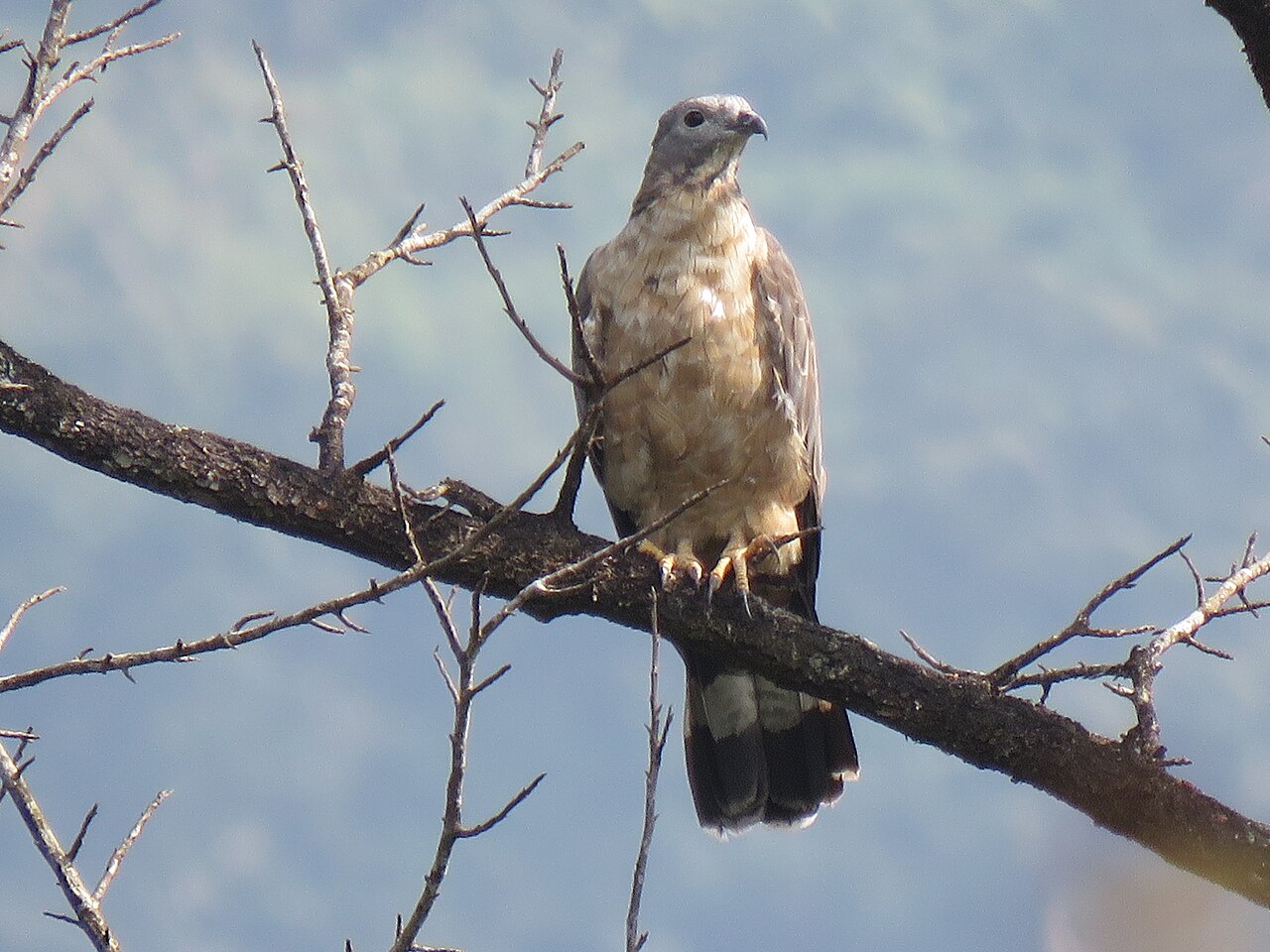
The Crested Honey Buzzard is the only raptor in this region that lives off wasp and bee nests: a slim, long-tailed buzzard-like bird with a strikingly small, almost pigeon-like head on a long thin neck. It does not breed in Australia — here it is a northern passage migrant and non-breeding visitor that reaches only the far north.
Voice
A silent bird, and in Australia it is hardly ever heard. Where it does call, mainly on the breeding grounds in north-east Asia, there is a high thin whistle that lifts slightly at the end: wee-weeoo or a two-note pee-loo, thinner and more musical than a goshawk's barking. Harsh raw cries are added at the nest. Do not count on it giving itself away in the field.
No freely licensed recording has been found for this species yet; what to listen for is described below.
Identification
About the size of a Black Kite, but built quite differently. The head is small and the neck long and thin, so that in flight the silhouette suggests a cuckoo or a pigeon rather than a raptor. The wings are long, narrow at the base and end in six clearly spread fingers; the tail is long and rounded. Adults show two broad dark bands close to the tail base and a third broad band at the tip — a pattern no Australian raptor matches. Plumage ranges from near white to dark brown, and many birds show a dark throat stripe. The male has a blue-grey head and a dark eye, the female a brown head and a yellow eye. The short nape crest usually lies flat.
Confusion species
Black Kite (Milvus migrans) is the same size and equally brown, but has a forked tail, a bigger head and a much looser, rocking flight. Whistling Kite (Haliastur sphenurus) is paler and shaggier about the head and shows a pale M on the underwing that the honey buzzard lacks. Square-tailed Kite (Lophoictinia isura) has a white face and a cut-off square tail. In doubt the head decides it: in no other raptor here does so small a head project on so long and narrow a neck, and none has those three broad tail bands.
Habitat
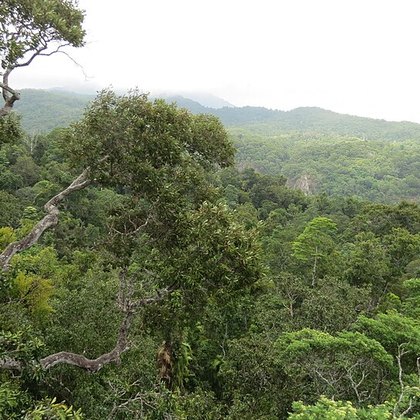
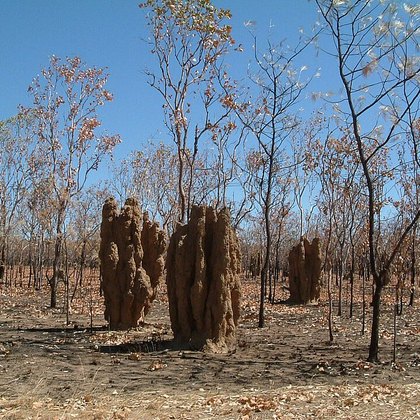
In northern Australia it keeps to monsoon forest, vine thicket and the edges of tropical rainforest, and beyond that to eucalypt savanna along creeks and to the green suburbs and parks of Darwin. It hunts low and searchingly over the canopy, and on the breeding grounds digs wasp nests out of the ground; in Australia it appears to live mainly on insects and small vertebrates.
Where the bird is most often found, arranged by main group and formation.


Range and movements
The far north only: the Kimberley, the Top End around Darwin and Kakadu, and Cape York, with the rare record further south. The birds belong to the northern subspecies orientalis, which breeds in Siberia, north-east China and Japan and winters in South-East Asia; a small share carries on into Australia and appears here mostly between October and April, while some birds stay through the southern winter. It does not breed here, and it never reaches New Zealand.
- Breeding (summer)
- dark = core range, pale = thinly spread
Where and when to look
Look for it in the Top End in the middle of the day, when the thermals are working and raptors circle above the forest edge. Work through the circling birds one by one and watch the head alone: the small, forward-thrust head on a thin neck stands out once you look for it, even when the plumage gives nothing away. The gardens and golf courses of Darwin and the woodland edges along the Arnhem Highway produce most of the records.
Conservation
Not threatened (LC), with a world range running from Siberia to Indonesia and a population in the hundreds of thousands. Australia carries no breeding responsibility for this species — the birds that come here are guests. The pressure lies elsewhere: large-scale trapping and shooting of migrating raptors at the narrow crossings of South-East Asia, and forest loss on the breeding grounds. Within Australia it is too scarce and too patchy for a trend to be read.
Scientific name
Pernis ptilorhynchus | (Temminck, 1821)
Temminck described the bird in 1821 as Falco ptilorhyncus; because it later moved to another genus, author and year stand in parentheses. The genus Pernis was introduced by Cuvier in 1816 and goes back to Greek pernes, the name of a bird of prey in Aristotle. ptilorhynchus is formed from ptilon 'feather' and rhunkhos 'bill' and points to the dense scale-like feathering around the bill base, which shields the face from wasp stings. The type locality is Java. The English and Dutch names both refer to the nests of social wasps whose larvae it eats; 'Crested' refers to the short nape crest.