All species › Birds of prey › Kites, Old World vultures, eagles and hawks › Collared Sparrowhawk
Collared Sparrowhawk | Tachyspiza cirrocephala
Grijskopsperwer | Gavilán acollarado
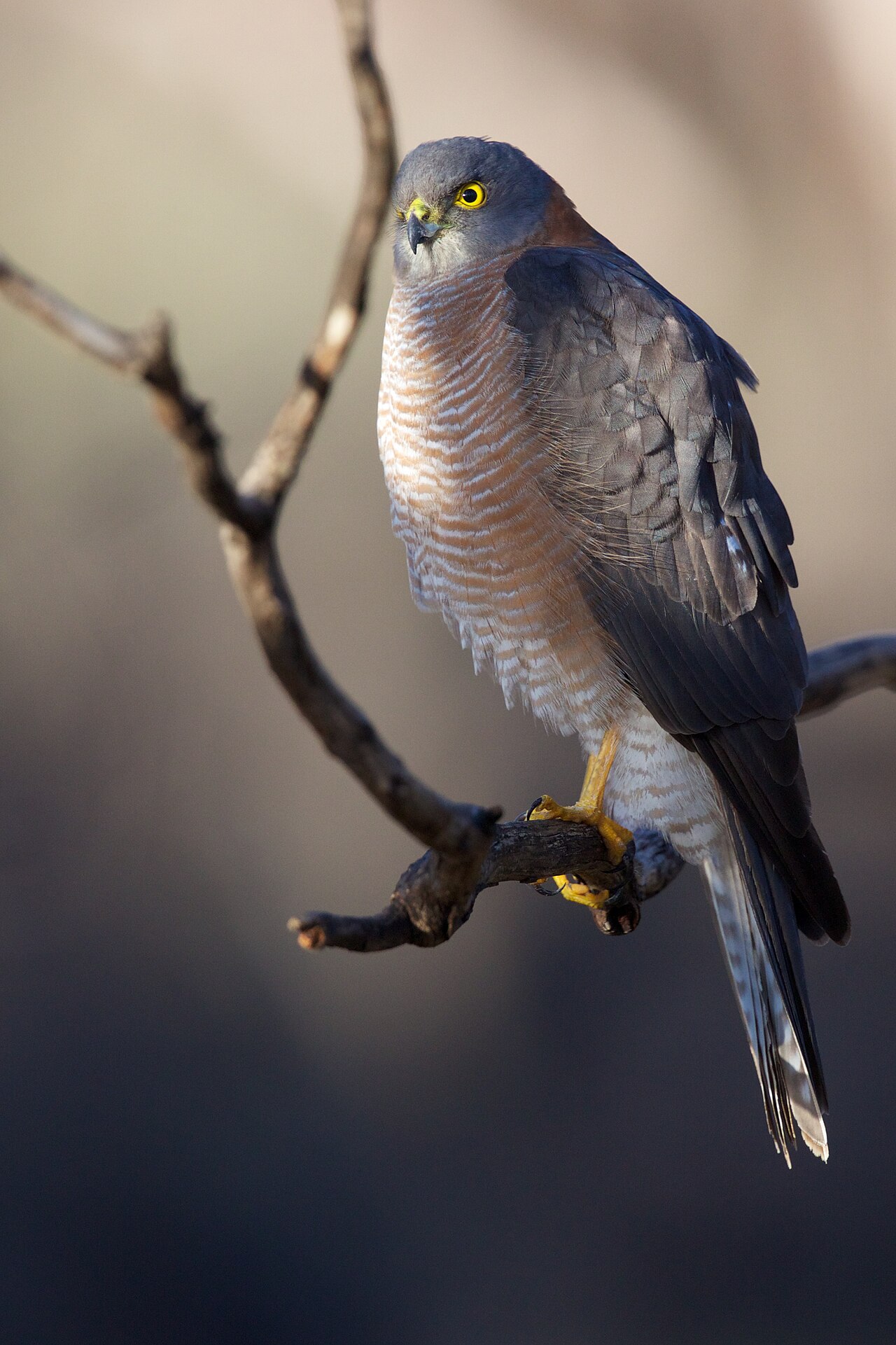
The Collared Sparrowhawk is the smallest and slimmest of the Australian sparrowhawks and goshawks, a nimble hunter of songbirds that cuts through gardens and forest edges on a jerky, undulating flight. Wide staring yellow eyes with no overhanging brow give it a startled look, and its long thin legs with an outsized middle toe are built to pluck a bird out of the air.
Voice
A rapid, high, almost trilled keek-keek-keek-keek, more hurried and thinner than that of the Brown Goshawk, and besides it a soft mewing wit-wit between partners. Hunting, it is wholly silent; the call is heard mainly in early spring around the nest tree.
No freely licensed recording has been found for this species yet; what to listen for is described below.
Identification
Thirty to forty centimetres, with a wingspan of fifty-five to seventy-eight centimetres; the male weighs barely a hundred and thirty grams, the female over two hundred. The upperparts are slate-grey, with a rufous half collar on the nape; the underparts are finely barred rufous on white. The tail tip is square-cut with sharp corners and looks slightly notched when the tail is closed. The wings are short and rounded with a clearly curved trailing edge. The legs are long, thin and spindly and the middle toe projects well past the claws of the others. The eye is large, bright yellow and set full in the face, with no heavy brow.
Confusion species
Brown Goshawk (Tachyspiza fasciata) is the classic problem and is all but identical in plumage. Shape and build decide it, not colour: the goshawk has a rounded tail tip, a straight trailing edge to the wing, thick legs with a short middle toe and a heavy, overhanging brow that gives it a frowning rather than a startled look, and its call is lower and slower. Size helps only halfway, because a female Collared Sparrowhawk measures exactly as much as a male Brown Goshawk. Grey Goshawk (Tachyspiza novaehollandiae) is far bulkier, plain grey or wholly white, and has a dark red iris instead of a yellow one.
Habitat
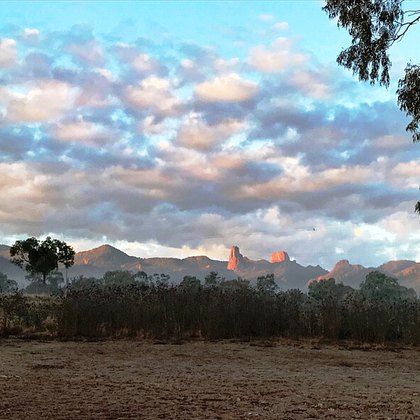
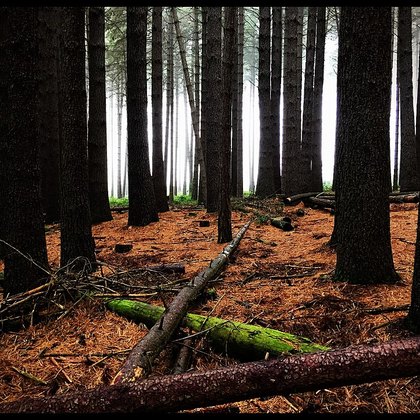
Almost any country with trees or shrubs bar the bare desert: eucalypt forest, riverine woodland along creeks, mallee, plantations and above all gardens, parks, school grounds and village edges, where small birds are densest. It nests on an untidy stick platform high in a living tree, often near water.
Where the bird is most often found, arranged by main group and formation.


Range and movements
Across the whole of mainland Australia and Tasmania, from the tropical north coast to Tasmania and from the west coast to the east; only the heart of the sand deserts is skipped. It does not occur in New Zealand; beyond this guide's window it lives in New Guinea. Everywhere it is widespread but nowhere numerous, and southern birds wander some way north in winter.
- Resident
- dark = core range, pale = thinly spread
Where and when to look
Post yourself at the feeder or the birdbath: it dives at speed between the shrubs after sparrows and starlings and sometimes ends up inside a veranda or an open window. When it lands, look in this order: first the tail tip — square with sharp corners — then the legs, which here are thin and long-toed. A bird crossing a forest edge in shallow undulating bursts is more often this species than the goshawk.
Conservation
Least Concern (LC), spread across nearly the whole continent, but at low density everywhere and so never a given. Window strikes are a known cause of death in a hunter that crosses gardens at full speed; besides that, rodenticide reaches its food through mice and small birds, and it is still shot illegally at pigeon lofts.
Scientific name
Tachyspiza cirrocephala | (Vieillot, 1817)
Vieillot described the species in 1817 as Sparvius cirrocephalus; because it was later moved to another genus, author and year stand in parentheses. The genus Tachyspiza was introduced by Kaup in 1844 and brought back into use in 2024, when Accipiter as formerly understood proved not to be a natural group; the name is from Greek takhus, 'swift', and spizias, 'hawk'. The epithet is read as Greek kirrhos, 'tawny, reddish', with -kephalos, '-headed', for the rufous nape. The type locality is New Holland, narrowed by Mathews in 1912 to New South Wales.