All species › Waders, gulls and terns › Skimmers, noddies, terns and gulls › Black-naped Tern
Black-naped Tern | Sterna sumatrana
Zwartnekstern | Charrán de sumatra
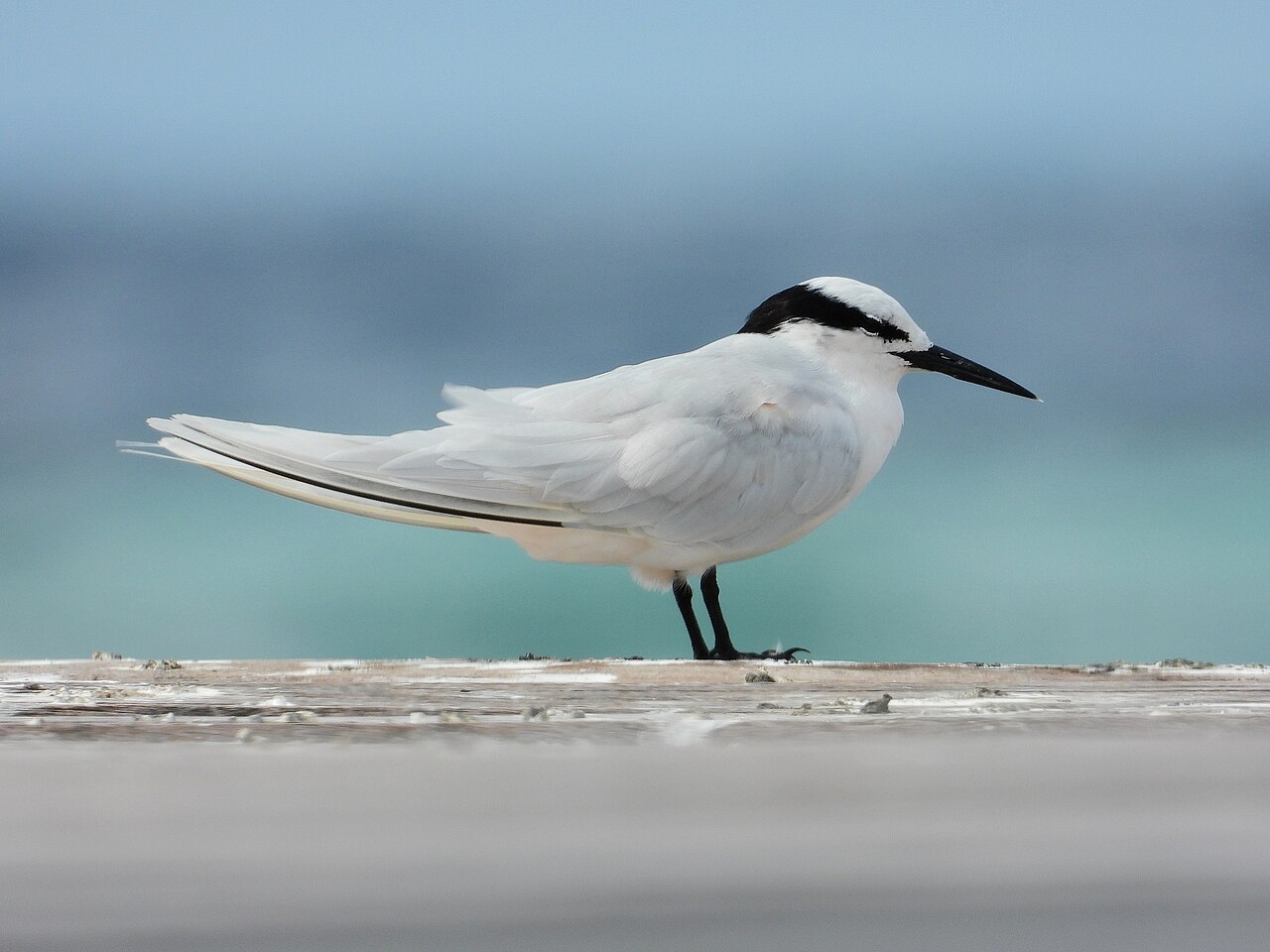
The Black-naped Tern is the tern of the coral: an ice-white bird with long tail streamers, hunting over turquoise lagoons and reef edges. It is the exception in a family of black-capped birds, because its crown is white; the black runs as a narrow band from one eye-line across the hindneck to the other. In this region it belongs to the sand cays of the Great Barrier Reef and the islets of Torres Strait.
Voice
The call is a high, sharp, short tseet, repeated by a bird working the reef edge. Unrest in a colony turns it into a rasping, rapid chit-chit-chitter with dozens of birds calling across one another. Between partners on the way to a fishing spot comes a softer, two-syllable contact note. Its voice is thinner and higher than that of the crested terns it shares the cay with, and often gives it away before the white shows over the water.
No freely licensed recording has been found for this species yet; what to listen for is described below.
Identification
A medium-sized tern of thirty to thirty-five centimetres, a good part of which is tail. The upperparts are very pale pearl-grey, the underparts white with a soft rosy flush early in the season; the tail is deeply forked and white, with long streamers. The face pattern decides it: a black line runs from the bill base through the eye and broadens across the back of the head into a black nape band, while forehead and crown stay white. Bill and legs are black. The wing is short (just over 21 cm), which makes the beat quick and a little fluttery; young birds carry dull brown scaling on the mantle and a vaguer nape band.
Confusion species
Roseate Tern (Sterna dougallii) uses the same coral cays and is just as pale with a black bill, but has a full black cap instead of a nape band, a red bill base when breeding, still longer white streamers and a stiffer, shallower wingbeat. Common Tern (S. hirundo) has a black cap down over the eye, greyer underparts and, in winter, a dark carpal bar. White-fronted Tern (S. striata) is larger, much longer-billed and does not reach the tropics. Greater Crested Tern (Thalasseus bergii), the standing neighbour on every cay, is almost twice as long with a heavy yellow bill and a shaggy crest. Blue-billed White Tern (Gygis candida) is wholly white, with a black eye-ring and a blue bill base, and has no black on the head at all.
Habitat
Coral cays, sandbanks, rocky islets and reef lagoons; it nests in a simple scrape in coral rubble or on a bare rock ledge, usually in small loose groups of a few dozen pairs. It feeds by dipping and with short shallow plunges along the reef edge and in the lagoon, generally within a few kilometres of the island. It is seldom far out over open ocean; the reef line is its world.
Where the bird is most often found, arranged by main group and formation.



Range and movements
The tropical coasts and islands of northern Australia: the cays of the Great Barrier Reef from the Capricorn and Bunker groups northward, the Coral Sea, Torres Strait, the Arafura Sea and the offshore islands of the Northern Territory and the Kimberley. Southward it barely passes the tropic. It is absent from New Zealand: over ten years six records there, against some three thousand in Australia.
- Resident
- dark = core range, pale = thinly spread
Where and when to look
Stand on a coral cay and look at the crown of every tern that passes: white means Black-naped Tern, black means all the others. The best time is the falling tide, when the birds work the reef edge as the water drains off the platform. On a boat trip between cays you usually see it shuttling low over the water from island to island, never far from land.
Conservation
Least Concern (LC): the range runs from East Africa into the Pacific and the species is fairly common throughout. The vulnerability lies in where it nests: low coral cays are exposed to cyclones and to high water as sea level rises, and a colony can vanish in a single storm. The cays are also exactly the islets where tourist boats land, and disturbance in the breeding season costs a whole season at once; introduced rats have done the same on a few islands.
Scientific name
Sterna sumatrana | Raffles, 1822
Sir Thomas Stamford Raffles described the species in 1822 as Sterna sumatrana, and since it remains in that genus author and year carry no parentheses. Sterna comes from Old English stearn, 'tern'. sumatrana simply means 'of Sumatra': the type locality is Sumatra, where Raffles was Lieutenant-Governor at the time. The Spanish name keeps that origin, while the Dutch and English names point at the black band on the hindneck — the character that separates it from every other tern at a glance.