All species › Passerines › Munias, parrotfinches, waxbills and allies › Black-throated Finch
Black-throated Finch | Poephila cincta
Gordelamadine | Diamante gorjinegro
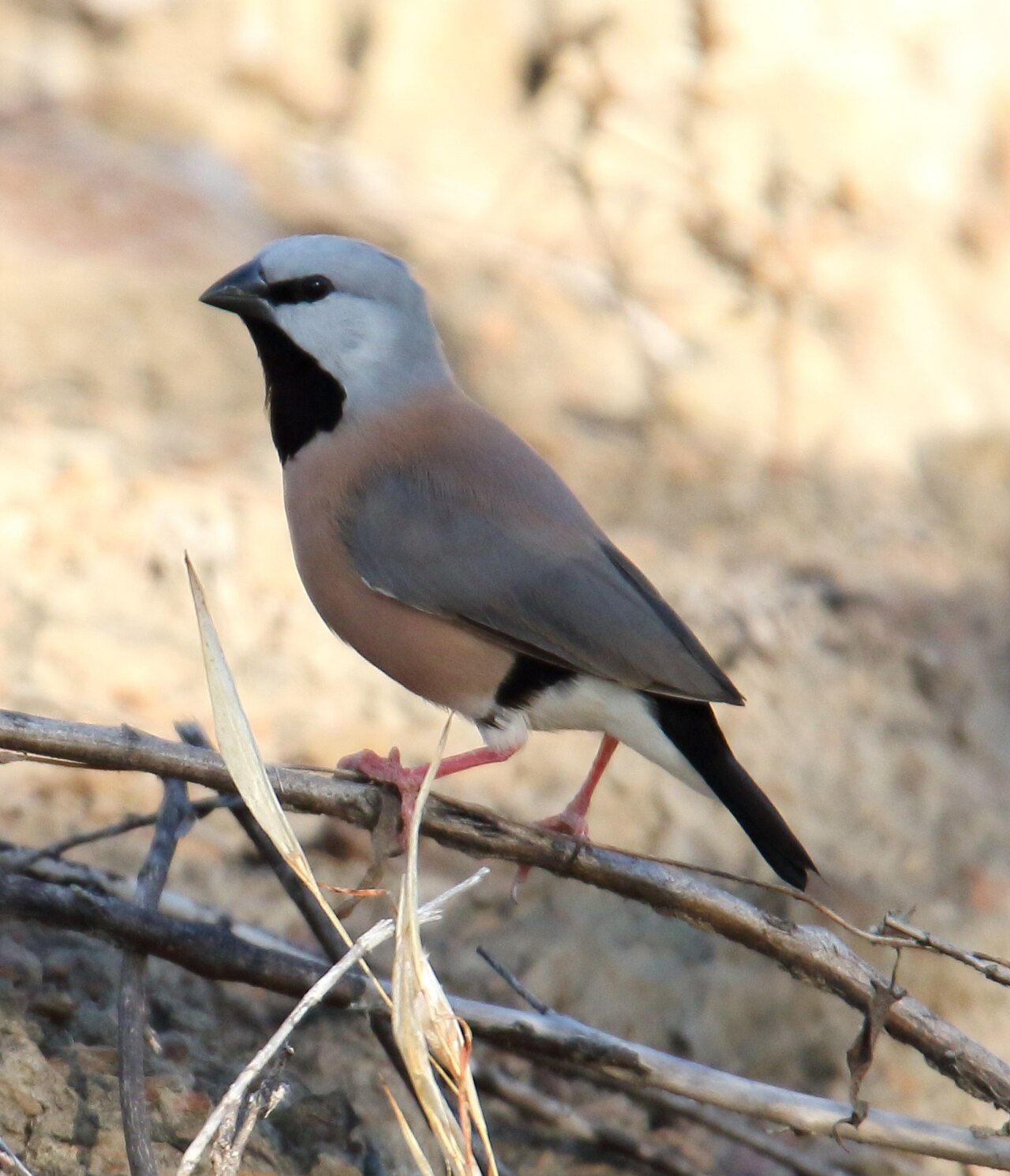
The Black-throated Finch is a small, grey-headed grassfinch of north-eastern Australia, named for the black throat bib that hangs under the chin like a belt. It lives year-round in small, chattering parties in grassy eucalypt woodland, never far from drinking water. In the south of its range it has declined so severely that the southern subspecies is among the most talked-about threatened birds in Australia.
Voice
The contact note is a clear, rather plaintive whistle that birds in a party call back and forth continuously — it usually gives the species away before the eye finds it. Alarm brings a short, dry note. The male's song is a soft, halting warble of squeaky and rattling notes delivered with the bill almost closed, audible only at close range; it is not a song that carries across a plain, but something muttered on a branch beside the female.
No freely licensed recording has been found for this species yet; what to listen for is described below.
Identification
A stocky little finch of ten centimetres and about fifteen grams. Head and neck are soft blue-grey, with a black lore and a broad black throat bib running from chin across the throat and cut off square below. The bill is short, conical and black — the key character within this trio. Back, wings and breast are warm cinnamon-brown, the belly paler, with a black flank patch separated from the brown breast by a white line. The rump is white in the southern subspecies and black in the northern one; the tail is black and short, squarely pointed, not elongated. Sexes alike; juveniles are duller, with a grey-black bill and a vague bib.
Confusion species
Tell the three grassfinches apart on bill colour and bib pattern. Long-tailed Finch (Poephila acuticauda) also has a grey head and a black bib, but at fifteen to sixteen centimetres is far longer thanks to the strongly elongated, finely pointed tail, and its bill is yellow or orange-red — never black. Masked Finch (Poephila personata) has a waxy yellow bill, a brown rather than grey head, and the black is confined to a mask round the base of the bill and the chin; it does not run as a broad band across the throat. Double-barred Finch (Stizoptera bichenovii) is smaller, has a white face framed in black and two black cross-bars, and lacks the grey head entirely.
Habitat
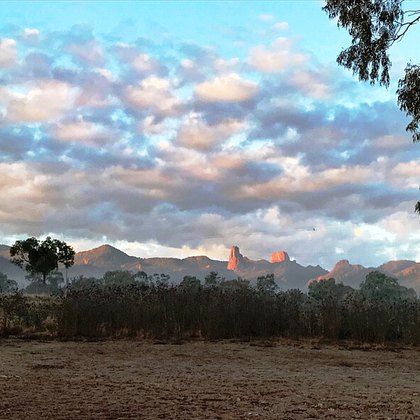
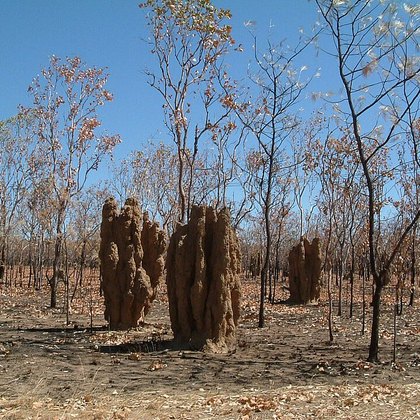
Open grassy eucalypt and melaleuca woodland with a continuous ground layer of perennial grasses, almost always within a few hundred metres of permanent drinking water. It also uses cleared grazing country with remnant trees, as long as seeding grass remains. Seed of perennial grasses is the staple; insects are added in the breeding season.
Where the bird is most often found, arranged by main group and formation.

Range and movements
North-eastern Australia. The northern subspecies atropygialis occupies Cape York south to about Townsville. The southern subspecies cincta originally reached from central Queensland to the upper Hunter valley in New South Wales, but is now almost entirely reduced to a remnant range around Townsville and Charters Towers; there have been no confirmed New South Wales records for decades.
- Resident
- dark = core range, pale = thinly spread
Where and when to look
Settle beside a stock dam or waterhole in grassy woodland in the late morning and wait: small parties of finches come in to drink briefly. Put the binoculars on the bill first — black makes it Black-throated Finch, yellow or red one of the other two.
Conservation
Least Concern (LC) as a species: the IUCN category in AviList 2025 is LC, largely on the strength of the northern subspecies. The story lies with the southern subspecies Poephila cincta cincta, the southern Black-throated Finch, listed as Endangered under Australia's EPBC Act. Its range has contracted by well over eighty per cent, it has gone from New South Wales, and its centre of gravity now lies on the Townsville coastal plain and at the edge of the Galilee Basin — where the proposed Carmichael coal project turned the bird into a national political issue. Pressures are clearing of grassy woodland, overgrazing that removes perennial grass seed, altered fire regimes, and loss of drinking water.
Scientific name
Poephila cincta | (Gould, 1837)
Gould described the species in 1837 as Amadina cincta, from birds of the interior of New South Wales (the upper Hunter River district); because it has changed genus, author and year stand in parentheses. Gould erected the genus Poephila in 1842: Greek poa 'grass' and philos 'loving', the grass-loving finches. cincta is Latin for 'girdled', after the black throat band. Two subspecies are recognised, white-rumped cincta in the south and black-rumped atropygialis on Cape York; some authors have treated them as separate species.