All species › Passerines › Munias, parrotfinches, waxbills and allies › Masked Finch
Masked Finch | Poephila personata
Maskeramadine | Diamante enmascarado
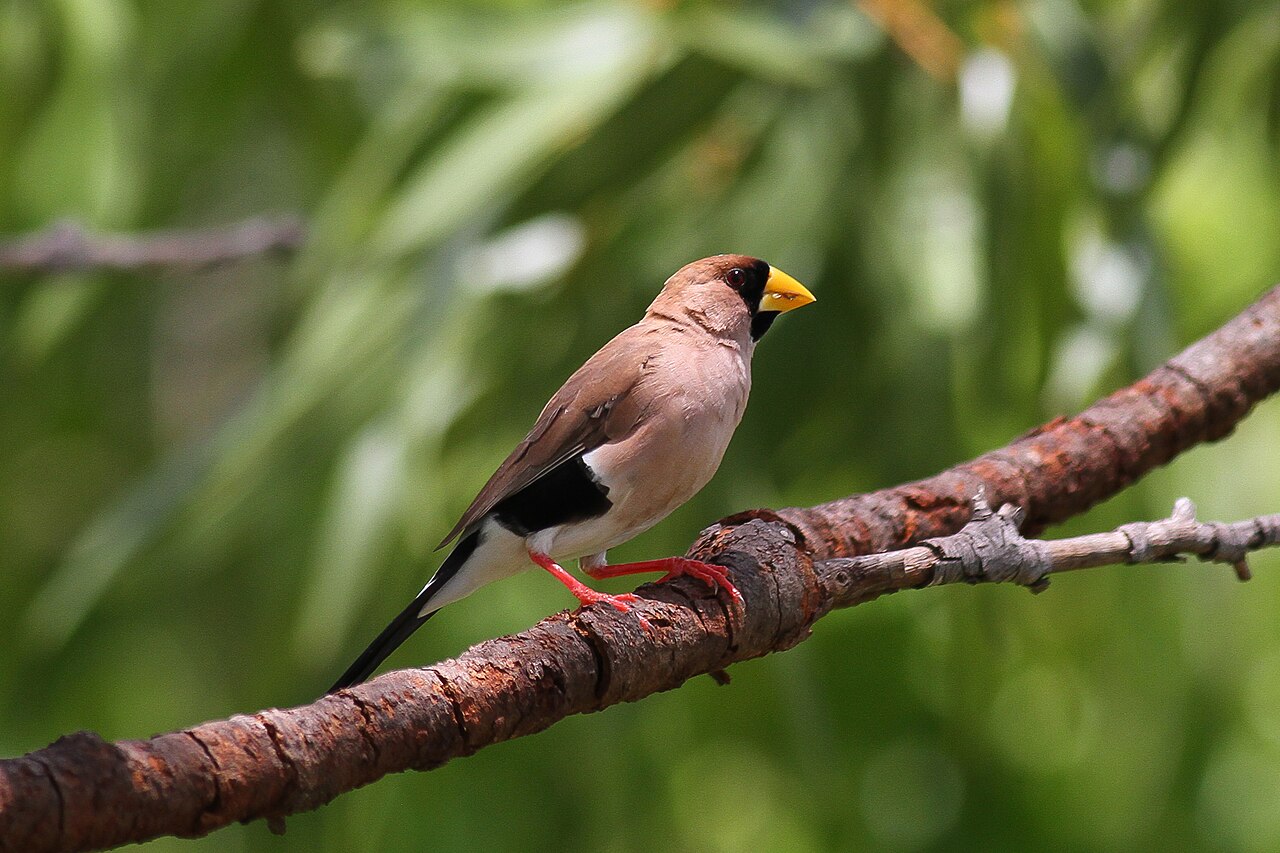
The Masked Finch is the grassfinch of the northern monsoon belt: a warm earth-brown bird with a conspicuous waxy yellow bill that juts from a black mask as though pushed into it. It shuffles about in parties on bare ground between the grass tussocks, often on recently burnt patches, and comes faithfully to the same waterholes right through the dry season.
Voice
The usual contact note is a nasal, slightly tinny call sounded constantly by a foraging party and speeded up on take-off. Disturbance brings a sharp, repeated tick. The song is soft and rambling: a run of scratchy, squeaky and clicking notes without fixed pattern, audible only from a few metres and usually given while the bird bobs on a low branch beside its mate.
No freely licensed recording has been found for this species yet; what to listen for is described below.
Identification
Twelve to thirteen centimetres and about thirteen grams, slightly larger and slimmer than Black-throated Finch. The whole plumage is warm earth-brown to cinnamon, head included — there is no grey cap. The black is confined to a mask covering lore, bill base, chin and the very top of the throat; it does not continue as a band across the throat. From it protrudes the short, thick, waxy yellow bill, the most striking feature at range. The belly is pale cream, with a black flank patch topped by a narrow white line; the rump is white and the black tail tapers to a point. Sexes alike. The Cape York subspecies leucotis has white ear-coverts and a paler face. Juveniles have a dark bill and a vague mask.
Confusion species
Black-throated Finch (Poephila cincta) has a blue-grey head, a broad black throat bib cut off square, and a black bill — never yellow. Long-tailed Finch (Poephila acuticauda) likewise has a grey head and a rounded black bib, and is clearly longer thanks to the elongated pointed tail; its bill is yellow or orange-red. In haste the yellow bill of a Masked Finch can be confused with that of a western Long-tailed Finch, but head contrast decides it: brown with a small black mask against grey with a large black bib. Double-barred Finch (Stizoptera bichenovii) is smaller, white-faced and double-barred.
Habitat
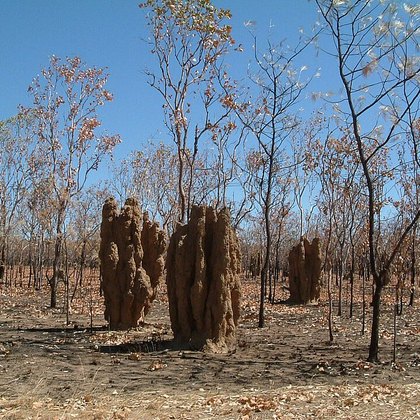
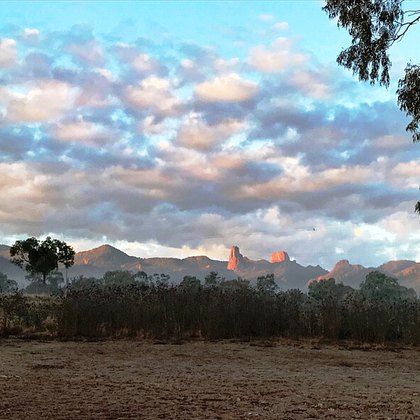
Tropical eucalypt savanna and grassy woodland, preferably with sandy or stony open ground between the tussocks; also rocky hillsides, rank growth along creeks and freshly burnt country, where fallen grass seed lies exposed. Always within reach of permanent water. It takes nearly all its food while walking on the ground, and adds many termites and other insects in the breeding season.
Where the bird is most often found, arranged by main group and formation.

Range and movements
The northern monsoon belt of Australia: from the Kimberley in Western Australia across the Top End of the Northern Territory to the Gulf country and Cape York in Queensland, home of the white-eared subspecies leucotis. In the east the range largely abuts that of Black-throated Finch without really overlapping it.
- Resident
- Winter
- dark = core range, pale = thinly spread
Where and when to look
Look for it walking on open ground, not in the trees: a party of brown finches tripping over recently burnt country in the Top End is almost always this species. The yellow bill shows in sunlight from a good distance. At the nest it is recognisable by the habit of carrying in charcoal and small pebbles.
Conservation
Least Concern (LC) and still locally numerous, but in parts of the Kimberley and Top End the species has genuinely declined. The causes are those affecting other grass-seed eaters of the northern savanna, the Gouldian Finch among them: fire too frequent and too late in the season, which replaces perennial grasses with annuals, and heavy grazing by cattle and feral ungulates, so that the seed supply fails in the late dry season. Management with cool early burns and the upkeep of drinking points works in its favour.
Scientific name
Poephila personata | Gould, 1842
Gould described the species in 1842 as Poephila personata, from birds at Borroloola in the Northern Territory; author and year stand without parentheses because it has never changed genus. Poephila is Greek poa 'grass' and philos 'loving'; personata is Latin for 'masked', from persona, the actor's mask. English and Dutch names follow the same image. The Cape York subspecies leucotis, with white ear-coverts, was formerly treated as a separate species, the White-eared Finch.