All species › Passerines › Munias, parrotfinches, waxbills and allies › Beautiful Firetail
Beautiful Firetail | Stagonopleura bella
Vuurstaartastrild | Diamante hermoso
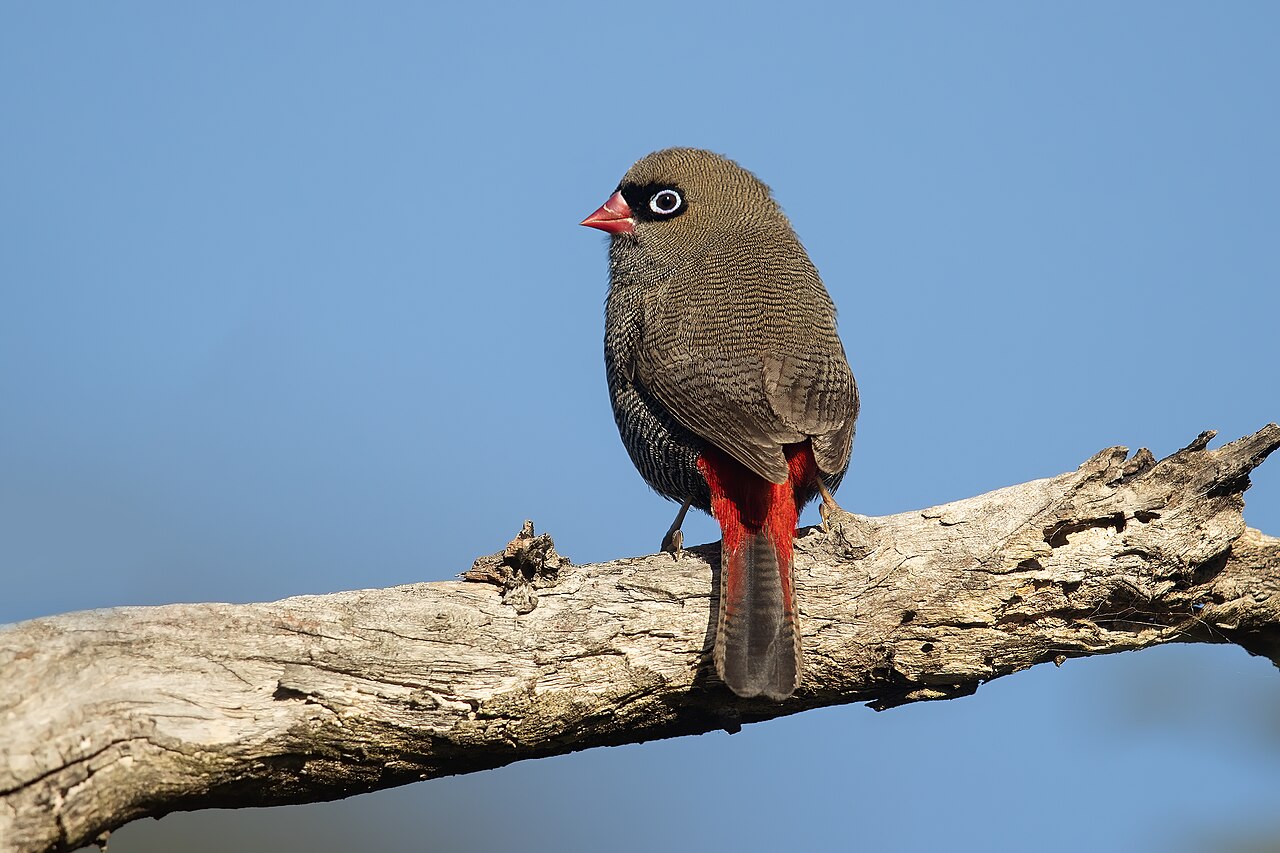
The Beautiful Firetail is the waxbill of the cool, wet south-east coast and of Tasmania: an unobtrusive olive-brown bird that gives up its fine markings only in good light — the whole plumage finely rippled with black, a black mask, a pale blue eye-ring, a coral-red bill and a crimson rump that flares like a spark as it flies off.
Voice
The call is a long drawn-out, mournful, pure whistle on one note that slowly fades; it carries well through dense scrub and is usually the first sign of the species. There is also a short sharp contact tick used between members of a pair. The male's song is soft, high and hard to hear: a series of reedy whistles with a few rattling notes among them, delivered during a display on a branch with a grass stem in the bill.
No freely licensed recording has been found for this species yet; what to listen for is described below.
Identification
Twelve centimetres and about fourteen grams. The whole body, above and below, is olive-brown to grey-brown with dense, fine black barring, which close up looks like a ripple pattern and at range blurs into dull grey-brown. A black mask covers the lore and surrounds the eye; the bare eye-ring is pale sky-blue and the short thick bill coral-red. Rump and uppertail-coverts are crimson, the tail black. The male has a black patch in the centre of the belly; the female's belly is greyish with the black patch small or absent — one of the few waxbills in which the sexes can be separated in the field. Juveniles are duller, without a mask and with a blackish bill.
Confusion species
Red-eared Firetail (Stagonopleura oculata) looks strikingly similar — same barring, black mask, red bill and red rump — but has a scarlet patch on the ear-coverts and black, densely white-spotted underparts; it also lives only in south-west Australia, so the two never meet in the field. Diamond Firetail (Stagonopleura guttata) is bulkier, white on throat and belly, with a broad black breast band, large white flank spots and a red eye-ring, and keeps to dry grassy woodland instead of wet heath. In Tasmania the Beautiful Firetail is the only native waxbill; a small brown finch with a red rump there is always this species. On the mainland Red-browed Finch (Neochmia temporalis) can be similar in shape, but has a red eyebrow stripe and no barring.
Habitat
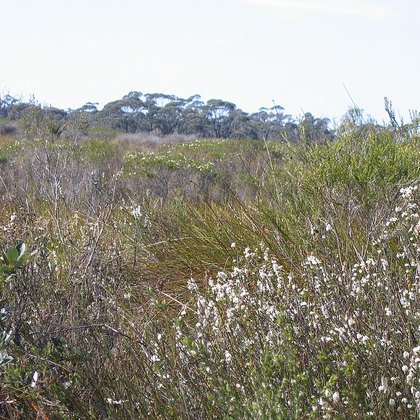
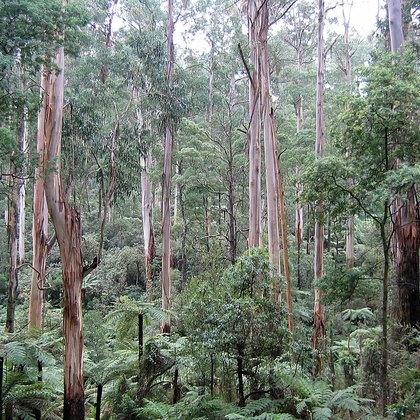
Coastal heath, tea-tree and banksia scrub, sedgeland and the wet, dense gullies and forest edges of the cool south-east, often around swampy hollows and along small creeks. It keeps low in the scrub and takes the seed of grasses, sedges and heath plants, usually straight from the stem. The nest is a large bottle-shaped ball of grass, low in dense shrubs.
Where the bird is most often found, arranged by main group and formation.


Range and movements
South-eastern Australia: the coastal strip of New South Wales from roughly the Sydney district southwards, all of coastal Victoria and its moist highlands, the south-east of South Australia and the Mount Lofty Ranges, and Tasmania with the Bass Strait islands. Tasmania holds by far the larger part of the population; on the mainland the distribution is fragmented.
- Resident
- dark = core range, pale = thinly spread
Where and when to look
Walk a track through coastal heath or a wet gully at the forest edge and listen for the long mournful whistle; in Tasmania it can be heard on almost any patch of heath. If a small dark finch flushes from a bush, watch its back: the red rump against dull brown is unmistakable. Sexing needs a clear view of the belly.
Conservation
Least Concern (LC), but the picture has two halves. In Tasmania and on the Bass Strait islands the species is widespread and locally common. On the mainland it fares less well: populations in Victoria, New South Wales and especially South Australia are fragmented and thinning, and in South Australia it is listed as threatened under state legislation. The causes are clearing and draining of coastal heath and swampy hollows, coastal urban expansion, and fire too frequent to let the dense shrub layer and the seed-bearing heath plants recover.
Scientific name
Stagonopleura bella | (Latham, 1801)
Latham described the species in 1801 as Loxia bella, with New Holland — in practice Sydney — as the type locality; because of the change of genus, author and year stand in parentheses. The genus Stagonopleura is Reichenbach's (1850), Greek stagon 'drop' and pleura 'flank'. bella is simply Latin for 'beautiful', a judgement carried over into the English name. The Dutch name vuurstaartastrild refers instead to the glowing red rump and uppertail-coverts, which gave the whole English group name 'firetails'.