All species › Passerines › Munias, parrotfinches, waxbills and allies › Diamond Firetail
Diamond Firetail | Stagonopleura guttata
Diamantastrild | Diamante moteado
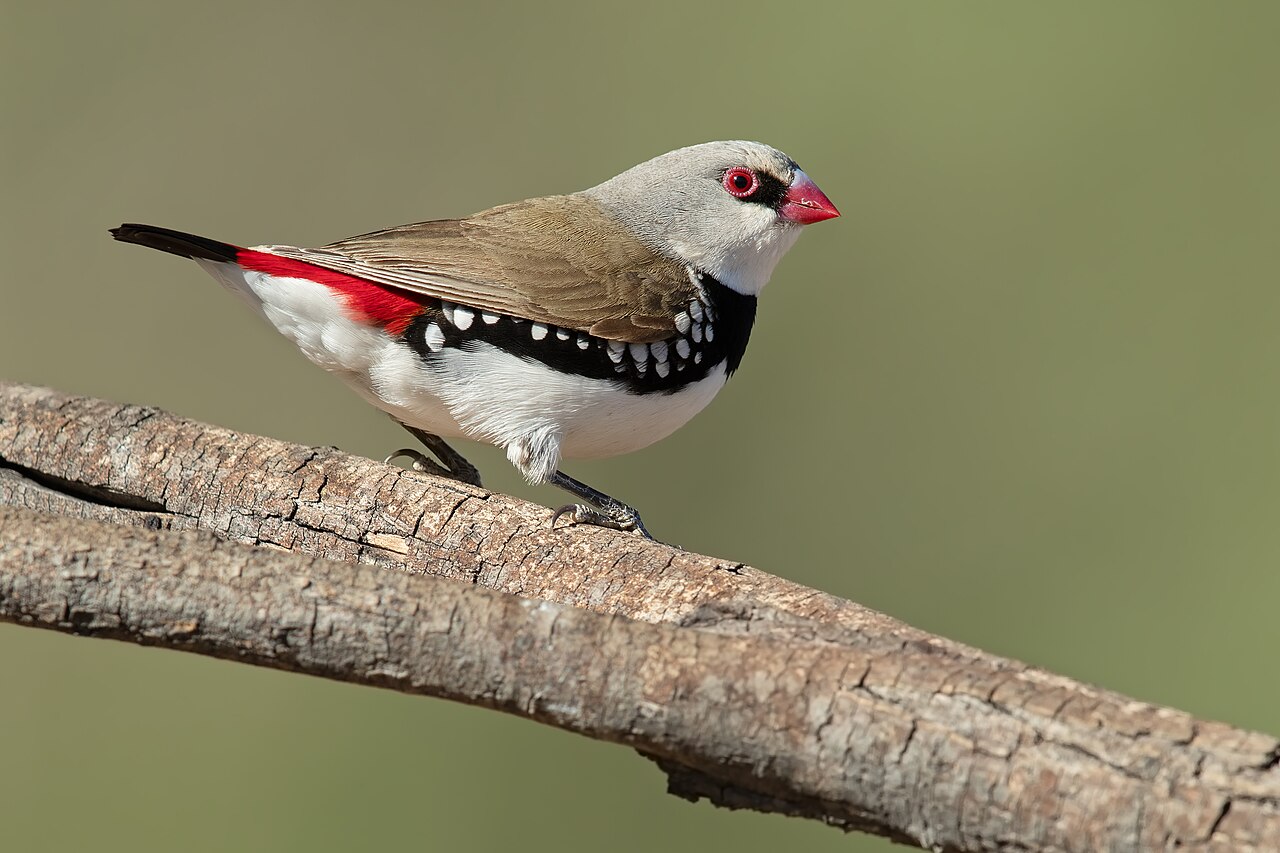
The Diamond Firetail is the largest and heaviest-built of the Australian firetails, and with its crimson bill, red eye-ring, fiery red rump and the row of white 'diamonds' on black flanks also the most striking. It belongs to the grassy eucalypt woodland of the south-east — a landscape so thoroughly cleared that the bird is now rated Vulnerable.
Voice
The voice is as distinctive as the plumage: a long drawn-out, nasal and mournful bleat, roughly a stretched 'twoo-heee', repeated slowly and carrying far across open woodland. It sounds sad rather than musical and often gives the bird away on a bare branch. The male's song is a soft, extended version of the same note with a few scratchy additions, delivered during a display in which he bobs up and down with a grass stem in his bill.
No freely licensed recording has been found for this species yet; what to listen for is described below.
Identification
Twelve centimetres and nearly eighteen grams: a short, thick, rounded bird that suggests a small bunting more than a waxbill. The head is grey, the back grey-brown, throat and underparts pure white. A broad, sharply defined black band crosses the upper breast and continues on either side into black flanks bearing two or three rows of round white spots — the diamonds of the name. Bill and eye-ring are bright crimson; rump and uppertail-coverts are scarlet, the tail black. Sexes look alike. Juveniles have a black bill, lack the breast band and show dull, poorly marked flanks.
Confusion species
Within the genus confusion is largely theoretical, since the ranges barely overlap. Beautiful Firetail (Stagonopleura bella) of the south-east coast and Tasmania lacks the black breast band entirely, is finely barred black all over instead of white-spotted, has a pale blue rather than red eye-ring, and the male carries a black belly patch. Red-eared Firetail (Stagonopleura oculata) of south-west Australia has a scarlet ear patch, a black face and finely white-speckled black underparts without any breast band. Outside the genus, Red-browed Finch (Neochmia temporalis) is similar in shape but has a red eyebrow stripe, grey underparts and no rows of spots at all. Double-barred Finch (Stizoptera bichenovii) is much smaller, white-faced with a black frame, and lacks the red rump.
Habitat
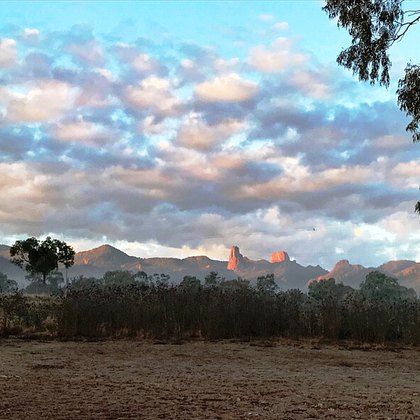
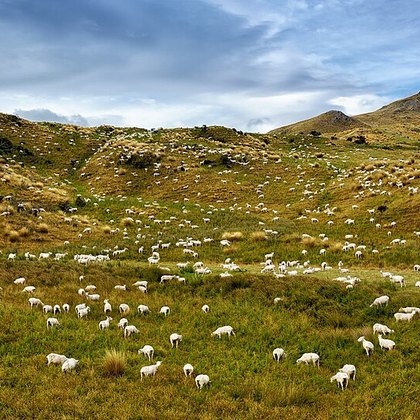
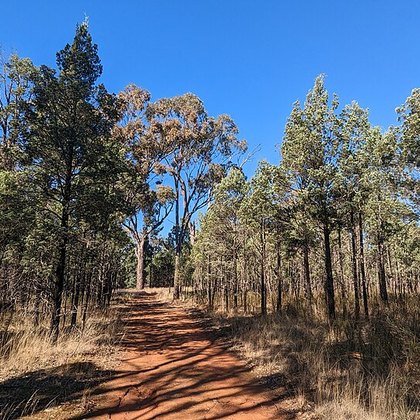
Grassy eucalypt woodland and open forest of the temperate south-east, with a ground layer of seeding grass; also mallee, casuarina and cypress-pine woodland, and farmland with remnant trees, roadside strips and shelterbelts. It drinks daily and therefore stays near dams, creeks and troughs. The nest is a large bottle-shaped ball of grass stems, often in a dense shrub or a clump of mistletoe, or even in the underlayer of a raptor's nest.
Where the bird is most often found, arranged by main group and formation.

Range and movements
South-eastern Australia, from the central Queensland coast through the inland and coastal districts of New South Wales and Victoria to the Mount Lofty Ranges and Eyre Peninsula in South Australia. It is absent from Tasmania and from the wettest coastal country; the stronghold lies on the western slopes and inland of New South Wales and Victoria.
- Resident
- dark = core range, pale = thinly spread
Where and when to look
Look for it not in dense forest but on the edge between grassy woodland and open farmland, often along a roadside strip of old eucalypts. The long mournful bleat from a dead branch is the best way to find it; once the call is known, the bird is heard before it is seen. A party flying to a stock dam shows the fiery rump on the way.
Conservation
AviList 2025 gives the species as Vulnerable (VU), a recent uplisting — it was long rated Least Concern. It has declined sharply across much of its range and is also listed as threatened or vulnerable under state legislation in New South Wales and Victoria. The cause is almost entirely the loss of temperate grassy eucalypt woodland: that landscape is the most heavily cleared vegetation type in south-eastern Australia, and what remains is fragmented, heavily grazed and invaded by exotic grasses that yield less usable seed. On top of this come nest predation by feral cats and foxes and, historically, trapping for aviculture.
Scientific name
Stagonopleura guttata | (Shaw, 1796)
Shaw described the species in 1796 as Loxia guttata, from a specimen in Sir Ashton Lever's collection with Australia — in practice Sydney — as the type locality; because of the change of genus, author and year stand in parentheses. Reichenbach erected the genus Stagonopleura in 1850: Greek stagon 'drop' and pleura 'side, flank', after the drop-shaped white spots on the flanks. guttata says the same in Latin, from gutta 'drop'. Both the English name Diamond Firetail and the Dutch diamantastrild refer to those spots, the English one also to the fiery rump.