All species › Passerines › Munias, parrotfinches, waxbills and allies › Red-eared Firetail
Red-eared Firetail | Stagonopleura oculata
Roodoorastrild | Diamante orejirrojo
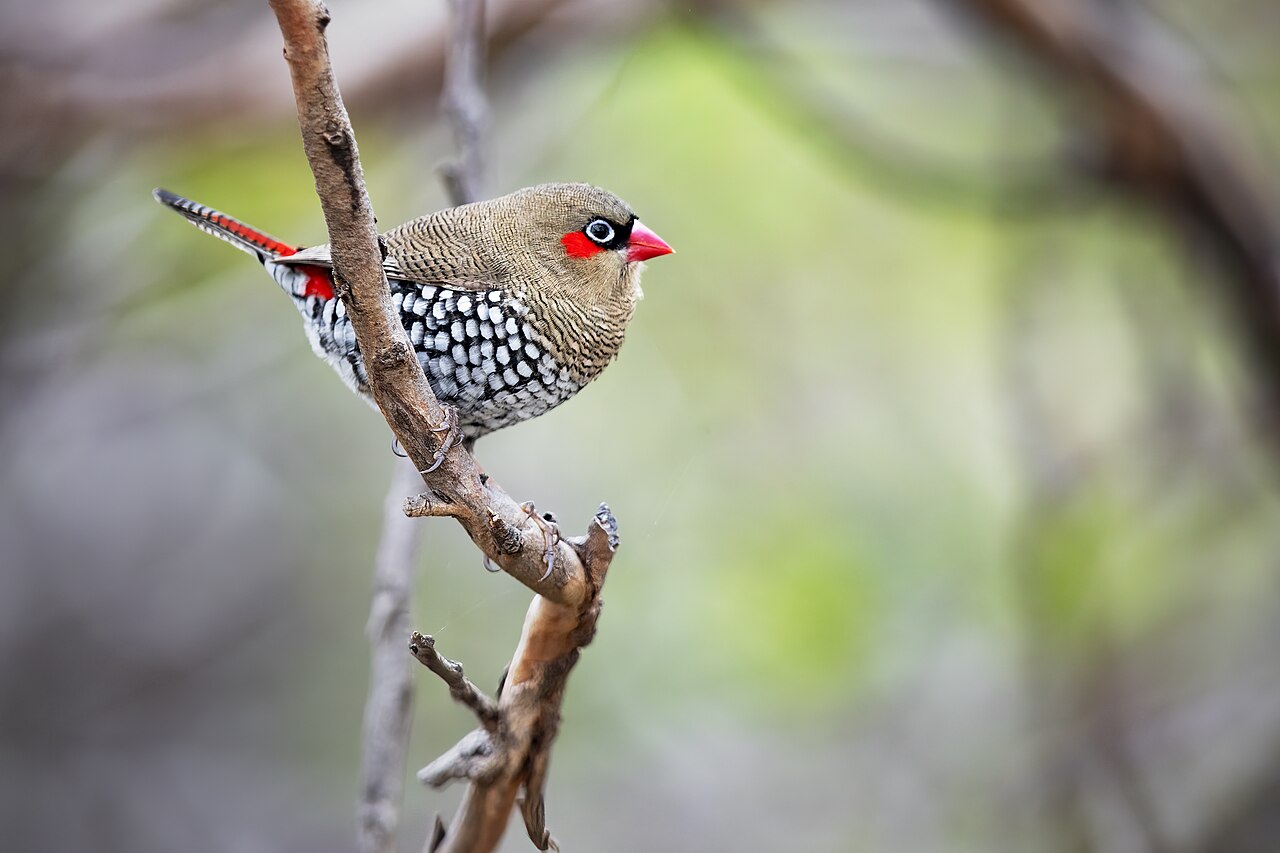
The Red-eared Firetail is the waxbill of the wet south-west corner of Australia and occurs nowhere else on earth. It is a shy, quiet bird of dense scrub beneath karri and jarrah, more often heard than seen: finely black-barred olive-brown, with a black face, a scarlet spot on the ear-coverts and a fiery red rump.
Voice
The call is one of the thinnest and highest of any Australian songbird: a long, reedy whistle that fades away, roughly a soft oo-weeee, hard to locate in thick scrub and often missed by beginners or taken for an insect. It is almost the only sound the species makes; the male's song is little more than a softer, slightly varied version of that whistle, with a few scratchy notes added at close range.
Recording: Louis Masarei — CC BY-NC-SA 4.0 · Arpenteur Nature Reserve, Cheynes Beach, Western Australia, Australia · xeno-canto
Identification
Twelve centimetres and nearly thirteen grams. The upperparts are dark olive-brown and finely barred black throughout, which at range reads as a dull, rippled grey-brown. The face is black, and behind it on the ear-coverts sits a scarlet patch carried by adults only. The bill is crimson, the bare eye-ring pale blue-grey. Rump and uppertail-coverts are bright crimson, the tail black. The underparts are blackish and densely covered with small round white spots that continue onto the belly. Sexes are near-identical; the female's ear patch averages smaller. Juveniles lack the red ear patch and have a black bill.
Confusion species
Within the genus, Beautiful Firetail (Stagonopleura bella) is the closest match — also finely barred, with a black mask, a red bill and a red rump — but it lacks the scarlet ear patch entirely, has lightly barred rather than white-spotted underparts, and occurs only in the south-east and Tasmania; the ranges lie thousands of kilometres apart, so confusion does not arise in the field. Diamond Firetail (Stagonopleura guttata) has white underparts with a black breast band and large white flank spots, and does not reach the south-west. Within south-west Australia there is no other small finch with a red rump, which makes the species effectively unmistakable there once seen well.
Habitat
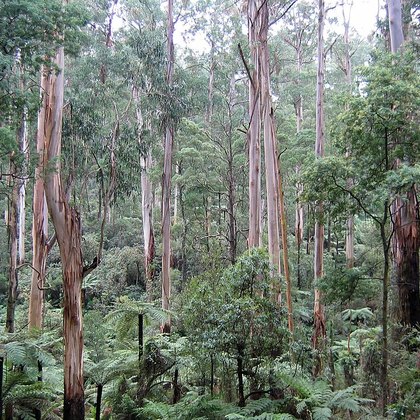
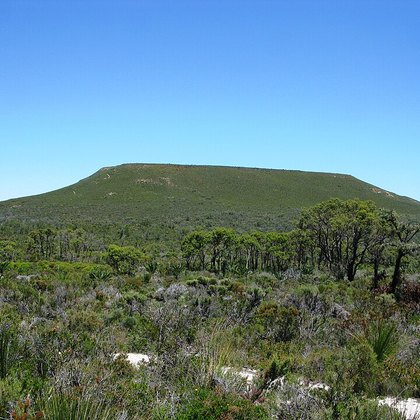
Dense understorey in the wet forest of the far south-west: karri and jarrah forest with a closed shrub layer, thickets along creeks and rivers, paperbark swamps, and the densest parts of the coastal heath and dune scrub. It stays low and under cover almost throughout and rarely comes into the open. Food is grass seed and the seed of sedges and shrubs, often taken directly from the stem.
Where the bird is most often found, arranged by main group and formation.


Range and movements
Endemic to the far south-west of Western Australia, roughly from the Avon valley north-east of Perth south to Albany and from there east along the coast to Cape Arid. The whole range fits into a belt a few hundred kilometres wide; the species has never been recorded outside it.
- Resident
- dark = core range, pale = thinly spread
Where and when to look
Stand at first light beside a thickly vegetated creek in karri or jarrah forest and listen for the thin, fading whistle; move as little as possible. A second good spot is the edge of a drinking place in dense heath, where it comes briefly into the open. If it flies off, watch for the red rump against the dark undergrowth.
Conservation
Least Concern (LC), but a status resting on a small range: the entire world population sits in the south-west corner of Western Australia. In the forested core, with large continuous reserves of karri and jarrah, the species is secure. Along the northern and eastern margin, against the wheatbelt, it has gone from many places through the clearing and draining of scrub and swamp and through fires too frequent to let the dense understorey it needs persist. Keeping a closed shrub layer along creeks is the most effective management.
Scientific name
Stagonopleura oculata | (Quoy & Gaimard, 1832)
Quoy and Gaimard described the species in 1832 as Fringilla oculata, from birds at King George's Sound near present-day Albany, collected on the voyage of the corvette l'Astrolabe; because of the change of genus, author and year stand in parentheses. The genus Stagonopleura is Reichenbach's (1850), Greek stagon 'drop' and pleura 'flank'. oculata is Latin for 'provided with eyes' or 'with eye-spots', after the conspicuous red mark on the ear-coverts — the same image carried by the Dutch name roodoorastrild and the English Red-eared Firetail.