All species › Passerines › Munias, parrotfinches, waxbills and allies › Double-barred Finch
Double-barred Finch | Stizoptera bichenovii
Bichenows astrild | Diamante de bicheno
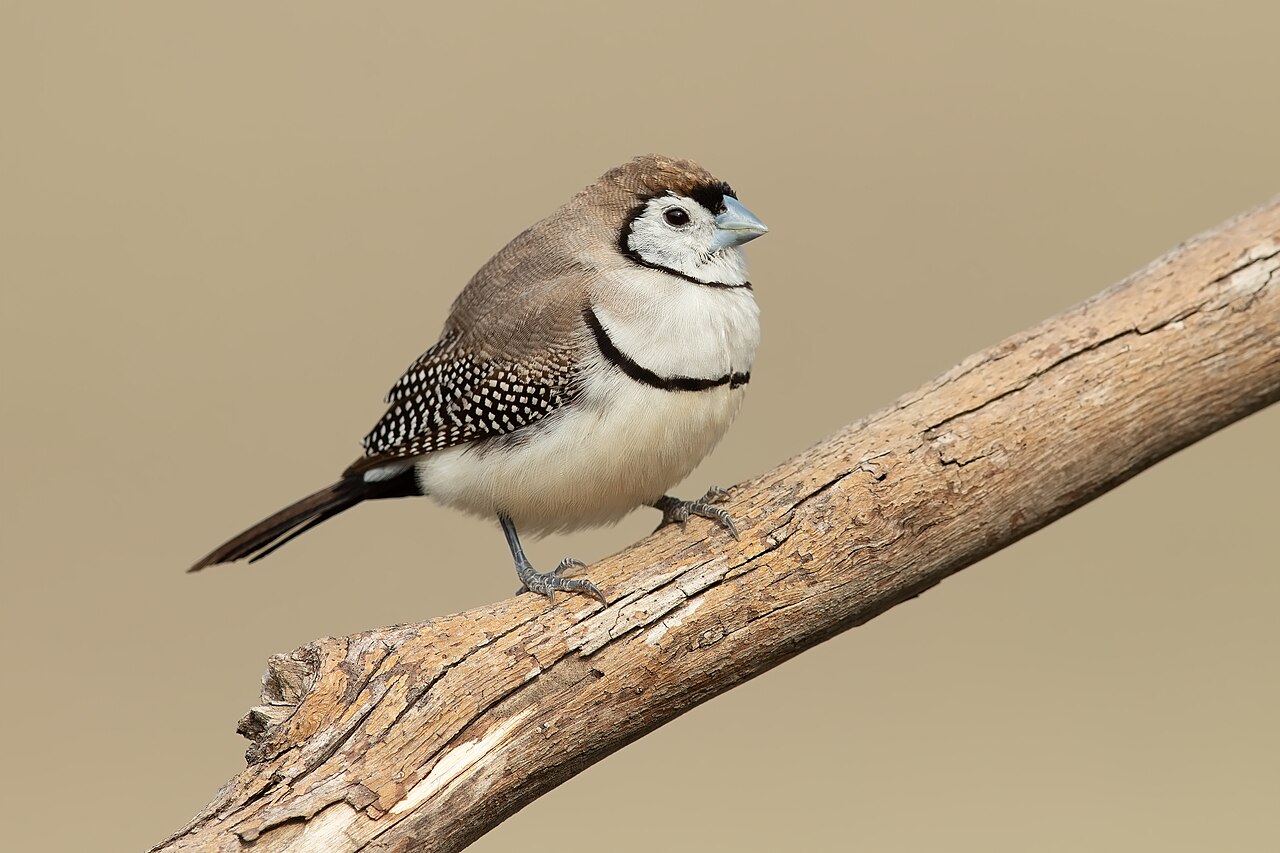
The Double-barred Finch is the smallest finch in this company and at the same time the easiest to recognise: a white face, neatly framed in a black border, and a second black cross-bar over the lower breast. Those two bars gave it its English name, and the white face its aviary name, Owl Finch. It is spread over half of Australia and comes right into country gardens.
Voice
The contact note is a soft, nasal, slightly tinny call, given continuously by a party and running into a rapid series on take-off; it is the sound by which the species is traced in rank grass. There is also a shorter, sharper tick when alarmed. The male's song is a soft, rambling affair of scratchy and squeaky notes, audible over a few metres at most, delivered while he bobs on the branch with a grass stem in his bill.
No freely licensed recording has been found for this species yet; what to listen for is described below.
Identification
Ten to eleven centimetres and under ten grams — noticeably smaller and rounder than the grassfinches and the Stagonopleura firetails. The face, from forehead to chin and cheek, is white, enclosed by a narrow black border running from the forehead down past the cheek to the throat. A second sharp black bar crosses the lower breast. Crown and back are grey-brown, the wings dark brown with rows of fine white spots, the underparts white to cream, the tail black and the short bill blue-grey. The eastern subspecies bichenovii has a white rump, the northern annulosa of the Top End and Kimberley a black one. Sexes alike; juveniles have a vague face pattern and a dull, incomplete breast bar.
Confusion species
Within the wider waxbill family it shares the stocky build, the short conical bill and the habit of feeding on the ground in parties with the Stagonopleura and Poephila species, and on silhouette alone they can indeed look alike. Once the pattern shows, confusion ends: the three Stagonopleura firetails have a red bill and a red rump, the three Poephila grassfinches a black throat bib or a black mask, and none of the six has a white face framed in black or a second black bar across the breast. Juveniles without clear markings most resemble a young Zebra Finch (Taeniopygia guttata), but that bird has a black-and-white barred tail and a straighter, reddening bill as it matures, while the Double-barred Finch's tail stays plain black.
Habitat
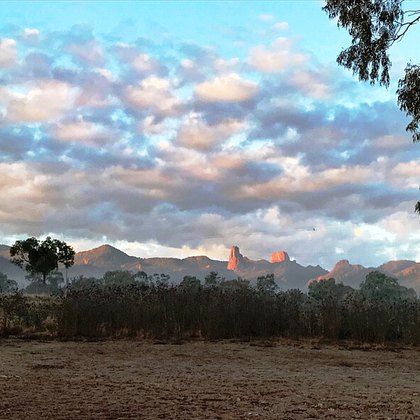
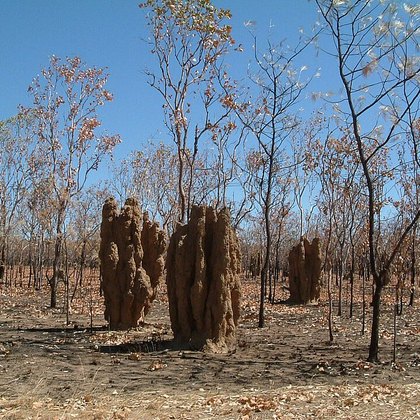
Grassy eucalypt woodland and tropical savanna, rank growth and tall grass along creeks, and dense scrub at the edge of open country; it is also well adapted to modified land: paddocks with stock troughs, road verges, farm plantings, parks and gardens on the edge of settlement. It drinks daily and therefore stays close to water. Food is almost entirely grass seed, topped up with insects in the breeding season; the nest is a bottle-shaped ball of grass, low in a dense shrub or a thorny tree.
Where the bird is most often found, arranged by main group and formation.


Range and movements
Northern and eastern Australia. The northern subspecies annulosa, black-rumped, occupies the Kimberley and the Top End; the white-rumped nominate form runs from Cape York through Queensland and New South Wales south to about the Victorian border, and inland as far as woodland persists before the dry interior. Intergrades occur where the two forms meet.
- Resident
- dark = core range, pale = thinly spread
Where and when to look
Walk a creek with rank grass or a stock fence with a trough and watch for small finches flying low and undulating away on a black tail; as they land they turn the white face towards you and the matter is settled at once. In the east it is one of the few waxbills that will simply come onto a country lawn to look for seed.
Conservation
Least Concern (LC): the species is widespread, numerous and one of the few Australian waxbills that copes well with cleared country, as long as rank grass, drinking water and dense shrubs remain. It has declined locally in intensively cropped districts of New South Wales, where both the seeding ground layer and the nesting cover disappear. It is also a common aviary bird; present stock comes from captive-bred lines, so there is no trapping pressure on wild birds.
Scientific name
Stizoptera bichenovii | (Vigors & Horsfield, 1827)
Vigors and Horsfield described the species in 1827 as Fringilla Bichenovii, from birds at Shoalwater Bay and Broad Sound in Queensland; because of the change of genus, author and year stand in parentheses. The specific name honours James Ebenezer Bicheno (1785–1851), English naturalist and later Colonial Secretary of Van Diemen's Land, today's Tasmania — which is what the Dutch name Bichenows astrild preserves. The genus Stizoptera was erected by Oberholser in 1899, from Greek stizo 'to prick, to spot' and pteron 'wing', after the finely white-spotted wing. The species has been placed in turn in Poephila, Taeniopygia and Stizoptera; AviList 2025 keeps it in its own genus Stizoptera, while older literature and datasets such as AVONET still carry it under Taeniopygia.