All species › Passerines › Munias, parrotfinches, waxbills and allies › Zebra Finch
Zebra Finch | Taeniopygia guttata
Soendazebravink | Diamante cebra de timor
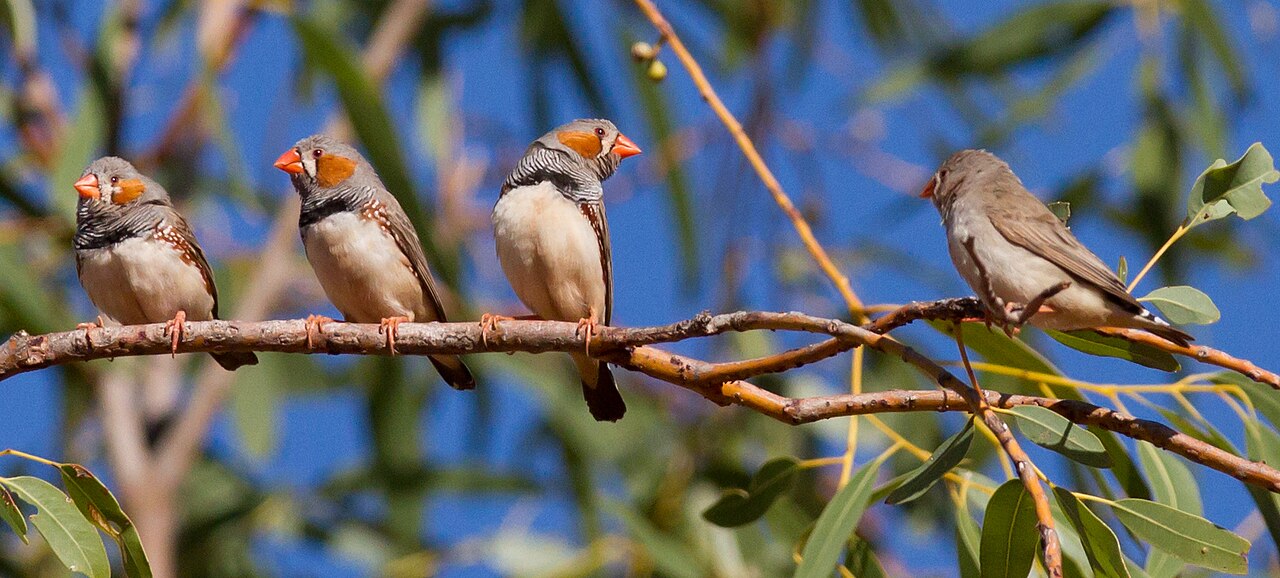
The Zebra Finch is the smallest and most numerous finch of the dry Australian interior: a grey bird with a bright red bill, a black tear stripe, an orange-chestnut cheek patch and a black-and-white barred tail base, which drops in at troughs and stock dams in flocks of tens to hundreds. Outside Australia it is, besides, the best studied songbird in the world.
Voice
The sound most often heard is a nasal, slightly plaintive meep or tya, called by dozens of birds at once in a flock and therefore sounding like a continuous tinny chatter — from hundreds of metres away the best sign that there is drinking water nearby. The song, given only by the male, is a short rhythmic motif of a few seconds: a run-up of identical chek notes followed by a fixed series of buzzes, rattles and whistles, slightly different in every male and unchanged for the rest of his life. Each young male learns that motif by copying an adult bird around him — exactly why this species has such a large part in research on how birds and people learn to speak.
No freely licensed recording has been found for this species yet; what to listen for is described below.
Identification
A small, stocky finch of about ten centimetres with a short tail and a thick coral-red bill. The male is grey on head and back, with a narrow black line running down from the eye like a tear, a warm orange-chestnut cheek patch behind it, and a finely black-and-white barred throat and upper breast ending below in a broad black breast band. The flanks are chestnut with round white spots, the belly white, the uppertail coverts black with white bars. The female has none of this: she is plain grey-brown with only the black tear stripe, a white belly and a paler orange bill, and is far less conspicuous. Juveniles resemble the female but have a black bill. The barred black-and-white tail base is present in both sexes and is the mark the scientific name refers to. Birds of the Lesser Sunda Islands have finer breast barring without the broad black band and are slightly smaller.
Confusion species
Double-barred Finch (Stizoptera bichenovii) is the species that most resembles the Zebra Finch within the same country: small too, and in flocks on the ground too, but with a white face framed by a thin black line, two black bars across the breast, and no orange cheek patch, no red bill and no black tear stripe. The grassfinches of the genus Poephila are clearly larger, sandy brown, with a black throat patch and a long tail. Females and juvenile Zebra Finches, which lack all the colour, are the hardest: hold then to the black tear stripe below the eye, which they do keep, and to the black-and-white barred uppertail coverts that flash briefly in flight. Watch also for escaped cage birds: the species is kept worldwide in enormous numbers and has colour forms — white, pied, fawn — that do not exist in the wild.
Habitat
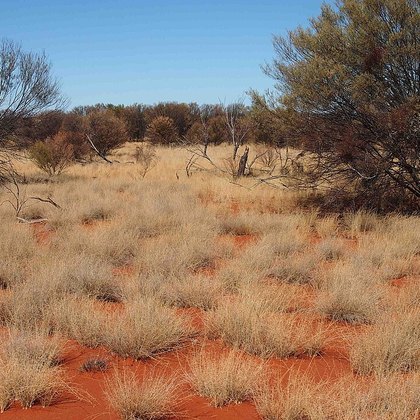
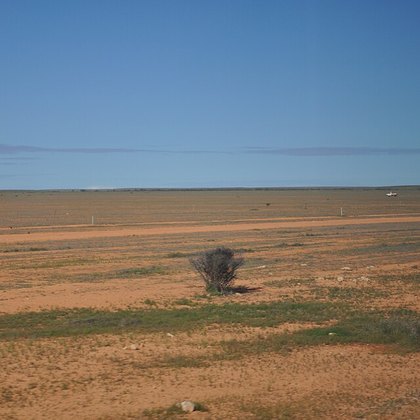
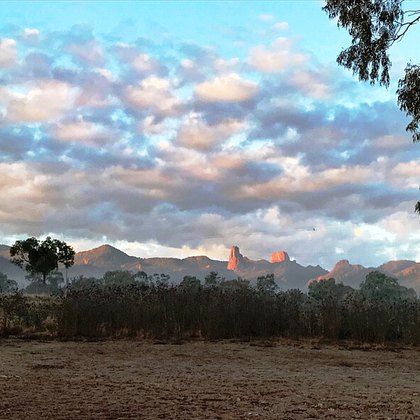
Dry, open country: grass plains of Mitchell grass, saltbush and bluebush flats, mulga and acacia scrub, spinifex, open eucalypt savanna, and in settled country pasture, farmyards and the edges of towns. The one hard requirement is drinking water: the bird eats almost nothing but dry grass seed and must therefore drink daily, so it stays near pools, stock troughs, dams and bores. It is precisely the provision of stock watering points by the pastoral industry that has made it more numerous inland than it naturally was. The domed grass nest is built in a low shrub, in a hollow, in another bird's old nest or simply inside a fence post.
Where the bird is most often found, arranged by main group and formation.



Range and movements
Virtually the whole Australian mainland, centred on the dry interior; it is missing only from the wet coastal districts of the far north, east and south-west, and from Tasmania. The species also occurs on Timor and the other Lesser Sunda Islands, home to the form from which the Dutch name soendazebravink is taken. It is not established in New Zealand. Elsewhere in the world escaped cage birds have formed local self-sustaining populations, among others in Portugal and Puerto Rico. Within Australia it does not migrate but wanders over great distances after rain, and it starts breeding as soon as rain has fallen, whatever the season.
- Resident
- dark = core range, pale = thinly spread
Where and when to look
In the dry interior, stand by a stock trough or a dam late in the morning and wait a quarter of an hour: the tinny nasal chatter is audible well in advance and the flock comes in waves, drinks in seconds and is gone again. Within that flock, look at the ratio of plain grey birds to birds with the orange cheek: the first group is females and juveniles, the second males. To hear the song you must get close — a singing male can be followed well from about ten metres.
Conservation
Least Concern (LC), and one of the most numerous birds in Australia; there is no sign whatever of decline. The species is remarkable for another reason as well: no songbird has been studied so thoroughly. It breeds readily in captivity and learns its song from a tutor, which has made it the standard model since the 1960s in research on how an animal acquires a sound pattern — work that bears directly on human language development. In 2010 its complete genetic material was published, the second bird after the chicken. Note that the checklist this guide follows carries no Red List category for the Zebra Finch, because different works draw the boundary between the Australian and the Sunda birds differently; both forms are assessed as Least Concern on the world list.
Scientific name
Taeniopygia guttata | (Vieillot, 1817)
Vieillot described the species in 1817 as Fringilla guttata, from a bird said to come from the Moluccas but in fact from Timor. Because it has moved to another genus, author and year stand in parentheses. The genus Taeniopygia is Greek for 'band-rump', after the black-and-white barred uppertail coverts, and guttata is Latin for 'spotted', after the white spots on the flanks. The taxonomy here is unsettled: several works now split the Australian birds off as Taeniopygia castanotis, the Australian Zebra Finch, leaving Taeniopygia guttata for the birds of Timor and the Lesser Sundas — hence the Dutch name soendazebravink beside the plain zebravink. The list this guide follows still keeps the two together. The English name Zebra Finch refers to the barring on throat and tail.