All species › Kingfishers, bee-eaters and rollers › Kingfishers › Blue-winged Kookaburra
Blue-winged Kookaburra | Dacelo leachii
Blauwvleugelkookaburra | Cucaburra aliazul
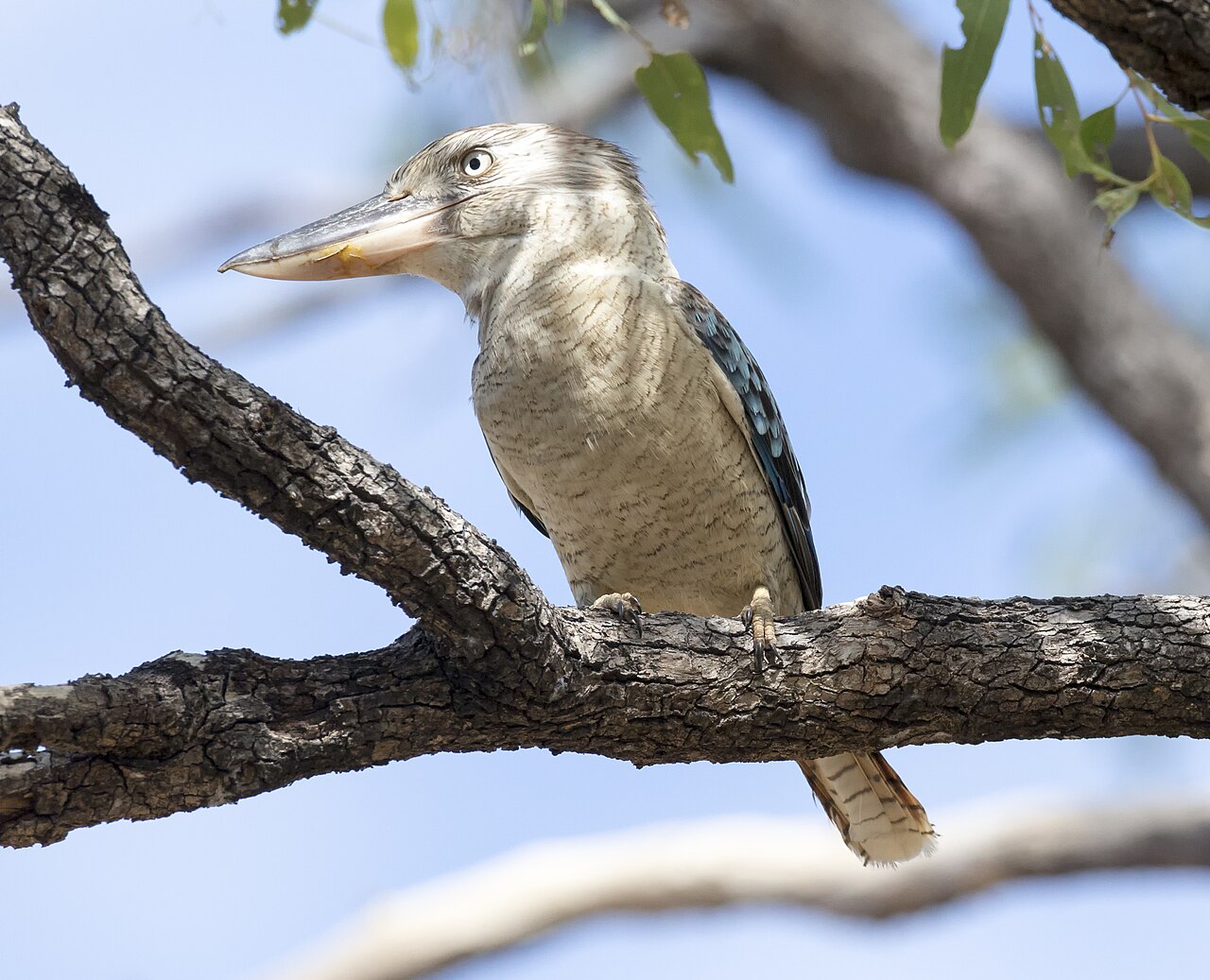
The Blue-winged Kookaburra is the kookaburra of the tropical north: almost as bulky as its familiar southern relative, but with a pale staring eye, a streaked white head without a dark mask, and a large bright blue wing panel. And it does not laugh — it screams, barks and cackles in a harsh chorus that breaks off abruptly.
Voice
The sound is a maniacal screeching cackle that runs into loud trills and then stops dead, often delivered by a whole family group at once from high branches, at first light and again at dusk. Between the bouts come hoarse barks, screeching yells and short rattles. Unlike the Laughing Kookaburra there is no rolling laugh in it: it is rawer, higher and less companionable.
No freely licensed recording has been found for this species yet; what to listen for is described below.
Identification
A heavy, short-tailed bird of forty centimetres with an enormous dagger bill and a head that reads cream-white with fine brown streaking — no dark eye stripe, and a strikingly pale white eye that gives the bird a staring look. Shoulders and wing coverts are sky blue and the rump is uniform blue. The male has an entirely dark blue tail, the female a rufous tail barred with black — the one sex difference usable in the field. Throat and underparts are white with faint orange-brown scalloping.
Confusion species
Laughing Kookaburra (Dacelo novaeguineae) is the only real confusion, and where the two meet in northeastern Queensland three things settle it: that bird has a dark eye, a broad dark brown eye stripe and far less blue in the wing, and in it both sexes have a rufous barred tail. It is also slightly larger, and its voice is the famous rolling laugh rather than a harsh scream. The kingfishers of the genus Todiramphus are all less than half the size and wear a black mask.
Habitat
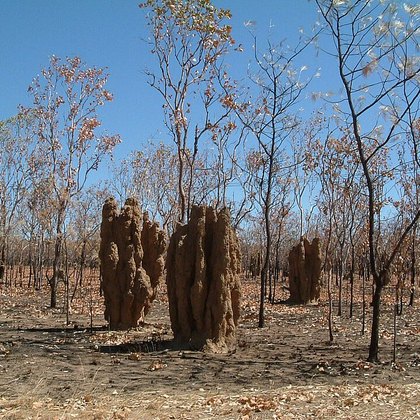
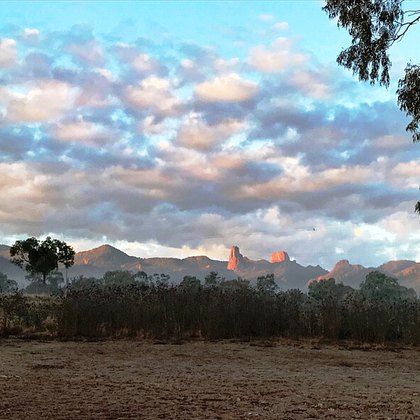
Tropical and subtropical open eucalypt woodland, melaleuca swamps, timber along watercourses, clearings, canefields and farmland. It hunts from a high branch whatever moves below it: large insects, lizards, snakes, frogs, fish, mice and nestling birds. The nest is a cavity high in a tree, in an arboreal termite mound or in a hollow in a boab; the birds live in family groups in which older young help raise the brood.
Where the bird is most often found, arranged by main group and formation.


Range and movements
Northern Australia: from about Brisbane north through Queensland, across the Gulf Country and the Top End to Broome and the Kimberley in Western Australia, mainly in the coastal and subcoastal belt. Also on islands in Torres Strait and in southern New Guinea. It is absent from the arid interior, the south of the continent and Tasmania, and does not occur in New Zealand.
- Resident
- dark = core range, pale = thinly spread
Where and when to look
Stand at first light by a melaleuca swamp or open eucalypt woodland in the Top End or Gulf Country; the family group starts calling then and gives itself away from far off. On a perched bird look first at the eye — pale and staring — and then at the tail, which tells you at once whether it is a male or a female.
Conservation
Least Concern (LC): widespread and common across tropical Australia, and the bird uses farmland, canefields and town edges as well. As a hole-nester needing large cavities it does depend on old trees and on the termite mounds built in them; where those go in the tidying away of dead timber, the nest sites go with them. Very hot and frequent fires in the north press on the food supply locally.
Scientific name
Dacelo leachii | Vigors & Horsfield, 1827
Vigors and Horsfield described the species in 1827 as Dacelo leachii from the start, so authors and year carry no parentheses. The epithet honours the British zoologist William Elford Leach (1791–1836), and it is a nice turn that the genus Dacelo, which Leach himself introduced in 1815, is an anagram of Alcedo, the classical Latin word for kingfisher. The type locality is the east coast of Australia: Keppel Bay, Shoalwater Bay and Broad Sound in Queensland. The name kookaburra itself comes from Wiradjuri, where guuguubarra imitates the bird's sound.