All species › Gannets and cormorants › Boobies and gannets › Brown Booby
Brown Booby | Sula leucogaster
Bruine gent | Piquero pardo
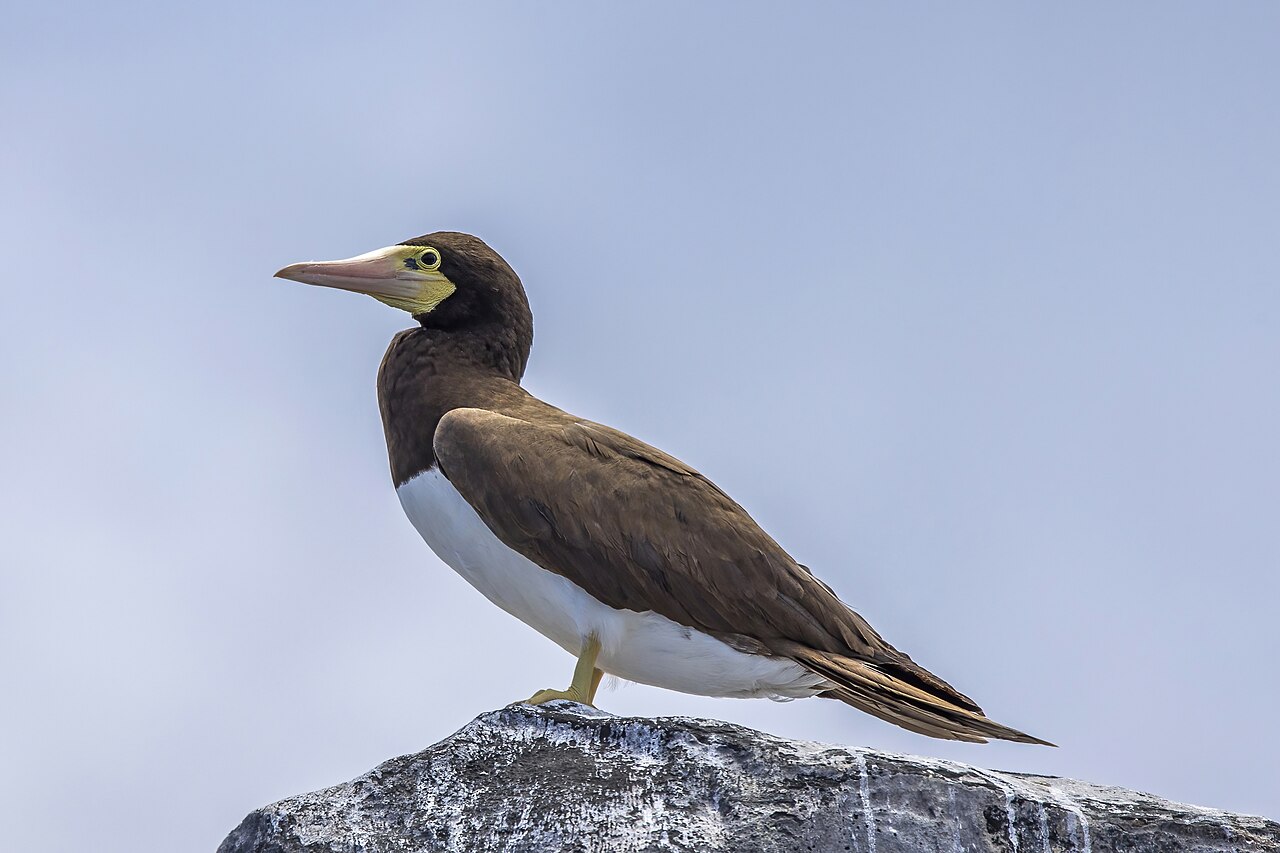
The Brown Booby is the commonest booby of the Australian tropics and the only one breeding there in tens of thousands of pairs. It is chocolate brown with a snow-white belly, and between the two runs a dead-straight line across the breast — the only feature you need. It hunts close inshore, often shearing low over the swell, and enters the water at an angle rather than vertically like a gannet.
Voice
At sea it is silent. In the colony the sexes sound different: the female gives a low, hoarse raa or kwaa with something of a goose in it, the male a thin rising whistle, shwee. They are heard most as a bird comes in to land and at the nest changeover, when the two voices run together. Chicks beg with a thin, persistent piping. Away from the colony it comes down to a short growl when two birds want the same buoy.
No freely licensed recording has been found for this species yet; what to listen for is described below.
Identification
A medium-sized booby of 75 to 80 centimetres, with fairly short broad wings and a long pointed tail. Head, neck, back and upperwing are uniform chocolate brown, and that colour ends abruptly in a straight line across the breast; belly and underwing coverts are white, with a broad brown margin framing the white underwing panel. The female is larger than the male and differs in face colour: she has yellow bare skin round the eye and a yellow-grey bill, he blue facial skin and a blue-grey bill. Young birds are brown throughout, with a dull brown rather than white belly, but even then the breast line shows as a change of tone.
Confusion species
Adult Masked Booby (Sula dactylatra) is white and unmistakable, but its young are not: they are paler, with a white hind-collar and without the sharp straight breast line. Red-footed Booby (Sula sula) has a brown morph that looks very similar but lacks that line entirely — it is evenly brown from head to belly — and always has bright red feet and a pale blue bill with a pink base. Young Australasian Gannets (Morus serrator) are much larger, with a wingspan of nearly two metres, and irregularly white-speckled rather than sharply two-toned.
Habitat
Warm inshore waters and water over the continental shelf, usually within sight of land and often around reefs, shoals and beacons. It breeds on the bare ground of coral cays, guano islets and rocky islands, in open colonies without shelter, and uses buoys, wrecks and ships' rails as roosts.
Where the bird is most often found, arranged by main group and formation.

Range and movements
Within the map window its belt runs along the whole tropical northern rim of Australia, from Bedout Island off the Pilbara around the Northern Territory coast to the Bunker Group in Queensland. The large colonies are in the west — Bedout Island with about 9,600 pairs, the Lacepede Islands with over 17,000, Adele Island with some 7,500 and White Island at the Rowley Shoals with four to five thousand — and in the east at Raine Island (7,600 pairs) and Moulter Cay, with dozens of smaller cays through the Great Barrier Reef, the Swain Reefs and the Coral Sea. The last national count put the total at sixty to seventy-four thousand breeding pairs. In New Zealand it is a vagrant appearing in most years, chiefly off Northland and in the Hauraki Gulf, with scattered records to Nelson, Farewell Spit, the Kermadecs and the Chathams.
- Resident
- dark = core range, pale = thinly spread
Where and when to look
In north Queensland and the Kimberley this is the booby you will see without effort from a ferry or a reef trip: watch for a medium-sized dark seabird shearing low over the swell on quick beats before shooting in at an angle. On a buoy or a reef beacon it sits still, and then the breast line is readable at long range. In New Zealand it pays to check the loafing birds at a gannet colony: vagrants usually attach themselves there.
Conservation
Least Concern (LC), with an Australian population of the order of seventy thousand pairs and a world range across all the tropical oceans. The pressure is on the colonies themselves: rats and land crabs on breeding islands, historic taking of eggs and chicks, disturbance by visitors and ecotourism after which gulls plunder unguarded nests, and oil pollution. An El Nino year can also strip the food supply and write off a whole breeding season.
Scientific name
Sula leucogaster | (Boddaert, 1783)
Boddaert named the species in 1783 as Pelecanus leucogaster, among the pelicans; because it later moved to Sula, author and year are in parentheses. His description is no more than a name attached to a coloured plate by Daubenton — an ordinary way of working in the eighteenth century. The genus Sula was introduced by Brisson in 1760; sula is the Norse word for the gannet. leucogaster is Greek for 'white-bellied', after the only pale part of the bird. The type locality is Cayenne, on the coast of French Guiana.