All species › Gannets and cormorants › Boobies and gannets › Masked Booby
Masked Booby | Sula dactylatra
Maskergent | Boba enmascarada
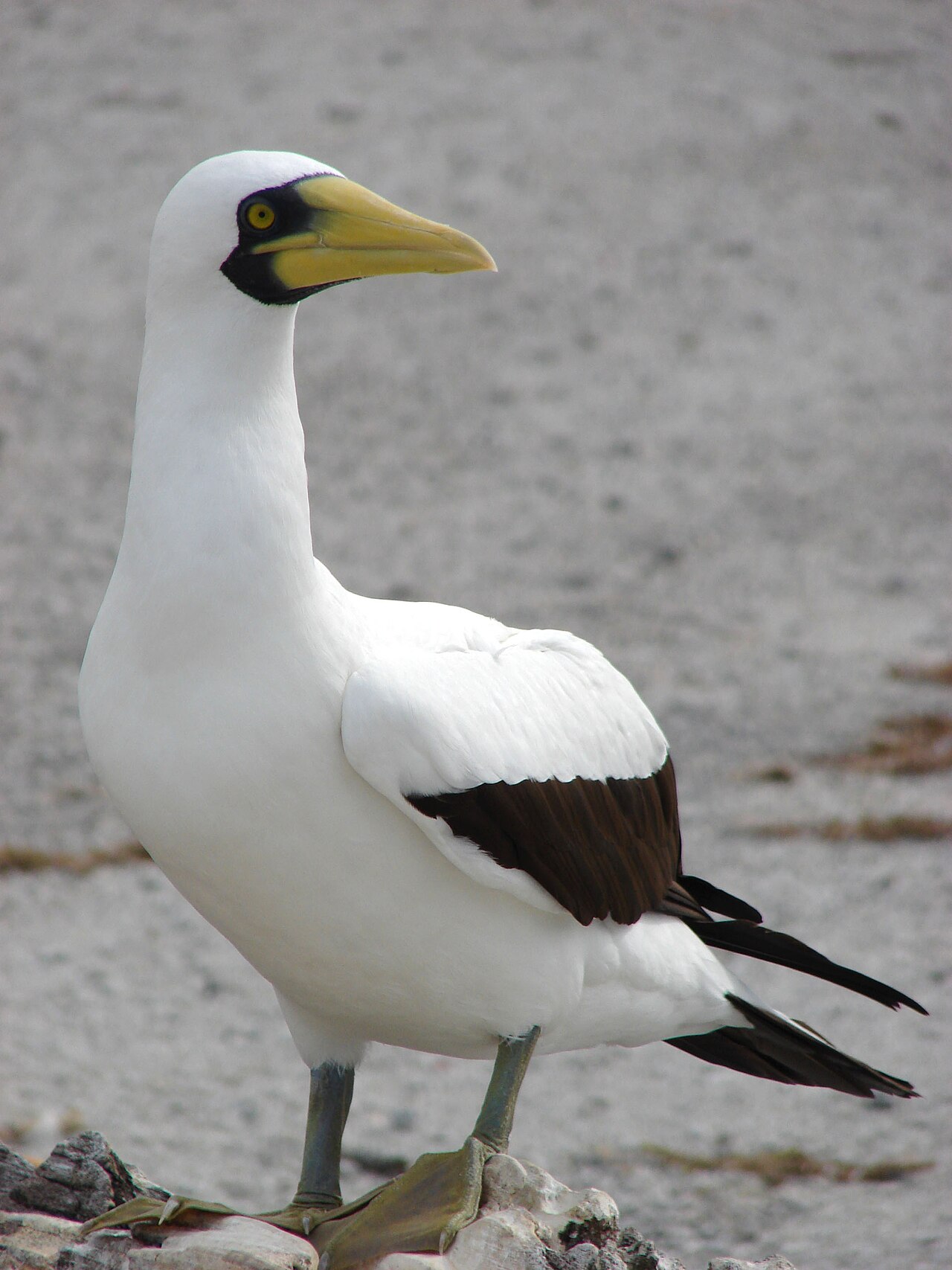
The Masked Booby is the largest of the three tropical boobies and the only one that looks pure white as an adult: spotless white with a continuous black trailing edge along the whole wing, a black tail and — the feature that gives it its name — a blue-black bare mask round the base of the bill and the throat. It hunts further offshore than the other boobies and dives deeper.
Voice
At sea it is generally silent, like the other boobies. At the colony the voices are sharply distinct: the male gives a thin descending whistle, the female a loud, hoarse honk or croak that carries across the whole colony. Pairs greet by throwing the head back and clapping the bill briefly. Chicks beg with a hoarse, persistent bleat.
No freely licensed recording has been found for this species yet; what to listen for is described below.
Identification
A large booby of 75 to 85 centimetres with a wingspan of 160 to 170, cigar-shaped with a long pointed tail. The adult is brilliant white with both primaries and secondaries black, so the black trailing edge runs as an unbroken band along the entire wing — from below the clearest feature of all. The tail is black. Round the base of the bill and on the throat sits a black to blue-black bare mask standing out sharply against the white head feathering. The bill is yellow, brighter in the male than in the slightly larger female; the feet are grey-green to olive-yellow. Young birds are brown on head and upperparts with a striking white hind-collar and a white belly.
Confusion species
Australasian Gannet (Morus serrator) is larger, has a golden-buff head, a pearl-grey bill and black only at the wingtip, not along the whole trailing edge. Adult Brown Booby (Sula leucogaster) is brown with a sharp breast line and unmistakable, but its young are not: they are darker than young Masked Boobies, lack the white hind-collar and keep the sharp division between breast and belly. The white morph of Red-footed Booby (Sula sula) is smaller and more slender, has a white tail, bright red feet and a pale blue bill with a pink base instead of a yellow bill and a black mask.
Habitat
Open, warm ocean water, often far out of sight of land and further offshore than Brown Booby. It breeds on bare, wind-swept level ground without vegetation: coral cays, guano islets and the bare slopes of volcanic islands, where the nest is no more than a scrape in the sand or grit.
Where the bird is most often found, arranged by main group and formation.


Range and movements
In Australian waters it breeds on the cays of the northern Great Barrier Reef, including Raine Island, and scattered through the Coral Sea and the Swain Reefs. The subspecies tasmani, with a dark brown rather than pale iris and longer wings, holds the southern triangle of the region: Lord Howe, Phillip Island off Norfolk (some 300 pairs around 2007) and the Kermadec Islands, where about a hundred pairs nest. Those are also the only breeding sites within New Zealand; along the North Island coast the species is no more than a rare vagrant.
- Resident
- dark = core range, pale = thinly spread
Where and when to look
A pelagic trip out of Sydney, Wollongong or Mooloolaba gives the best chance in summer, and around Norfolk and Lord Howe it can be seen from land. On any white booby, check the trailing edge of the wing: if the black runs right in to the body it is this species; if it stops at the tip it is a gannet. On a perched bird the yellow bill and black mask are enough through binoculars.
Conservation
Least Concern (LC), with a wide pantropical range, although BirdLife reports the world population as declining. At the colonies it is very exposed: the birds nest on the ground and so have no defence against introduced rats, cats and pigs, and a human visit can lay a whole row of nests open at once. The species lays two eggs, but the second chick is almost always pushed out and killed by the elder — the second egg is insurance, not a second chick — so a colony yields at most one young per pair per year.
Scientific name
Sula dactylatra | Lesson, 1831
Lesson described the species in 1831 as Sula dactylatra; it has stayed in that genus, so author and year carry no parentheses. The type locality is Ascension Island, in the middle of the South Atlantic. The epithet dactylatra combines Greek daktylos, 'finger', with Latin ater, 'black', and refers to the black primaries that stand out in flight like splayed fingers at the wingtip. The Dutch name points to the black bare mask round bill and throat, the same feature fixed in the English and Spanish names.