All species › Gannets and cormorants › Boobies and gannets › Australasian Gannet
Australasian Gannet | Morus serrator
Australische jan-van-gent | Alcatraz australiano
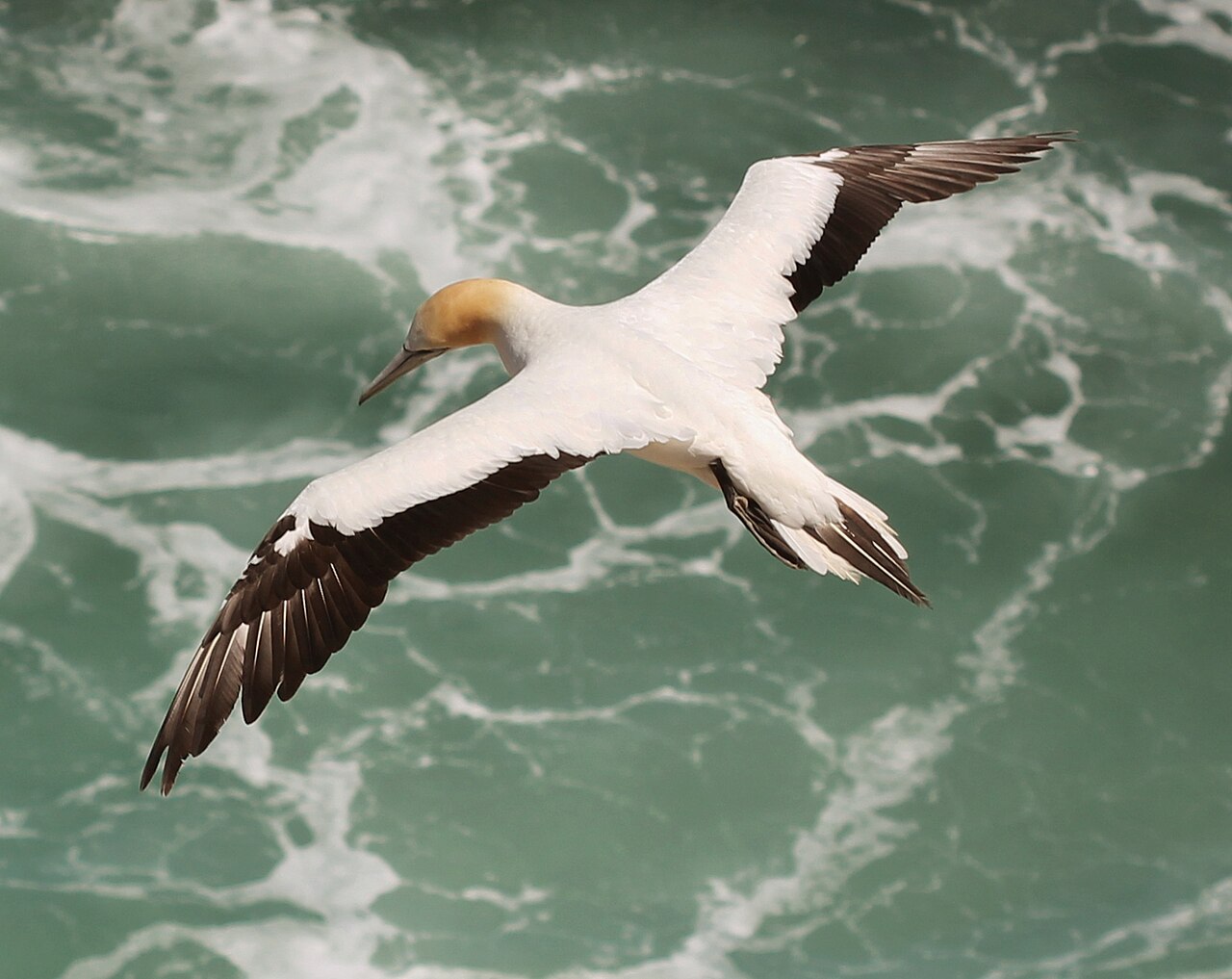
The Australasian Gannet is the big white plunge-diver of southern coastal waters: cigar-shaped, with narrow pointed wings close to two metres across, a golden-buff head and black wingtips. It hunts by folding its wings and dropping vertically into the sea from tens of metres up, and breeds in dense, clamorous colonies on rock islets and a handful of mainland headlands.
Voice
At sea it is usually silent. The colony is the opposite: a continuous din of harsh rattling arrah-arrah or urrah-urrah calls announcing every landing bird and defending every nest site. A bird about to take off gives a drawn-out oo-ah. Both sexes use the same call, with recognisable differences between individuals and even between colonies. Chicks beg with a high squeaking note.
No freely licensed recording has been found for this species yet; what to listen for is described below.
Identification
A solid, wholly white seabird of nearly a metre with a wingspan of 170 to 200 centimetres, tapering at head and tail so that in flight it reads as a cigar with wings. The head and neck are washed golden-buff, the bill is pearl-grey edged in black, and a thin blue-black line runs round the eye and along the throat. Black is confined to the outer primaries and the four central tail feathers; the rest of the wing is spotless white. First-year birds are dark brown with white speckling and whiten over three to four years, with intermediate plumages that are half white, half brown quite normal.
Confusion species
Cape Gannet (Morus capensis), a very rare vagrant that sometimes settles for years in an Australian colony, has all the secondaries black rather than only the wingtip, and a much longer black gular stripe — well over five centimetres against about two on Australasian. Masked Booby (Sula dactylatra) is smaller, with a white rather than golden head, a yellow bill, a black bare face mask and a continuous black trailing edge along the whole wing. Young gannets are often called Brown Booby (Sula leucogaster), but that bird is smaller and shows a sharp line between brown breast and white belly, where the young gannet is irregularly speckled.
Habitat
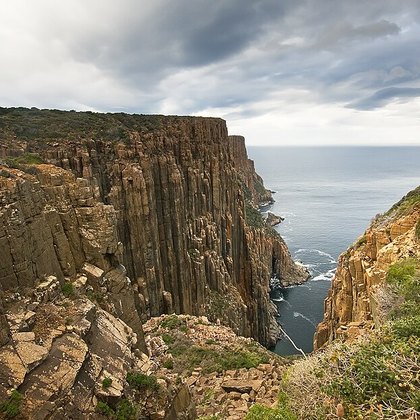
Inshore water and the continental shelf, mostly within a hundred kilometres of land, hunting over shoals of pilchard and anchovy. It breeds on flat ground wholly or largely surrounded by sea: rock islets, sea cliffs and a few headlands, with nests set in dense rows half a metre apart.
Where the bird is most often found, arranged by main group and formation.

Range and movements
In New Zealand nearly all colonies are on or around the North Island — Cape Kidnappers in Hawke's Bay (over 6,500 pairs, the most accessible mainland colony anywhere), Muriwai near Auckland and the Three Kings Islands; on the South Island the colony is at Farewell Spit, around 3,900 pairs. In Australia it breeds in Bass Strait and Victoria: Lawrence Rocks and Point Danger at Portland, Pope's Eye in Port Phillip Bay, and Black Pyramid Rock, Pedra Branca and Eddystone Rock off Tasmania. Outside the breeding season young birds in particular range widely, into southern Queensland and Western Australia, and New Zealand juveniles regularly cross the Tasman Sea.
- Resident
- Winter
- dark = core range, pale = thinly spread
Where and when to look
Stand on a headland along the Victorian south coast or the east coast of the North Island in an onshore wind and watch the horizon: a long line of white birds skimming low over the swell is almost always this species. Once there is a school of fish beneath them they go in one after another, throwing up the characteristic white plumes. At Muriwai and Cape Kidnappers a lookout puts you within tens of metres of the nests; mornings are quietest.
Conservation
Least Concern (LC), and one of the few seabirds here demonstrably doing better: the population has grown by a few per cent a year for decades and several colonies have multiplied tenfold since they were found. Plumage was once harvested and eggs eaten, but protection ended that. What remains is disturbance of colonies by boats and drones, bycatch in gillnets and on hooks, and entanglement in discarded fishing line and plastic, which is visibly worked into nests in the colonies.
Scientific name
Morus serrator | (Gray, 1843)
George Robert Gray introduced the name in 1843 as Sula serrator, a replacement name for Gould's Sula australis, which was already taken; because the species later moved to Morus, author and year are in parentheses. The type locality is Tasmania. serrator is Latin for 'sawyer', after the fine saw-teeth along the cutting edge of the bill with which the bird holds slippery fish. The genus Morus goes back to Greek moros, 'foolish' — the same thought as behind the English word booby, because nesting gannets let themselves be picked up without resistance. The Maori name is takapu.