All species › Gannets and cormorants › Boobies and gannets › Cape Gannet
Cape Gannet | Morus capensis
Kaapse jan-van-gent | Alcatraz del Cabo
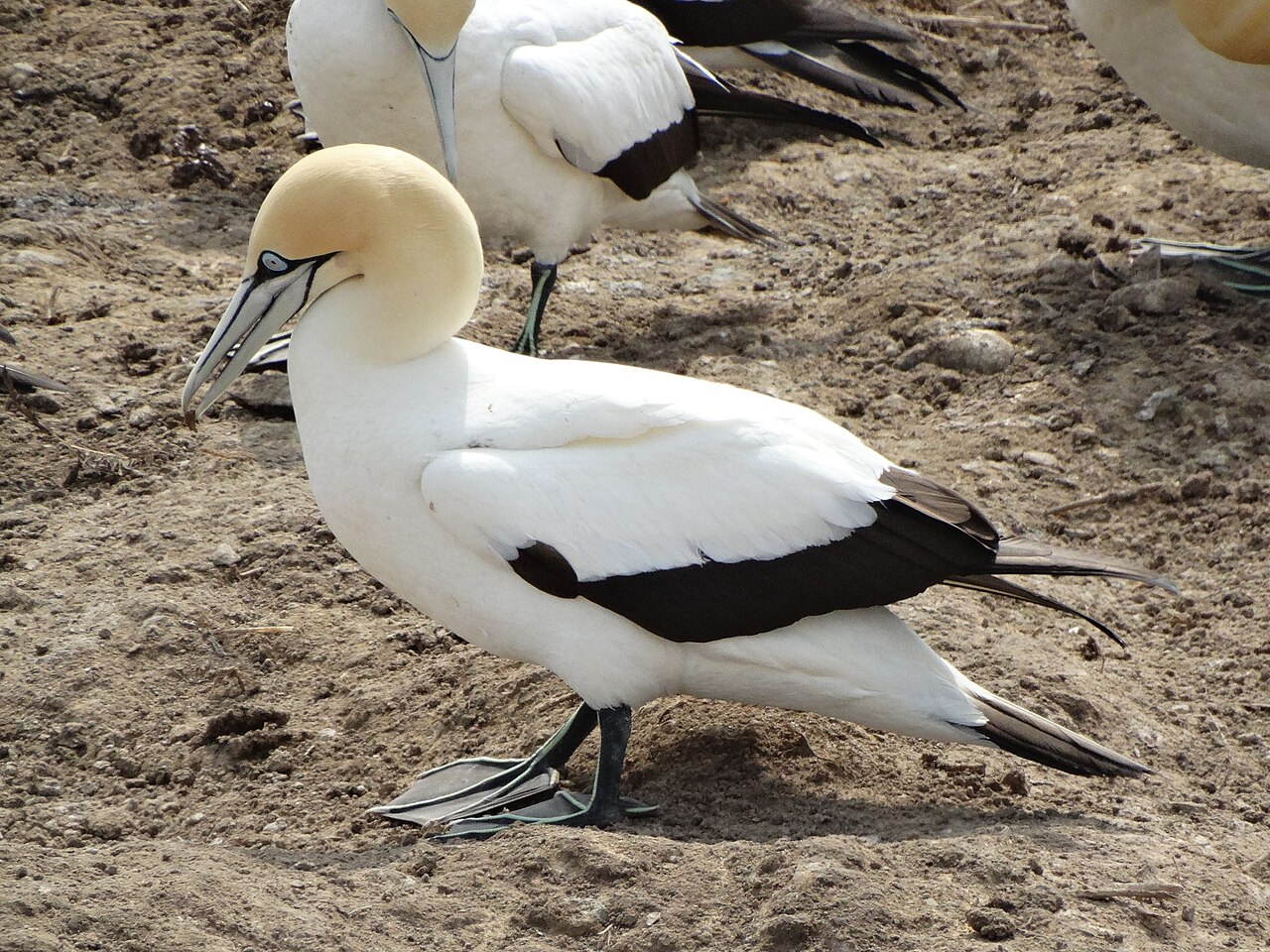
The Cape Gannet breeds on six islands off South Africa and Namibia and is a rare visitor to this region. It is almost always found among Australasian Gannets, standing at a nest within a colony, where it gives itself away by its long black gular stripe and its wholly black tail.
Voice
In the colony it calls the same hard rattling arrah-arrah-arrah as the Australasian Gannet, but clearly lower — by about two thirds of an octave, a difference that with practice can be picked out among the thousands of voices in a colony. Away from the colony it is silent. A single bird among Australasians sometimes betrays itself by pitch before it does by appearance.
Recording: Daniel Danckwerts — CC BY-NC-SA 4.0 · Bird Island, South Africa · xeno-canto
Identification
A gannet of ninety centimetres and some two and a half kilos, white with black primaries and a golden-yellow head washed orange, slightly larger and heavier than the Australasian Gannet. The gular stripe is a long, featherless black line running to the middle of the throat, about three times the length of the Australasian's. The tail is entirely black, not merely the central feathers, and the secondaries are black as well; the iris is white and the lines over legs and toes are bright cyan. Young birds are brown with white speckling and cannot be told with certainty from young Australasians in the field.
Confusion species
For this species this is the block that matters. Australasian Gannet (Morus serrator) has a short gular stripe not reaching past the chin, white outer tail feathers against a black central pair, a pale grey iris, a more golden and less orange head and a higher-pitched voice. Hybrids between the two occur in Australasian colonies and show a gular stripe of intermediate length or a tail with some white; so record every feature separately and have the throat and the spread tail photographed before naming a bird. A bird identified on head colour or on an impression of size alone has not been identified.
Habitat
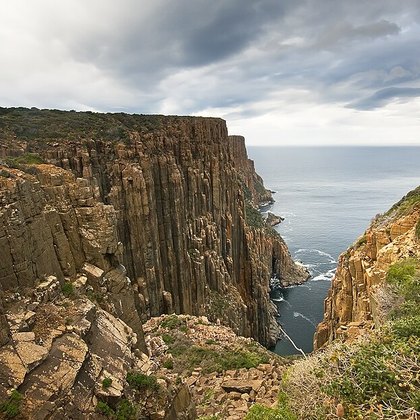
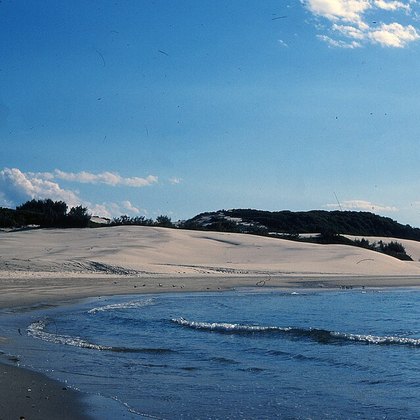
Cool, productive water over the continental shelf, where it dives for sardine and anchovy from ten to thirty metres up. Breeding takes place on flat island tops and guano rocks, in dense colonies where nests lie a bill's length apart. In this region it keeps to where the Australasian Gannets are: colonies on headlands and rock stacks and the fishing grounds around them.
Where the bird is most often found, arranged by main group and formation.

Range and movements
It breeds only on six islands off South Africa and Namibia, by far the most birds on Bird Island in Algoa Bay; outside the breeding season birds range along both African coasts to Mozambique and into the Gulf of Guinea. In New Zealand the records are few and well documented: an adult male stayed in the Cape Kidnappers colony from 1997 to 2005, and a bird sat on Farewell Spit in December 2015. In Australia there are likewise only a handful of records, of which a bird at the gannet colony of Point Danger near Portland, Victoria, in March 2018 is the best known.
- Breeding (summer)
- dark = core range, pale = thinly spread
Where and when to look
Look for it not at sea but in a colony, in the breeding season from September to February: Cape Kidnappers and Muriwai in New Zealand, Point Danger and Lawrence Rocks in Victoria. Work through the sitting birds row by row with the telescope and watch only the throat; then wait until a bird spreads its tail or takes off, because only then can you see whether the outer tail feathers are white.
Conservation
Endangered (EN). The world population has fallen steeply within a few decades and now has three quarters of its birds on a single island, which makes one oil spill or one disease outbreak a large risk. The main cause is the collapse of the sardine and anchovy stocks off the west coast of southern Africa; oil pollution, bycatch behind trawlers and predation by fur seals at the colonies take their toll on top of that.
Scientific name
Morus capensis | (Lichtenstein, 1823)
Lichtenstein described the bird in 1823 as Dysporus capensis; because it was later placed in another genus, author and year stand in parentheses. The genus Morus was introduced by Vieillot in 1816, from Greek moros, foolish, after the tameness with which breeding gannets allowed themselves to be caught. capensis means of the Cape. The type locality is the Cape of Good Hope, from which the bird also takes its Dutch name (as it does its English one).