All species › Passerines › Honeyeaters › Brown-headed Honeyeater
Brown-headed Honeyeater | Melithreptus brevirostris
Bruine diadeemhoningeter | Mielero cabecipardo
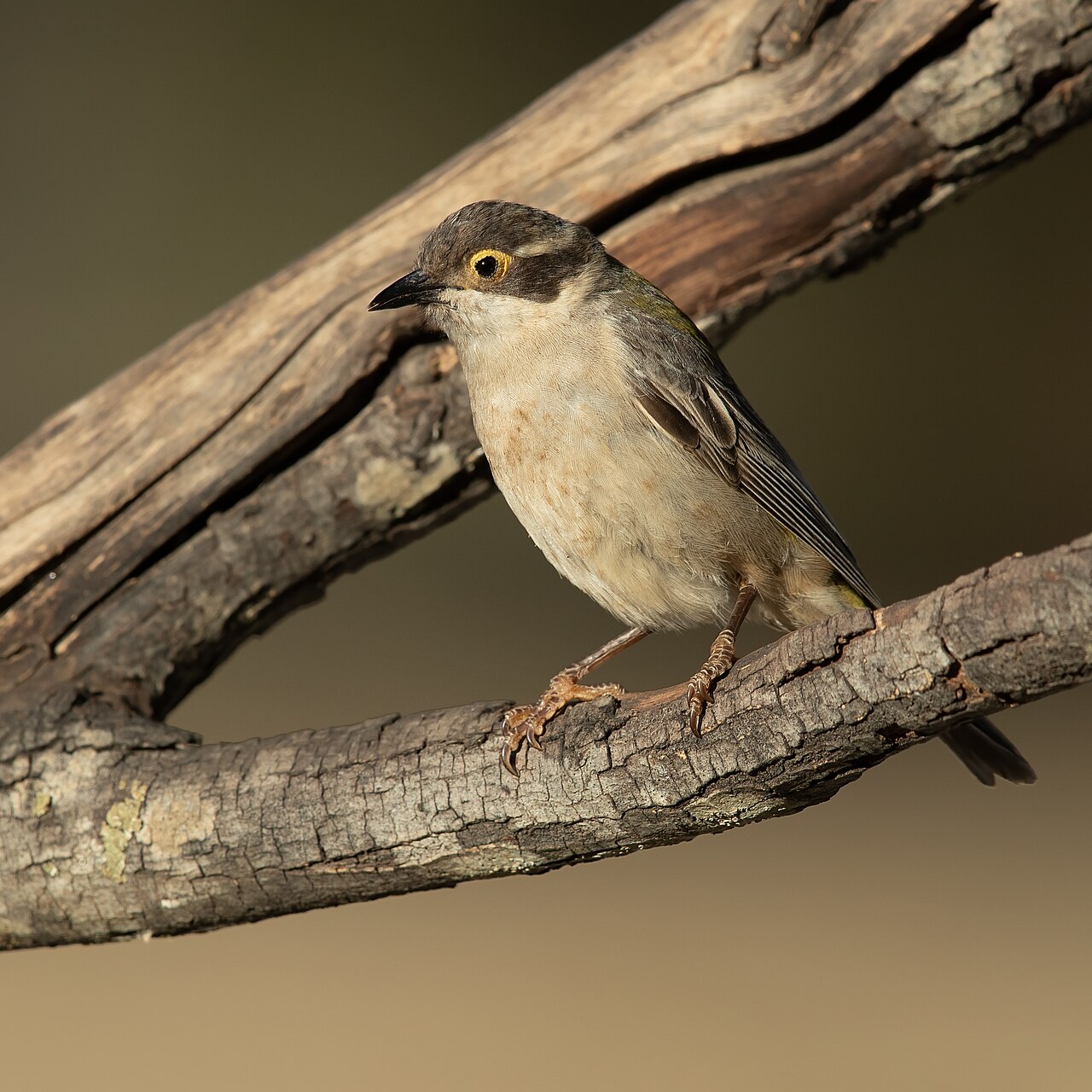
The Brown-headed Honeyeater is the odd one out among its genus. Where the six other Melithreptus species wear a jet-black head, this one has a soft olive-brown crown, and its nape band is not clean white but dull cream to buff — a mark you only pick up once the bird sits still. The clincher is around the eye: a creamy yellow to orange ring of bare skin that completely encircles it, whereas every relative carries only a crescent above the eye. It is a busy, restless bird of open eucalypt woodland, almost always in parties of six to twelve high in the canopy.
Voice
Sharp, slightly scratchy calls, usually written as a rapid chwik-chwik-chwik, frequently given in flight as the party moves from tree to tree. The sound is dry and wooden, without the clear whistled quality of the White-naped Honeyeater (Melithreptus lunatus), and in mixed woodland that difference is often the quickest separation of all. While feeding, the members of the group keep contact with a continuous soft chatter, so a party working through the crowns is usually heard before it is seen.
Recording: Zebedee Muller — CC BY-NC-SA 4.0 · Denman Prospect, Australian Capital Territory, Australia · xeno-canto
Identification
A small honeyeater of thirteen to fifteen centimetres, compactly built, with a short fine bill — the epithet brevirostris refers to exactly that. The upperparts are dull olive-green to olive-brown, the underparts pale grey to light buff and unstreaked. The head is brown rather than black, which sets the species apart at once, and a narrow dull-white to buff band crosses the nape, often barely visible at any distance. The bare skin around the eye is creamy yellow to orange and forms a complete ring: this is the only member of the genus in which that skin encircles the eye instead of sitting above it as a crescent. The bill is dark with a paler base, the legs flesh to orange-brown. Immatures are even more washed out, with a yellowish look to the base of the bill.
Confusion species
Within the genus this is the easy one: the brown rather than black head rules out White-naped Honeyeater (Melithreptus lunatus), White-throated Honeyeater (Melithreptus albogularis), Black-chinned Honeyeater (Melithreptus gularis), Gilbert's Honeyeater (Melithreptus chloropsis), Strong-billed Honeyeater (Melithreptus validirostris) and Black-headed Honeyeater (Melithreptus affinis) in one stroke. Be aware, though, that juveniles of all those species have brownish heads; then look at the bare skin at the eye, which in this species forms a complete creamy yellow to orange ring and in all the others is a crescent above the eye, white, blue-white or red. In south-western Australia it shares woodland with Gilbert's Honeyeater (Melithreptus chloropsis), where that species' black head and crisply defined white nape band make the difference. The species does not occur in Tasmania, so Strong-billed and Black-headed Honeyeater are not in question.
Habitat
Open eucalypt forest and woodland form the core country, from dry box and ironbark (eucalypt with deeply furrowed, hard bark) stands to mallee (low, multi-stemmed eucalypt scrub of dry southern Australia), river gum along inland creeks, casuarina strips and planted gardens and parks in country towns. It forages high in the crown and along the branches with an acrobatic, often upside-down searching action: the diet is mainly insects and lerp (sugary scale secreted by psyllids, food for honeyeaters) gleaned from bark, twigs and leaves, supplemented with nectar and honeydew. The breeding biology is unusual. The species breeds cooperatively, with up to five birds attending a single nest, and is known for plucking hair from live animals — horses, cattle, even people — as nest lining, showing a marked preference for pale hair over dark.
Where the bird is most often found, arranged by main group and formation.


Range and movements
Two separate areas on mainland Australia. In the east and south-east from southern Queensland through New South Wales and Victoria into eastern South Australia, including the Eyre and Yorke peninsulas and Kangaroo Island; in the west, the south-west of Western Australia. Between the two lie the arid interiors, where it is largely absent except along wooded creeks. It is entirely absent from the Northern Territory, from the tropical north and from Tasmania, and does not occur in New Zealand. Largely resident, with local wandering outside the breeding season.
- Resident
- dark = core range, pale = thinly spread
Where and when to look
Do not look for a single bird, look for a party: this species almost always moves through the canopy in loose groups and gives itself away with the dry, scratchy chwik-chwik in flight. Once you have one of the Melithreptus in the glass, go straight to the head. Black means one of the others; brown, with a complete pale ring around the eye, means this one. A second pointer is the nape band, here faint and buff rather than crisply white. In winter it turns up readily in South Australian and Victorian gardens with flowering eucalypt or grevillea.
Conservation
Least Concern (LC) and common over most of its range; every Australian state in which it occurs rates it secure. The pressure lies in the detail of the landscape: in the heavily cleared box and ironbark belt of the south-east much open woodland has been removed or fragmented, and cooperatively breeding woodland birds such as this need continuous stands with mature trees. Where woodland survives only as narrow strips along roads and creeks, the species drops out locally. At a national scale there is no evidence of steep decline.
Scientific name
Melithreptus brevirostris | (Vigors & Horsfield, 1827)
Vigors and Horsfield described the species in 1827 as Meliphaga brevirostris, from a specimen taken in New South Wales; because it was later moved to Melithreptus, author and year stand in parentheses. The generic name Melithreptus, erected by Vieillot in 1816, comes from Greek meli, 'honey', and threptos, 'nourished' — literally 'honey-fed'. The epithet brevirostris is Latin for 'short-billed' and points at the short, fine bill that separates this species from the heavy-billed Strong-billed Honeyeater. The English name, the Dutch bruine diadeemhoningeter and the Spanish mielero cabecipardo all choose the brown head, the one point on which the bird departs from all its relatives.