All species › Pigeons and doves › Doves and pigeons › Brush Bronzewing
Brush Bronzewing | Phaps elegans
Struikbronsvleugelduif | Paloma bronce elegante
The Brush Bronzewing is the dark, retiring cousin of the Common Bronzewing, tied to coastal heath and dense shrub layers across southern Australia. It is smaller and warmer-marked than its widespread relative, with a rufous-chestnut nape, a chestnut throat patch and two neat curved bars of metallic sheen across the wing. Usually you only get a view when it bursts from cover at your feet.

Voice
A low, dull, one-syllable hoop or whoo, repeated at short intervals and kept up for minutes; close to, it swells and fades, as though the bird keeps underlining the same point. It is duller and a shade faster in delivery than the slow oom of the Common Bronzewing. In display the bird bows deeply as it calls. Take-off is a hard clattering roar.
No freely licensed recording has been found for this species yet; what to listen for is described below.
Identification
A medium-sized, compact pigeon of around thirty centimetres, dark olive-brown above and blue-grey below, with a rich chestnut nape and shoulder. The face carries the identification: a dark chestnut stripe runs straight through the eye, underlined by a white line, and there is a chestnut patch on the throat. The male adds a chestnut forehead, which the female lacks. Across each wing lie two curved, sharply bounded bars that flare blue-green to bronze. On the ground it moves crouched and inconspicuous.
Confusion species
Common Bronzewing (Phaps chalcoptera) is the real risk and overlaps with it widely in the south: it is clearly larger (30–36 against 25–33 cm), paler and greyer, without the dark eye stripe and without the chestnut throat patch, with a yellow-white rather than chestnut forehead in the male, and with irregularly scattered wing panels instead of two neat bars. Flock Bronzewing (Phaps histrionica) is pale sandy with a black-and-white face and keeps to open inland grassland, so range and habitat separate it already. Crested Pigeon (Ocyphaps lophotes) is slimmer, grey and crested.
Habitat
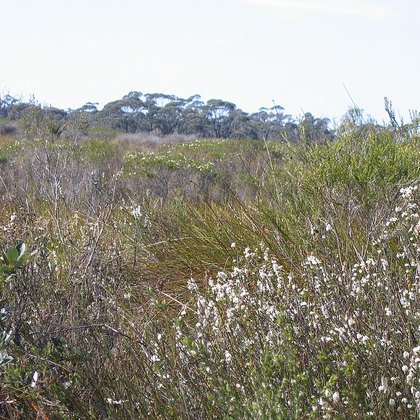
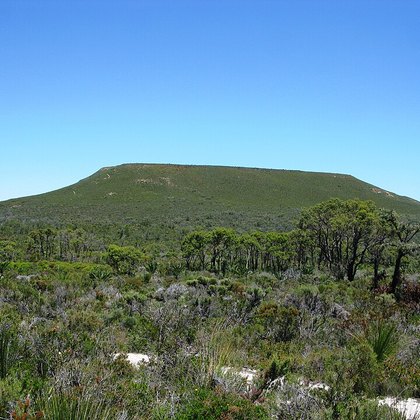
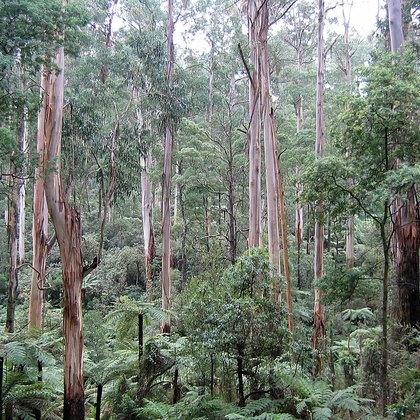
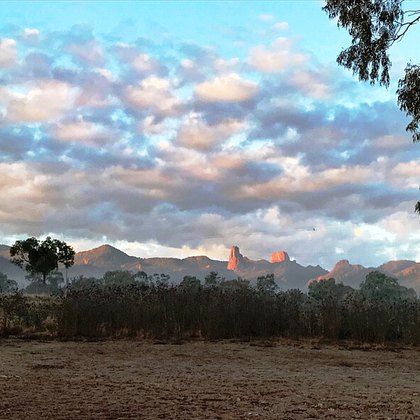
A dense, low shrub layer is the constant: coastal heath behind the dunes, kwongan heath in the west, wet and dry sclerophyll forest and woodland with a closed understorey of banksia, acacia, melaleuca or leptospermum, and locally dense mallee. It feeds entirely on the ground, singly or in pairs, and prefers to drink in the half-light of dawn or dusk.
Where the bird is most often found, arranged by main group and formation.
Range and movements
Two separate areas in southern Australia. The eastern one runs along the coast from Fraser Island in Queensland through New South Wales and Victoria to the Eyre Peninsula in South Australia, taking in Tasmania and the coastal islands. The western one covers the south-west corner of Western Australia, where a subspecies of its own, occidentalis, occurs. It is absent from the interior, from the north of the continent and from New Zealand.
- Resident
- dark = core range, pale = thinly spread
Where and when to look
Walk the edge of a coastal heathland or a dense shrub thicket in the south and listen for the low hoop, because you will seldom see the bird by its own choice. Wait at a pool or drinking point in the heath during the first two hours after sunrise; pairs then come down briefly to drink. If all you get is a flushing bird, note the two crisp wing bars and the dark, warm-toned upperparts.
Conservation
Least Concern (LC) and rated secure in every state, but the species is more sensitive than that suggests. It depends on a dense shrub layer, and that disappears through clearing, coastal development and above all through too-frequent fire: after a hot burn it takes years before the understorey is usable again. Foxes and feral cats take the birds on the ground; in parts of Western Australia the toxin in native Gastrolobium plants, which the native fauna tolerates, gives some protection against introduced predators. Nesting success is low to begin with.
Scientific name
Phaps elegans | (Temminck, 1809)
Coenraad Jacob Temminck described the species in 1809 as Columba elegans; author and year therefore stand in parentheses now the bird sits in Phaps, the genus Selby introduced in 1835 and whose name is the Ancient Greek word for a wild pigeon. The epithet elegans simply means 'elegant, handsome' and refers to the warmly marked plumage. The species was described from Australian material and has two subspecies: elegans in the east and Tasmania, and occidentalis in the south-west of Western Australia.