All species › Parrots › Old World parrots › Budgerigar
Budgerigar | Melopsittacus undulatus
Grasparkiet | Cotorrita australiana
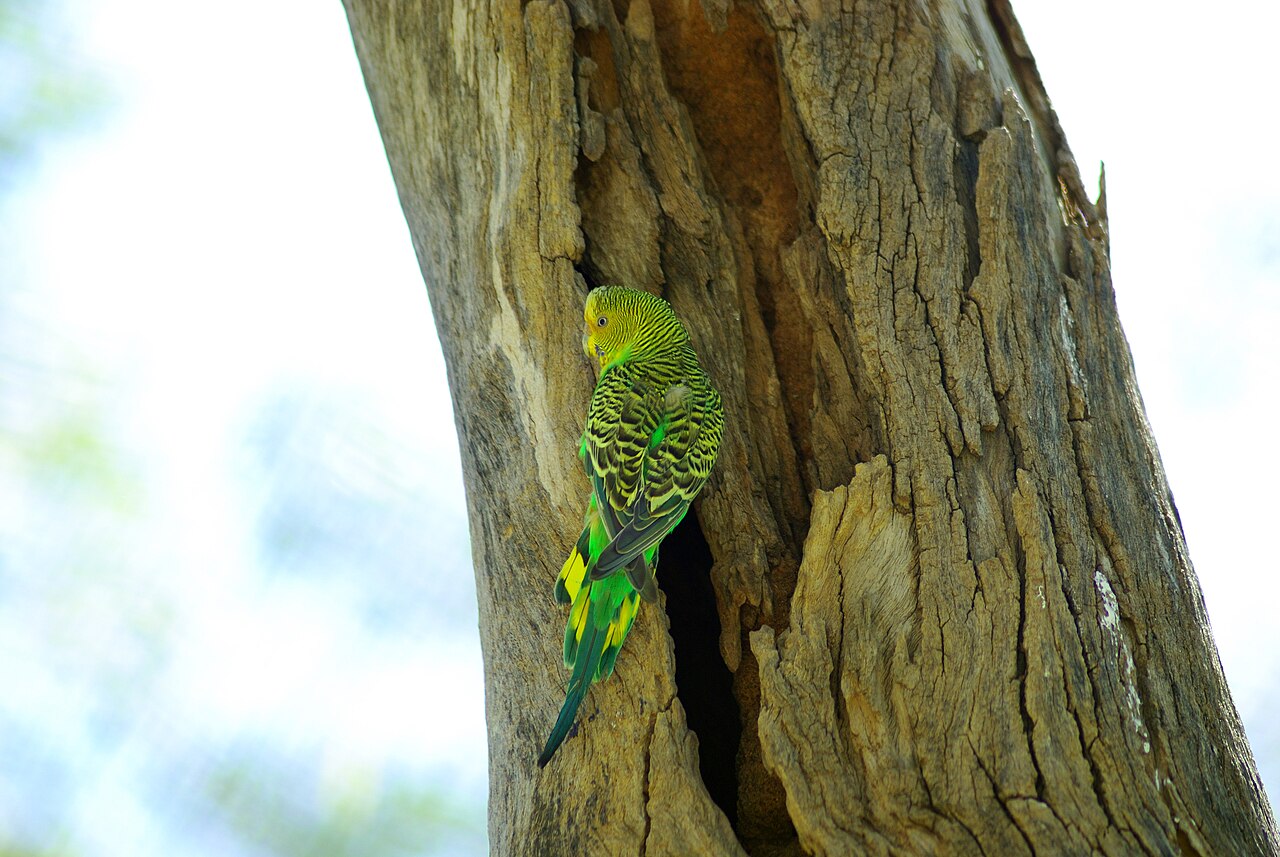
The Budgerigar is the smallest parrot in Australia and at the same time one of the most numerous birds on the continent: under twenty centimetres, grass-green with a yellow head and dense black barring across nape, mantle and wing. In the wild it is a nomad of the dry interior that appears after rain in flocks of thousands — a different animal from the pied cage bird bred worldwide in colours that do not exist in nature.
Voice
A feeding flock sounds like a continuous rustling chatter that never quite stops. The contact call is a rolling, questioning chirr-up, sharpened on sudden flush to a short zit of alarm. The male sings beside the nest hollow a long, varied babble of clicks, rolls and short whistled notes. At a waterhole the sound of hundreds of birds swells into an even hiss carrying far across the plain.
No freely licensed recording has been found for this species yet; what to listen for is described below.
Identification
Seventeen to eighteen centimetres, almost half of it the pointed blue-green tail, and a weight of about thirty grams. Wild birds are always grass-green on breast, belly and rump, with a bright yellow head and throat, three to six round black throat spots and a small iridescent violet-blue cheek patch. Crown, nape, mantle and wing coverts carry fine black barring on yellow, close and narrow on the head and broader out along the wing. The cere above the bill is deep blue in the male, brown in the breeding female and pale blue otherwise. Young birds are duller, carry the barring right down to the forehead and have a dark iris, while adults show a white to yellow iris. Flight is fast and undulating, and a flock turns and tilts as one body.
Confusion species
No other Australian parrot is this small and this finely barred, and the blue, yellow and white varieties of the cage trade do not occur in the wild. At a distance a flock can suggest Little Lorikeet (Parvipsitta pusilla) or Purple-crowned Lorikeet (Parvipsitta porphyrocephala), but those are shorter-tailed, fly arrow-straight to flowering trees and screech rather than chatter. The small parrots of the dry inland — Blue-winged Parrot (Neophema chrysostoma), Turquoise Parrot (Neophema pulchella) and Bourke's Parrot (Neopsephotus bourkii) — also take seed off the ground, but show a plain back without barring and blue, yellow or pink rather than a black-and-yellow barred nape.
Habitat
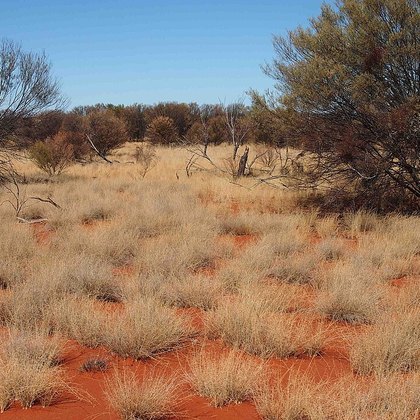
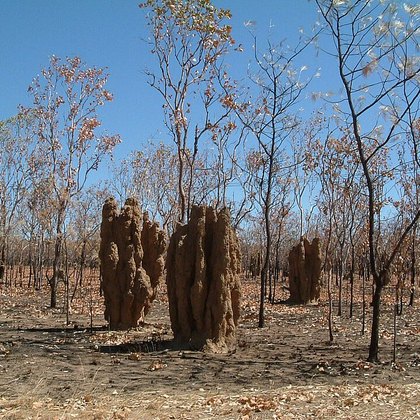
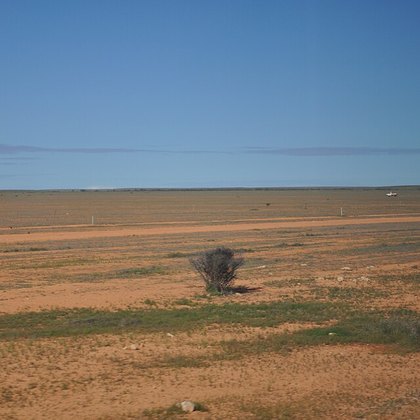
Open dry country with seeding grasses and drinking water within reach: spinifex plains, mulga and acacia scrub, saltbush flats and eucalypt savanna, plus crop margins and grain stubble where those lie inland. It nests in hollows and splits in trees, above all in the river red gums along creeks and ephemeral rivers, and at times in a fallen log or a post hole. Because it must drink daily it is never far from a stock dam, a waterhole or a bore.
Where the bird is most often found, arranged by main group and formation.


Range and movements
Nearly the whole Australian interior west of the Great Dividing Range, from the Pilbara and the Kimberley through the Northern Territory and South Australia into western Queensland and northern Victoria. It is absent from Tasmania, from Cape York and along the wet eastern, northern and south-western coasts; birds appearing there are usually escaped cage stock. New Zealand holds no wild population. Within that vast range nothing is fixed: the birds follow the rain, so a district may be black with parrots one year and empty the next.
- Resident
- dark = core range, pale = thinly spread
Where and when to look
Look for it at water. In the dry inland, sit by a stock dam or the outflow of a bore just after sunrise and wait: the flocks come in low, circle over the water a few times and then drop onto the edge in a single wave. Otherwise drive slowly along a creek lined with old river red gums and listen — the chatter gives them away before you see them. After a good wet spell the country around Alice Springs, the Strzelecki Track and western Queensland are the best bets.
Conservation
Least Concern (LC), and that understates it: the Budgerigar is probably the most numerous parrot in the world, running into the millions in good years. It has gained from stock dams and bores, which brought water to country that once went dry for months. Numbers do swing hard with the rain, and in long droughts whole flocks die at failed waterholes. The worries are longer-term: the loss of old hollow trees along the creeks and the retreat of native seeding grasses under grazing both narrow its nesting and feeding options in time.
Scientific name
Melopsittacus undulatus | (Shaw, 1805)
Shaw described the species in 1805 as Psittacus undulatus in The Naturalist's Miscellany; because it later moved to another genus, author and year are bracketed. Gould introduced the genus Melopsittacus in 1840, from Greek melos 'song' and psittakos 'parrot': the singing parrot. undulatus is Latin for 'wavy' and refers to the black barring across nape and wing. The type locality is New Holland, narrowed to New South Wales. The name budgerigar probably goes back to gidjirrigaa in Gamilaraay, the language of northern New South Wales.