All species › Parrots › Old World parrots › Orange-bellied Parrot
Orange-bellied Parrot | Neophema chrysogaster
Oranjebuikparkiet | Loro ventrinaranja
The Orange-bellied Parrot is one of the most threatened parrots in the world: a small, grass-green bird that breeds only in south-western Tasmania and crosses Bass Strait each winter to the saltmarshes of the mainland. In 2016 seventeen birds were left in the wild, three of them females; that the species is still here at all is the result of one of the most intensive rescue efforts in Australian conservation.
Voice
A curiously buzzing call, unlike the tinkling of its relatives: a single buzzing note repeated every one to three seconds as a contact call, written roughly as tzeet. The alarm is the same note repeated faster and sharper; sentinels in a feeding party mix alarm notes with chattering into a gurgling buzz. While feeding there is a soft, low chittering. Out on mainland saltmarsh that buzz is often the only thing that gives the birds away.
No freely licensed recording has been found for this species yet; what to listen for is described below.
Identification
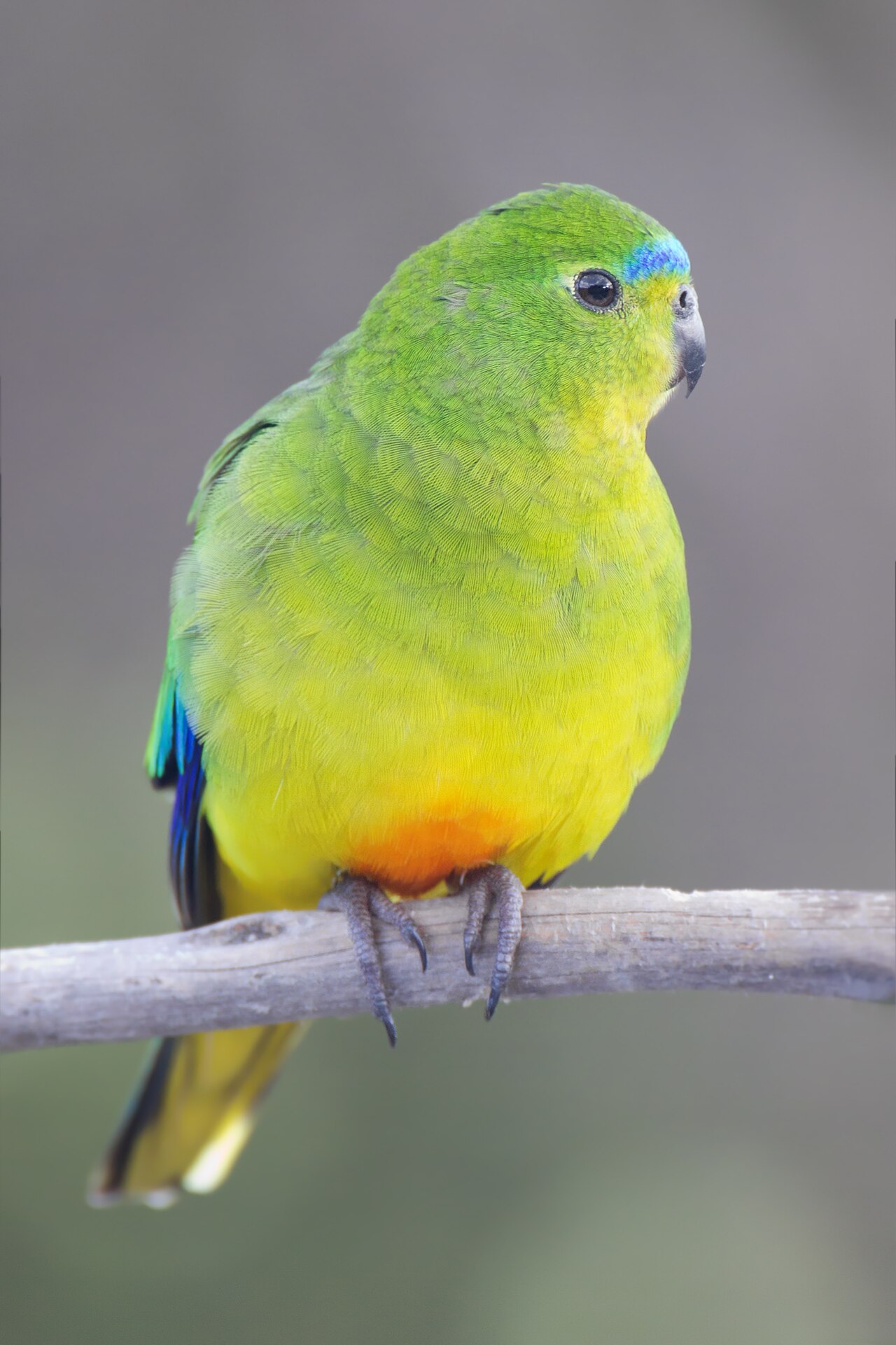
A compact parrot of about twenty centimetres with a fairly short tail. The male is bright grass-green on head, neck and upperparts, yellow-green on breast and belly, with a two-toned blue frontal band — dark blue in the middle, edged with paler blue above and below — reaching back to the eye. Mid-belly carries a sharply bounded orange patch some two centimetres across; the undertail coverts are bright yellow. Wing coverts and flight feathers are dark blue, so the wing shows a blue leading edge. The female is duller green, with a paler frontal band and an orange patch about a third smaller and less distinct. Juveniles are dull yellow-olive and all but lack the frontal band; the bill starts yellowish-orange and turns brown within three months.
Confusion species
This is the classic saltmarsh pitfall, because Blue-winged Parrot (Neophema chrysostoma) winters in exactly the same habitat and is regularly taken for this species. Check the ground colour: bright grass-green here, dull olive there. Check the wing: in Blue-winged almost the whole folded wing is a broad dark blue panel, here the blue is confined to a narrower leading edge. Check the belly: the orange patch here is large, round and cleanly defined, in Blue-winged at most a vague orange wash. And check the call: a buzz against a thin tinkle. Elegant Parrot (Neophema elegans) is golden yellow-green with a broader, doubly edged frontal band and usually no crisp orange patch; Rock Parrot (Neophema petrophila) is dull olive-brown with far more blue across lores and cheeks and no orange belly.
Habitat
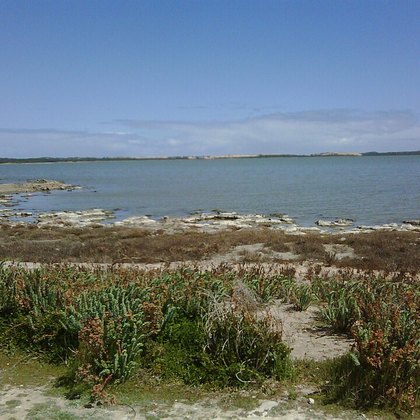
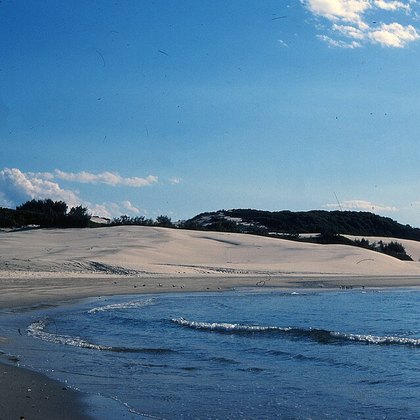
Two very different worlds, by season. For breeding it takes the buttongrass moorland of south-western Tasmania, with scattered eucalypts — Smithton peppermint and swamp gum — along its edges holding the nest hollows; those hollows have entrances of six to ten centimetres and run up to sixty centimetres deep, and since 1991 they have been supplemented with nest boxes. Outside the breeding season it lives in coastal saltmarsh and samphire along estuaries, lagoons and salt flats, almost always within three kilometres of the sea, eating the seed of saltmarsh plants such as glasswort and seablite.
Where the bird is most often found, arranged by main group and formation.


Range and movements
Within this guide's map window the breeding range has shrunk to a single place: Melaleuca in the far south-west of Tasmania, within thirty kilometres of the coast. Birds arrive there in early October and leave from March. Migration crosses Bass Strait, with King Island — Lake Flannigan among other sites — as a staging point, to the coast of Victoria and south-eastern South Australia. Regular wintering sites are the Werribee sewage farm and the rest of the Western Treatment Plant, Swan Bay and Swan Island, Lake Connewarre on the Bellarine Peninsula, Point Wilson and Murtcaim, The Spit, and the wetlands at Yambuk west of Warrnambool. It does not occur in New Zealand or on Norfolk Island.
- Breeding (summer)
- Winter
- dark = core range, pale = thinly spread
Where and when to look
In Tasmania there is really only one address: the feed table and hide at Melaleuca, reached only by boat or light aircraft, between October and February. On the mainland it comes down to saltmarsh in winter: walk slowly along the edge of a samphire flat and listen for the buzz, because the birds sit low among the plants and only show when they flush. Check every supposed Orange-bellied twice — the odds strongly favour a Blue-winged Parrot — and report every certain record to the regional count programme.
Conservation
Critically Endangered (CR) and repeatedly named the Australian bird most likely to become extinct; a 2018 study placed it second on that list. The low point came in February 2017, when fourteen birds were counted in the wild and sixteen individuals were confirmed over that breeding season — thirteen males and three females. Since then there has been a hard-won but real recovery: 118 birds in April 2020, about seventy in December 2021, 91 returning in the 2024–25 season and 86 in December 2025, of which 66 were born wild at Melaleuca and twenty released there as captive-bred juveniles. In the 2024–25 breeding season 27 of 34 monitored nests produced at least 99 fledglings, after which the Recovery Team put the migrating flock at about 172 birds. In the following season, 2025–26, 23 active nests produced at least 46 tagged fledglings, 51 captive-bred juveniles — 25 males and 26 females — were released at Melaleuca, and in June 2026 more than 165 birds set off on migration, 49 of them carrying transmitters. The captive population serves as an insurance against extinction and holds about three hundred birds across five institutions: the facility at Five Mile Beach and Taroona in Tasmania, Healesville Sanctuary, Adelaide Zoo, Moonlit Sanctuary and the Priam Parrot Breeding Centre; in 2024–25 it held forty breeding pairs, the most since 2020–21, and raised fifty young. In 2010 and 2011 twenty-one wild birds were taken in to broaden the genetic base of that programme. The threats stack up: loss and degradation of coastal saltmarsh through grazing by stock and rabbits, altered hydrology, salination, weeds and housing; wind farms and infrastructure in the migration corridor; predation by feral cats and foxes and competition for nest hollows; and above all the consequences of small population size itself — genetic erosion, inbreeding and the risk that one bad year takes everything. On mainland surveys only about a fifth of the birds present are thought to be detected.
Scientific name
Neophema chrysogaster | (Latham, 1790)
Latham described the species in 1790 as Psittacus chrysogaster, so author and year now stand in parentheses. The epithet is from Ancient Greek khrysos 'gold' and gaster 'belly', for the yellow underparts. The type locality is Adventure Bay on Bruny Island, Tasmania; the type was collected on one of Cook's voyages — in March 1773 or in January 1777 — and passed into Joseph Banks's collection, where it was later lost. Gould renamed the species in 1841 as Euphema aurantia and Ewing in the same year as Nanodes gouldii; both are synonyms. The genus Neophema was introduced by Salvadori in 1891. No subspecies are recognised.