All species › Parrots › Old World parrots › Blue-winged Parrot
Blue-winged Parrot | Neophema chrysostoma
Blauwvleugelparkiet | Periquito crisóstomo
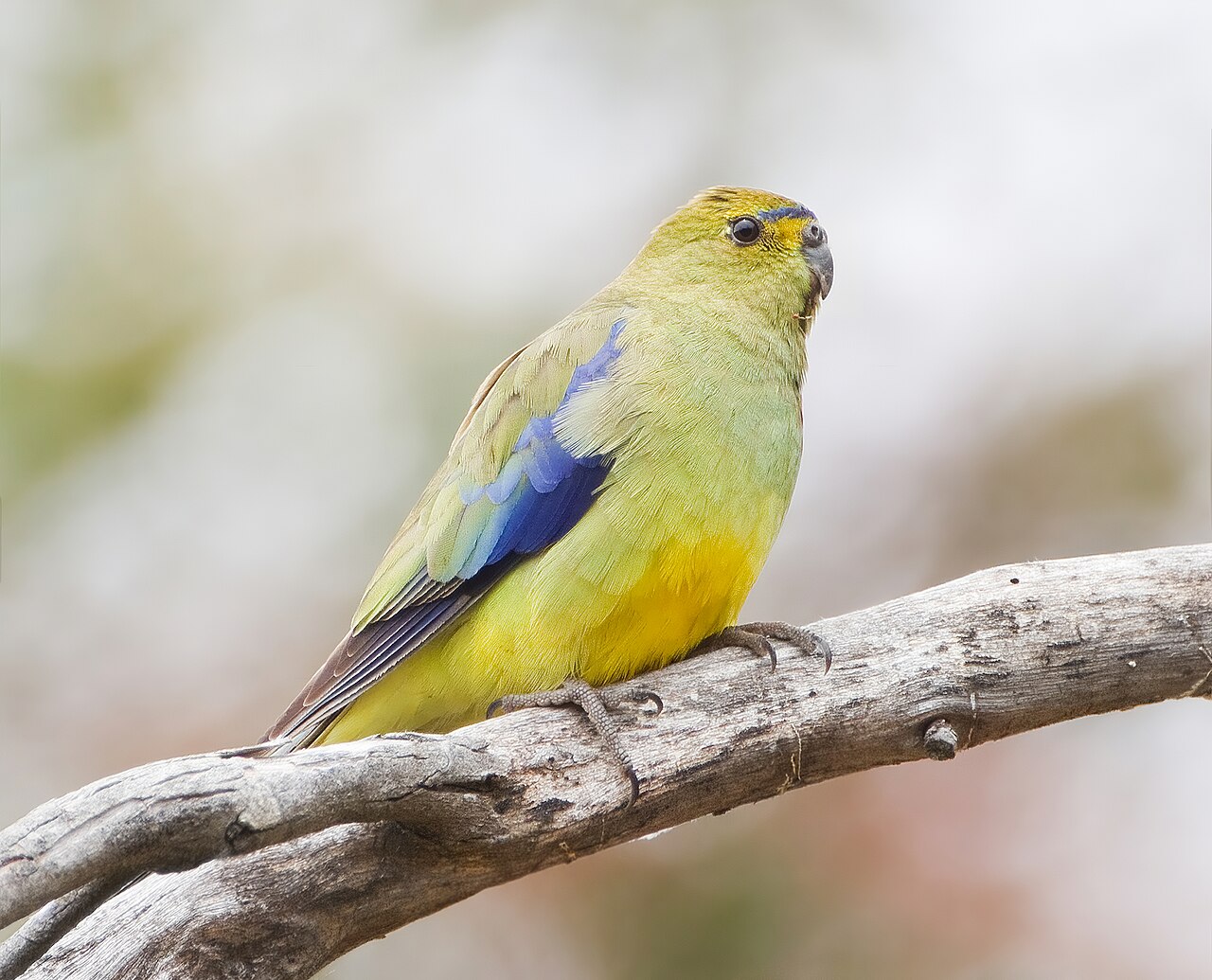
The Blue-winged Parrot is a slender, dull olive-green grass parrot of open grassland and grassy eucalypt woodland in south-eastern Australia, and one of the few parrots in the world that crosses a stretch of sea every year: most of the population breeds in Tasmania and winters on the mainland. The name is honest — of all the grass parrots it carries the largest, darkest blue wing panel.
Voice
A surprisingly un-parrot-like sound: an extremely high, thin tinkling tsit tsit, in fast short bursts followed by slower single notes, closer to the squeak of a thornbill or fairy-wren than to the screech a parrot suggests. A flock lifting off the grass jingles like small bells; on the ground they are almost silent. The alarm is the same note, repeated louder and sharper.
No freely licensed recording has been found for this species yet; what to listen for is described below.
Identification
A parrot of just over twenty centimetres with a long slender tail and a short grey-blue bill. Upperparts dull olive-green, throat and breast light green, belly yellow, sometimes with a faint orange smudge. A narrow dark blue band runs across the forehead from eye to eye, edged below with paler turquoise, but it does not reach behind the eye. Everything turns on the wing: coverts and flight feathers alike are deep dark blue, so the folded wing shows a broad, almost blackish-blue panel and the bird flashes blue from below in flight. The female is duller, with less blue and a fainter frontal band; juveniles lack the band altogether.
Confusion species
Elegant Parrot (Neophema elegans) is the hard case: brighter golden yellow-green, its blue frontal band broader, edged with pale blue above as well as below, and running back to just behind the eye, and on the wing it shows only a narrow blue leading edge instead of a broad panel. Orange-bellied Parrot (Neophema chrysogaster) is bright grass-green rather than olive, more solidly built, with a sharply defined orange belly patch some two centimetres across and a shorter tail. Rock Parrot (Neophema petrophila) is duller and browner still, carries far more blue on the face — across lores and forecheeks — and stays almost entirely within a few hundred metres of the coast.
Habitat
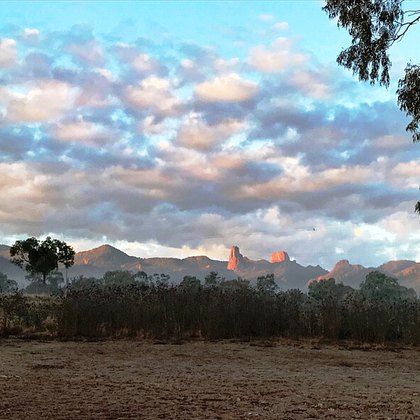
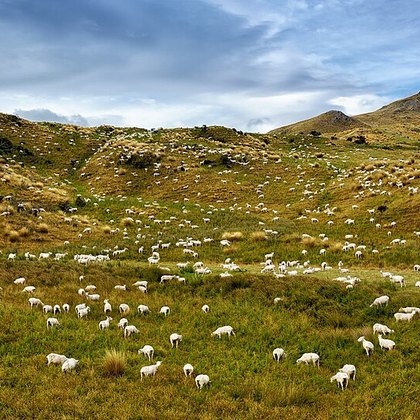
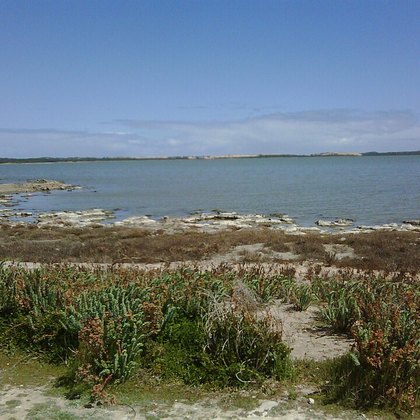
Grassland and grassy eucalypt woodland, from the coast far inland into semi-arid country, often near water. In Tasmania it belongs to open forest edges and the buttongrass plains; on the mainland to paddocks, airfields, golf courses, roadsides and stubble. In winter part of the population drops down to samphire and saltmarsh along the coast. It feeds almost always on the ground, among low grass and seeding herbs.
Where the bird is most often found, arranged by main group and formation.

Range and movements
Breeds in Tasmania, on the Bass Strait islands, in southern Victoria and in south-eastern South Australia. Outside the breeding season the Tasmanian birds cross Bass Strait in March and April and return between August and October, with King Island a regular staging point. On the mainland it wanders further north, scattered through inland New South Wales and Victoria and in dry years into south-western Queensland and as far north as Diamantina. It does not occur in New Zealand.
- Resident
- dark = core range, pale = thinly spread
Where and when to look
Look on the ground, not in the tree: walk a grassy paddock or an airfield edge in early morning and watch for small birds that tinkle high and thin as they flush. Then go straight to the wing — the broad dark blue panel is the one feature that still holds at fifty metres. Outside the breeding season flocks of twenty to a hundred are usual, and they circle back to exactly the same patch.
Conservation
Vulnerable (VU). The species long counted as common, but numbers have fallen across the range and the IUCN has moved it up accordingly. The causes sit at both ends of the migration: loss of grassy woodland and of old trees with nest hollows on the breeding side, and on the wintering grounds the ploughing and salting of grassland and the loss of saltmarsh. Add losses to feral cats and foxes. Because it shares its winter quarters with the critically endangered Orange-bellied Parrot it benefits from the restoration of coastal saltmarsh in Victoria and South Australia — but it is also regularly mistaken for that species, which muddies the counts.
Scientific name
Neophema chrysostoma | (Kuhl, 1820)
Kuhl described the species in 1820 as Psittacus chrysostomus, so author and year now stand in parentheses. The epithet is from Ancient Greek khrysos 'gold' and stoma 'mouth', and refers to the yellow skin around the bill base and eye, not to the belly. The genus Neophema was introduced by Salvadori in 1891: literally 'the new Euphema', after Wagler's older genus, itself from euphemos 'auspicious, of good report'. The type locality is in Tasmania.