All species › Parrots › Old World parrots › Elegant Parrot
Elegant Parrot | Neophema elegans
Prachtparkiet | Periquito elegante
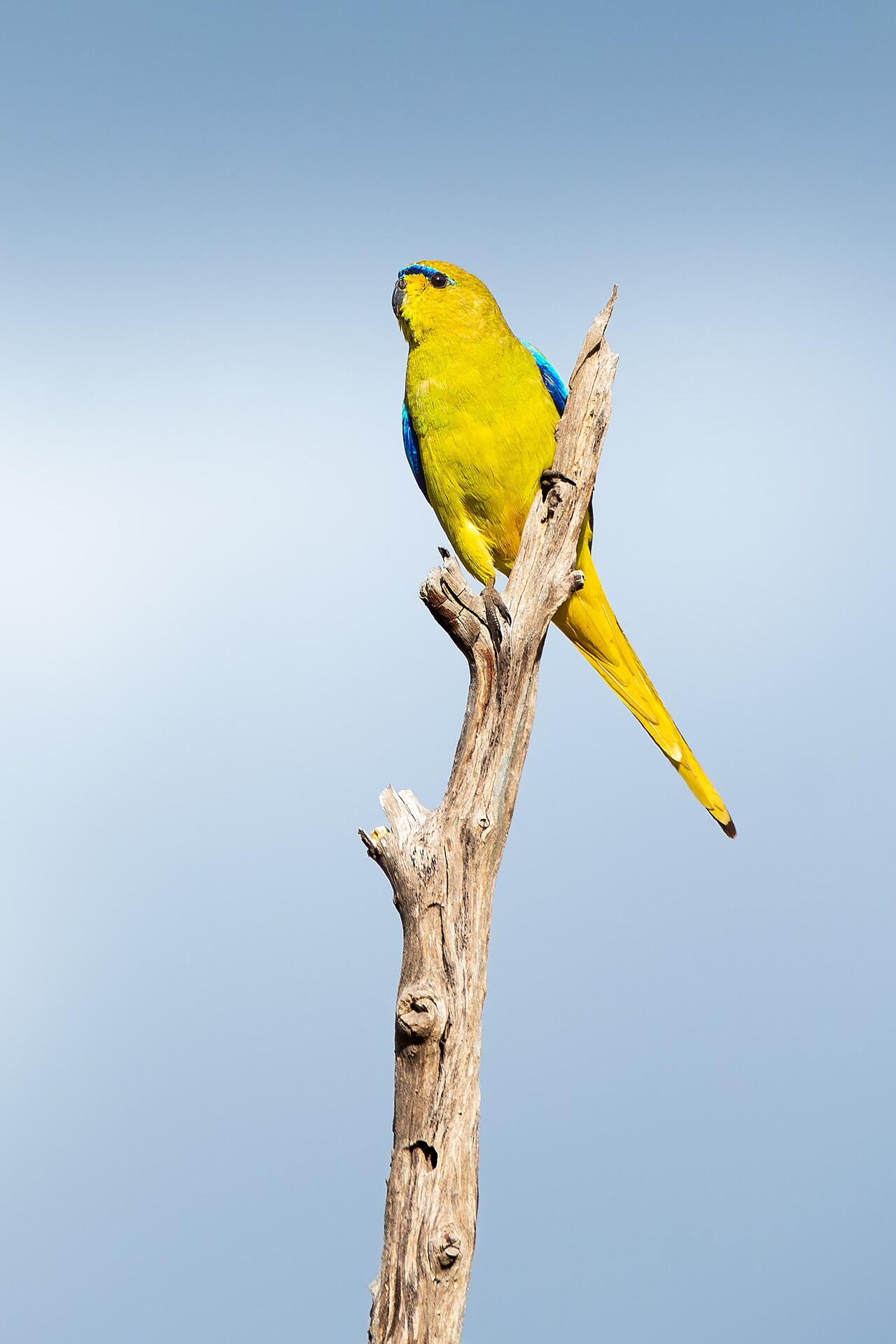
The Elegant Parrot is an olive-green grass parrot with a golden-yellow tone, and with its long slender tail one of the longest of the group. It lives in two separate blocks either side of the Nullarbor, is locally numerous in the Western Australian wheatbelt, and is increasing rather than declining.
Voice
A high, clear tinkling tsit-tsit, repeated quickly on take-off and often from a whole party at once, so that it carries across the grass like a handful of small bells. It is a shade fuller and less thin than the Blue-winged Parrot's call, but that difference only becomes usable when you hear the two close together. Feeding birds keep up a soft twitter; the alarm is a short shrill note.
Recording: Eddy Smith — CC BY-NC-SA 4.0 · Cox Scrub Conservation Park (near Ashbourne), Alexandrina Council, South Australia, Australia · xeno-canto
Identification
A slender parrot of about twenty-three centimetres with a long tail. Unlike the other olive-green grass parrots it is predominantly golden olive to golden yellow-green, which makes it look warm and bright in sunlight. The blue frontal band is the key feature: dark blue in the middle, edged with a paler blue line above as well as below, and running back to just behind the eye. Belly and undertail coverts are yellow, usually with an orange patch in the centre of the belly. On the wing only the outer edge is dark blue: the folded wing shows a narrow blue leading edge, not a broad panel. Bill and legs grey, eye dark brown. The female is duller olive with a narrower frontal band; juveniles lack the band.
Confusion species
Blue-winged Parrot (Neophema chrysostoma) is the real problem, and the two overlap in South Australia and western Victoria. Three things separate them: ground colour is dull olive-green there and golden yellow-green here; the frontal band is narrow there, edged pale only below and stopping at the eye, broader here, edged on both sides and running behind the eye; and above all the blue on the wing is a broad, almost blackish-blue panel across the whole folded wing there, no more than a narrow leading edge here. Rock Parrot (Neophema petrophila) is duller and browner, carries blue across lores and cheeks rather than only a band, and stays on the coast. Orange-bellied Parrot (Neophema chrysogaster) is brighter grass-green with a sharply bounded round orange belly patch and occurs only in the far south-east.
Habitat
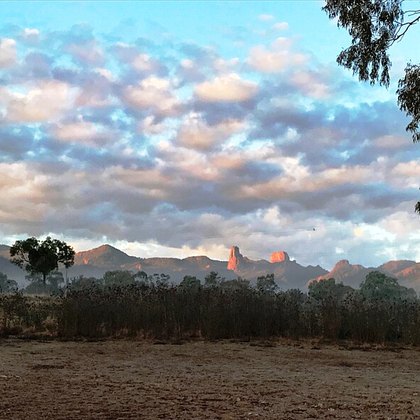
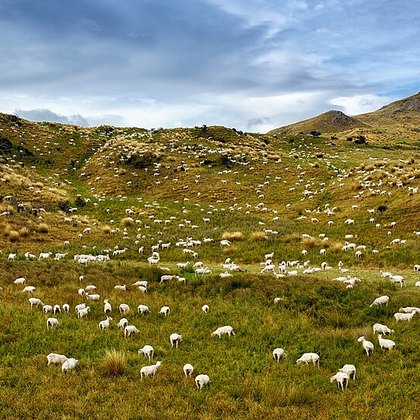
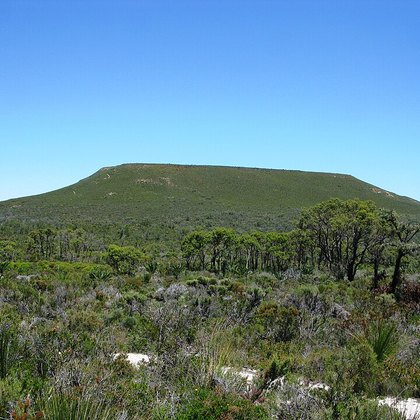
Open grassy country with scattered trees: eucalypt woodland and the edges of mallee (low, multi-stemmed eucalypt scrub of dry southern Australia), kwongan (species-rich heath-like scrub of south-western Australia) heath in the west, and above all the man-made versions of those — grain paddocks and stubble, pasture, wide roadside verges with remnant trees, orchards and fallow. It nests in eucalypt hollows, often high, above fifteen metres, and feeds on the ground on grass and herb seed. It is precisely the mosaic of cropland with tree lines along it that appears to suit it.
Where the bird is most often found, arranged by main group and formation.


Range and movements
Two separate blocks. In the west, south-western Western Australia, roughly from Moora in the north through Merredin to Esperance on the south coast — the wheatbelt. In the east, south-eastern South Australia, including the Eyre and Yorke peninsulas and the Murray country, running on into western Victoria. The Nullarbor separates the two. The range has expanded in both parts since the land was opened up for grain. It does not occur in Tasmania, New Zealand or on Norfolk Island.
- Resident
- dark = core range, pale = thinly spread
Where and when to look
Drive a wide roadside verge with old eucalypts in the Western Australian wheatbelt early in the morning and watch for small parrots that flush off the verge and drop straight back down. Then go to the head: the doubly edged blue band running behind the eye is what separates it from Blue-winged Parrot, and that works best when the bird settles briefly on a post or a wire. After harvest, stubble paddocks are a reliable place.
Conservation
Least Concern (LC), with an increasing population — one of few Australian parrots of which that can be said. Clearing for grain has helped rather than harmed it, because it produced exactly the open, seed-rich country in which it does best, as long as enough old hollow-bearing trees survive along the edges. That is also where it is vulnerable: where the last old eucalypts go from cropland, the nest hollows go with them, and feral cats and foxes take birds off the ground. At landscape scale there is no cause for concern for now.
Scientific name
Neophema elegans | (Gould, 1837)
Gould described the species in 1837 as Euphema elegans, from material at the Swan River in Western Australia, so author and year now stand in parentheses. The epithet is Latin elegans, 'elegant, choice', and the Dutch, English and Spanish guide names all go back to it. The genus Neophema was introduced by Salvadori in 1891 and means 'the new Euphema', after Wagler's older genus, itself from Greek euphemos 'auspicious, of good report'.