All species › Parrots › Old World parrots › Rock Parrot
Rock Parrot | Neophema petrophila
Rotsparkiet | Periquito roquero
The Rock Parrot is the coastal bird among the grass parrots: a dull olive-brown parrot that is hardly ever found more than a few hundred metres from the sea, living on bare rocky shore, dunes and offshore islands along the south and west coasts of Australia. It does not nest in a tree hollow like its relatives but under a stone or in a crevice — the feature its name points to.

Voice
A two-syllabled zitting contact note given in flight and while feeding, written roughly as tsi-tsit. The alarm is the same note but markedly louder and sharper, and it carries far above the surf. Parties lifting off the saltmarsh rattle over one another briefly and then fall silent. The voice is less thin than the Blue-winged Parrot's and less clear than the Elegant Parrot's.
Recording: JACOB Hervé — CC BY-SA 4.0 · Deepdene, Shire of Augusta Margaret River, Western Australia, Australia · xeno-canto
Identification
A stocky parrot of about twenty-two to twenty-four centimetres with a short tail, and at some 50 to 60 grams the heaviest of the grass parrots; the wingspan is 33 to 34 centimetres. Upperparts are dull olive-brown — no other species in the group is so colourless — and the underparts pale yellow-green, with no orange on the belly. The head is where it gives itself away: a dark blue band runs across the upper forehead between the eyes, edged above by a thin light blue line, with a thicker light blue band below it; in addition the lores and forecheeks are light blue, so the whole front of the face reads as blue rather than as a single stripe. The folded wing shows a two-toned blue leading edge, the tail is turquoise edged with yellow. In the female the dark blue is slightly duller and there is less blue on the face. Bill black, eye dark brown, legs and feet dark grey.
Confusion species
Blue-winged Parrot (Neophema chrysostoma) winters in the same South Australian coastal saltmarshes and is then the main confusion: greener and less brown, with only a narrow blue band across the forehead and no blue over the cheeks, but with a broad dark blue panel across the whole folded wing where this species shows only a narrow leading edge. Elegant Parrot (Neophema elegans) is far warmer golden yellow-green, has an orange belly patch and sits inland in grain country rather than on the rocky shore. Orange-bellied Parrot (Neophema chrysogaster) is bright grass-green with a round orange belly patch and does not occur on these coasts. The clinching argument is usually place: a dull brownish little grass parrot on bare rock platform just above the tide line is almost always this species.
Habitat
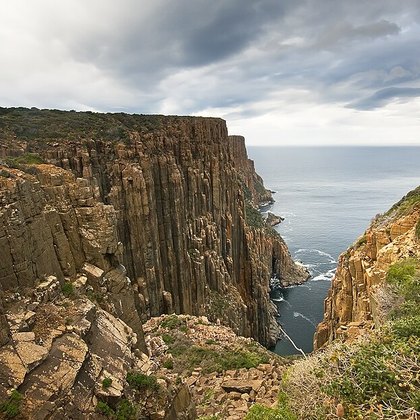
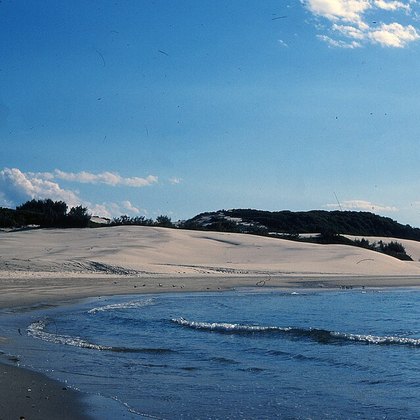
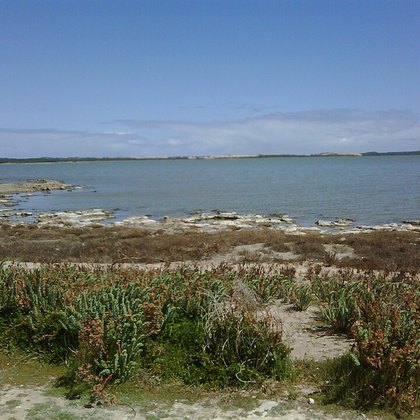
Bare rocky ground, rocky shore and sea cliff, and low coastal vegetation of tough salt-tolerant plants: pigface, saltbush (salt-tolerant dwarf shrubland of saline plains) and samphire (low, succulent saltmarsh shrubland on tidal mud). It comes right down to the high-water mark and feeds on the naked rock and among the coastal herbs, and also uses sandy beach, dune foot and the edges of estuaries and coastal lagoons. It nests under boulders, in crevices and in burrows, often on predator-free islets, from August to December; the clutch is three to six white eggs, incubation runs eighteen to twenty-one days and the young fledge at around thirty days.
Where the bird is most often found, arranged by main group and formation.

Range and movements
The south and west coasts of Australia and their offshore islands. In South Australia from Lake Alexandrina westwards, along Gulf St Vincent, Yorke Peninsula, Kangaroo Island, the Gambier Islands and Eyre Peninsula. In Western Australia from the Eyre Bird Observatory in the east along the whole southern and western coastline to Jurien Bay, with important island populations on Rottnest Island, in the Recherche Archipelago and on Eclipse Island. It is tied to the coastline and does not go inland, nor to Tasmania, New Zealand or Norfolk Island.
- Resident
- dark = core range, pale = thinly spread
Where and when to look
Look for it on foot across a bare rock platform or a saltmarsh edge on the south coast, preferably early in the day; it flushes late and then drops again a short way off with a fast low flight. On Rottnest Island and in the Recherche Archipelago a boat trip makes it fairly easy. With every grass parrot seen on the coast, go to the face pattern — the extensive light blue over lores and cheeks is the feature that works without a telescope.
Conservation
Least Concern (LC), but with a declining world population, and listed on CITES Appendix II as all parrots are. The range is long and narrow and lies exactly where pressure is greatest: coastal building, recreation and trampling of nest sites on the mainland. The greatest threat is feral cats and foxes, which reach ground nests easily — which is why the densest populations sit on predator-free islets. Sea level rise hits it directly too, because nests under boulders just above the tide line flood in heavy storms. The island populations are therefore both the species' stronghold and its gauge.
Scientific name
Neophema petrophila | (Gould, 1841)
Gould described the species in 1841, from material on the islands off the coast of Western Australia; author and year stand in parentheses because he did not originally place it in the present genus. The epithet is built from Greek petra 'rock' and philos 'loving', hence 'rock-loving' — a reference to both the nest site and the habitat, and the source of the Dutch, English and Spanish guide names. The genus Neophema was introduced by Salvadori in 1891 and means 'the new Euphema'. Two subspecies are recognised.