All species › Parrots › Old World parrots › Turquoise Parrot
Turquoise Parrot | Neophema pulchella
Turkooisparkiet | Periquito turquesa
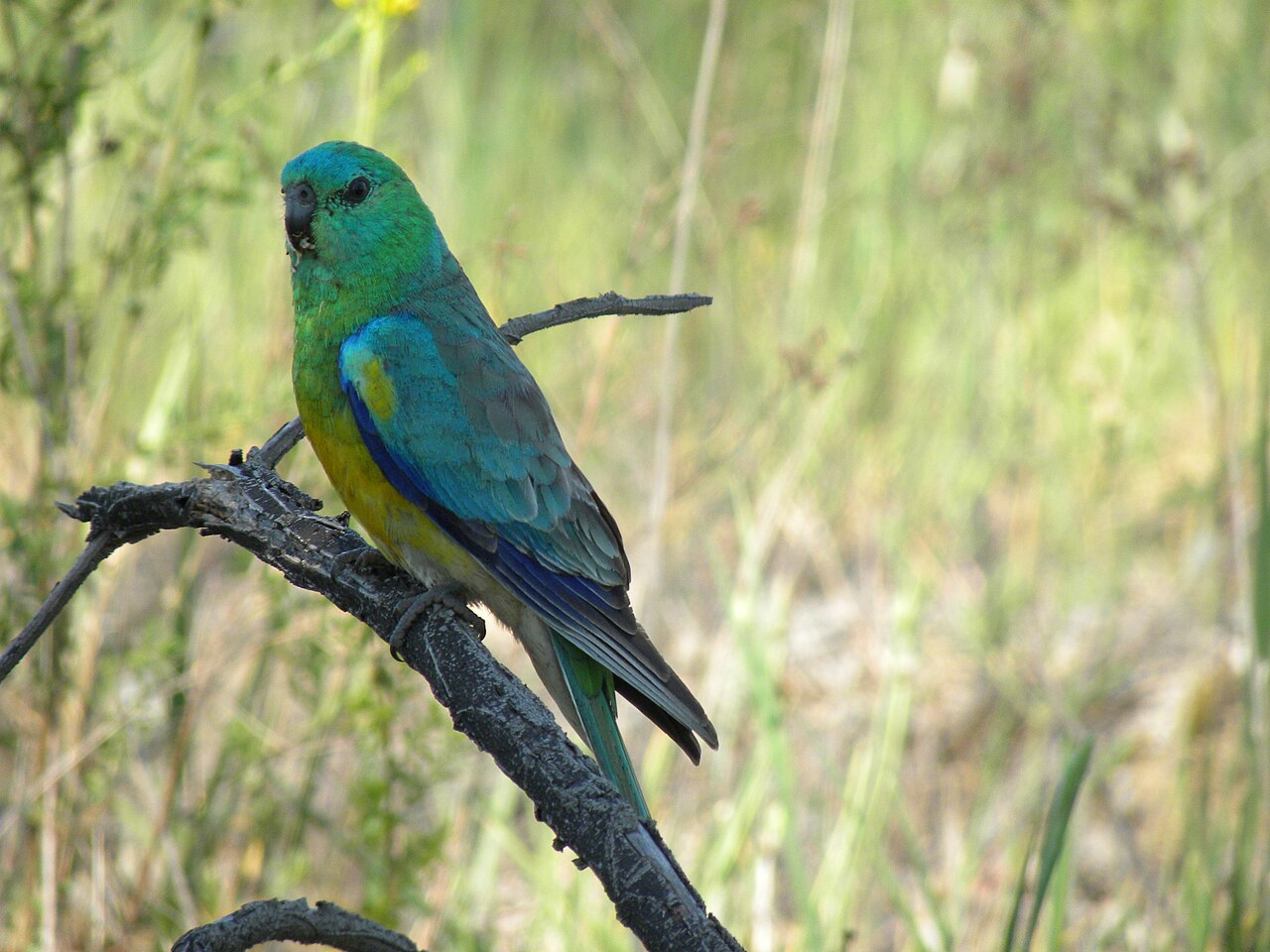
The Turquoise Parrot is the grass parrot of the eastern inland slopes: grass-green above, bright yellow below, with an entirely turquoise-blue face and, in the male, a red shoulder band that no other species in the group carries. Its history is remarkable — by about 1915 it was thought all but extinct, after which it came back of its own accord from the 1930s on.
Voice
Soft and high: a fine, muted contact note given both while feeding and in flight, roughly tseet, and at disturbance a high sharp zitting note repeated quickly. Towards dusk parties chatter at length over one another as they settle at a roost; that evening chatter is often the clearest sound it makes. It is never loud.
No freely licensed recording has been found for this species yet; what to listen for is described below.
Identification
A parrot of twenty to twenty-two centimetres, with a wingspan of about thirty-two centimetres and a weight around forty grams — the lightest member of the group. The male has a bright turquoise-blue face darkening towards the crown; upperparts and tail are grass-green with yellow tail edges. On the folded wing the covert panel is vivid blue with a red shoulder band across it; spread, that becomes dark blue with red along the trailing edge. Underparts are bright yellow, sometimes with an orange wash on the belly. The female is duller and paler, with a uniform pale blue face and a highly contrasting cream bare eye-ring, lacks the red shoulder band, and shows a broad white bar across the underwing in flight.
Confusion species
The female Scarlet-chested Parrot (Neophema splendida) is the hard case: she too has a blue face and a yellow belly, but her blue is deeper and more even, she lacks the conspicuous cream eye-ring and the white underwing bar, and the two barely overlap — Scarlet-chested sits in the arid interior far to the west. Blue-winged Parrot (Neophema chrysostoma), Elegant Parrot (Neophema elegans) and Orange-bellied Parrot (Neophema chrysogaster) all three carry only a narrow blue band across the forehead instead of a wholly blue face, and are olive or golden green rather than grass-green. The male's red shoulder band is unique among these seven species and rules everything else out at a glance.
Habitat
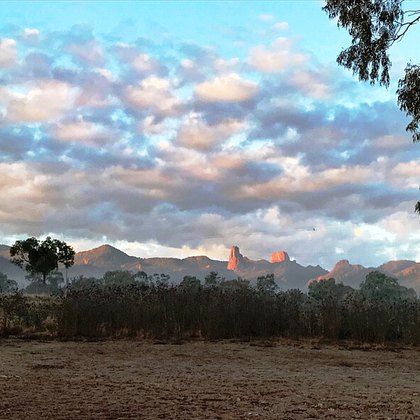
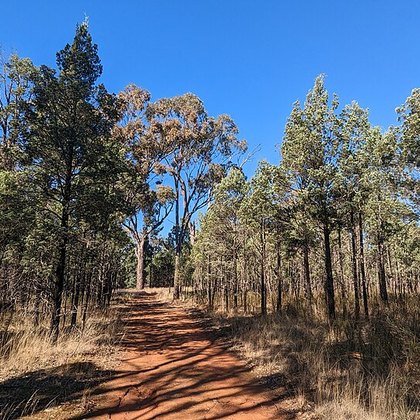
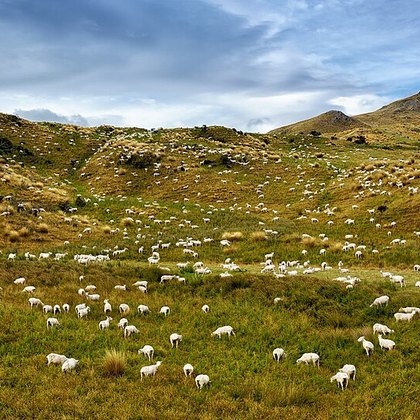
Open eucalypt and savanna woodland and above all native cypress, the callitris, with a grassy understorey and seeding herbs. It likes transitions: rocky ridges and gullies, forest edges against grassland, and the tree belts along creeks. It nests in vertical or near-vertical hollows of live and dead trees, usually eucalypts, from August to January, with two to five — rarely up to eight — white eggs, eighteen to twenty-one days of incubation and young that fledge as early as twenty-three days. It feeds on the ground, often in the shade of the woodland edge.
Where the bird is most often found, arranged by main group and formation.

Range and movements
The eastern inland slopes of Australia, roughly from south-eastern Queensland — Cooloola, Blackbutt and Chinchilla — through central and eastern New South Wales to north-eastern Victoria around Wangaratta and into East Gippsland. Its centre of gravity is the western slopes of the Great Dividing Range in New South Wales. Historically the range ran from Mackay to Melbourne; after the collapse around 1900, Victoria was not recolonised until the 1960s. It does not occur in Tasmania, New Zealand or on Norfolk Island.
- Resident
- Passage
- dark = core range, pale = thinly spread
Where and when to look
Look for it on the boundary of callitris woodland and grassland on the western slopes of New South Wales, in early morning or the last hour before sunset, when it is seeking seed on open ground. It is quiet and keeps low; usually you only see it when it flushes, and then you must go straight to the wing, because the male's red shoulder band shows for half a second. A pool in the woodland in late afternoon is a second good bet.
Conservation
Least Concern (LC) with a stable population, but the species has a cautionary history. Until the 1880s it was widespread from Mackay to Melbourne; it then collapsed through clearing of woodland, overgrazing of the herb layer by stock and rabbits, and wholesale trapping for the bird trade, until in 1915 it was considered all but extinct. From the 1930s numbers in New South Wales grew again, and in the 1960s it returned to Victoria. The recovery is uneven, though: in Victoria it remains scarce and confined to a few districts, and the bottleneck is still the same — the loss of old trees with nest hollows and of the grassy, seed-rich understorey, plus predation by feral cats and foxes while it feeds on the ground. As an aviary bird it is now so widely bred that wild-taking no longer plays a part.
Scientific name
Neophema pulchella | (Shaw, 1792)
Shaw described the species in 1792 as Psittacus pulchellus, from a bird taken around Port Jackson, now Sydney, so author and year stand in parentheses. The epithet is Latin pulchellus, a diminutive of pulcher 'beautiful', so something like 'pretty little one', while the English and Dutch names put a colour reference to the turquoise face in its place. The genus Neophema was introduced by Salvadori in 1891 and means 'the new Euphema', after Wagler's older genus.