All species › Parrots › Old World parrots › Scarlet-chested Parrot
Scarlet-chested Parrot | Neophema splendida
Glansparkiet | Periquito espléndido
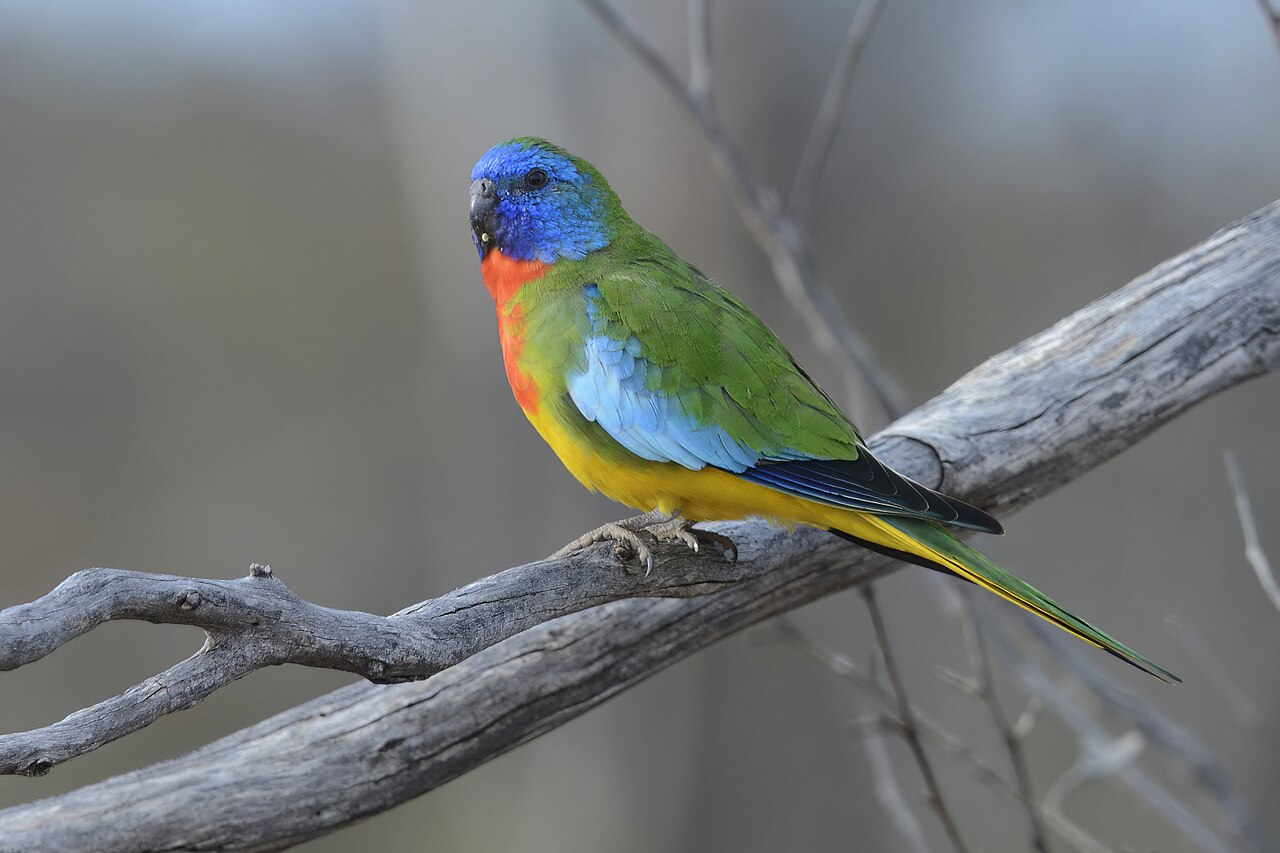
The Scarlet-chested Parrot is the least often seen of the grass parrots: a small bird of spinifex and mulga (acacia scrub of the dry interior, dominated by Acacia aneura) country in the arid interior, the male with a cobalt-blue face, a grass-green back and a blazing scarlet breast. It is nomadic and unpredictable — absent from a district for years, then suddenly present in dozens after a wet winter.
Voice
Notably soft for a parrot and clearly quieter than any other species in the genus: a thin, muffled twitter tsit-tsit-tsit, often carrying no more than a few tens of metres. In flight comes a thin descending contact note; feeding parties keep up a barely audible chatter. Because of that quietness it often goes unnoticed in the field.
Recording: Louis Masarei — CC BY-NC-SA 4.0 · Cosmo Newbery, Shire of Laverton, Western Australia, Australia · xeno-canto
Identification
A parrot of some twenty centimetres. The male is unmistakable: the whole face back past the eye is deep cobalt blue, crown and upperparts bright grass-green, the breast a large, sharply bounded scarlet patch, belly and undertail coverts yellow. Wing coverts are pale blue with dark blue primaries, so the folded wing shows two tones of blue. The female lacks the red entirely: face paler blue and less extensive, breast green, belly yellow. Young males get their first red feathers at two to three months, but the full scarlet breast only at fifteen to eighteen months.
Confusion species
The male can be confused with nothing — no other grass parrot has a red breast. The female is the problem. She closely resembles the female Turquoise Parrot (Neophema pulchella), but that bird has a pale, washed-blue face with a conspicuous cream bare eye-ring, a white bar on the underwing in flight, and lives far to the east in eucalypt and callitris woodland. In Blue-winged Parrot (Neophema chrysostoma) and Elegant Parrot (Neophema elegans) the blue on the head is confined to a narrow frontal band rather than a whole blue face, and the upperparts are olive or golden green rather than grass-green. Orange-bellied Parrot (Neophema chrysogaster) likewise has only a frontal band, carries an orange belly patch, and occurs only in the far south-east.
Habitat
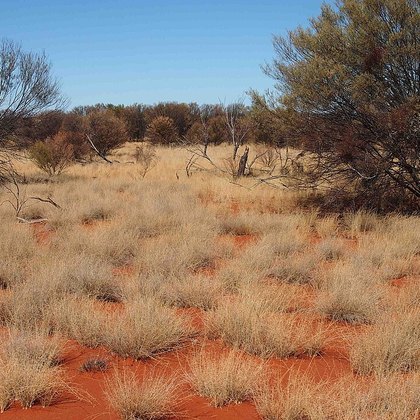
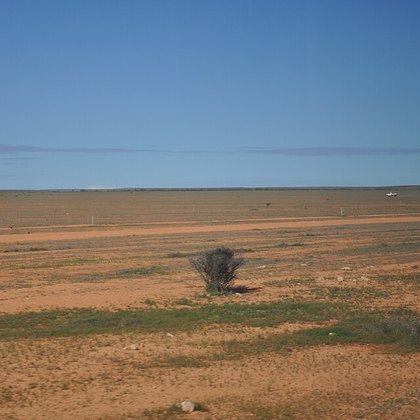
Dry inland scrub and grassland: mallee (low, multi-stemmed eucalypt scrub of dry southern Australia), mulga and acacia scrub, saltbush (salt-tolerant dwarf shrubland of saline plains) plains with Atriplex, and the margins of spinifex country with Triodia. It needs shrubs or low trees with hollows to nest in, and otherwise open ground carrying seeding herbs. Unlike most parrots it can go long periods without open water, taking moisture from dew and from succulent seeds and leaves — which is why it is often in country where no drinking place can be found at all.
Where the bird is most often found, arranged by main group and formation.


Range and movements
The interior of southern Australia, centred on the Great Victoria Desert and the country around it: from south-eastern Western Australia through northern and western South Australia to the southern Northern Territory and the far west of New South Wales. Those limits shift greatly: after good rain it appears well outside the core, in dry years it vanishes from whole districts. It does not occur in Tasmania, New Zealand or on Norfolk Island.
- Resident
- Passage
- dark = core range, pale = thinly spread
Where and when to look
Do not count on searching, count on timing: follow reports of rain in the interior and go one or two seasons later, when the herb layer is in seed. Drive sandy two-wheel tracks through mallee and spinifex (spiny, hummock-forming desert grass of the interior) slowly in early morning and watch for small parrots lifting off the bare verge. The call is little help — too soft — so watch for the vivid green and, with luck, the red breast of a male in the sun.
Conservation
Least Concern (LC), with a stable population: the range is very large and lies mostly in thinly settled, uncleared interior. Even so the species is scarce everywhere and very patchily distributed, and estimates are uncertain precisely because it is so nomadic and so quiet. Local threats are the loss of the herb layer to grazing by stock, goats and rabbits, too frequent and too extensive fire in spinifex country, and predation by feral cats and foxes. It is also a sought-after aviary bird; the trade now rests almost entirely on captive-bred stock, so wild-taking plays only a limited part.
Scientific name
Neophema splendida | (Gould, 1841)
Gould described the species in 1841 as Euphema splendida, from material out of the interior of southern Australia, and because it now stands in Neophema, author and year are in parentheses. The epithet is Latin splendidus, 'shining, splendid', which is what the Dutch guide name is built on, while the English name picks out the male's scarlet breast instead. The genus Neophema was introduced by Salvadori in 1891 and means 'the new Euphema', after Wagler's older genus.