All species › Parrots › Old World parrots › Bourke's Parrot
Bourke's Parrot | Neopsephotus bourkii
Bourkes parkiet | Periquito rosado
Bourke's Parrot is the odd one out among the grass parrots: not green but earth-brown and pink, a soft, dusty bird of the mulga scrub of inland Australia. It is also the only one of the group that is mainly active in the half-light — it comes to drink at sunrise and sunset, and through the middle of the day it sits motionless and all but invisible in an acacia.

Voice
Soft and melodious, far less shrill than the related Neophema parrots: a friendly two-syllable whistle chu-wee as a contact call, and in flight a soft twittering tseet-tseet. Drinking at dusk, a whole party keeps up a low continuous chatter, and a startled bird gives a short high tseep. Standing at a waterhole in the evening, you usually hear it before you see it.
No freely licensed recording has been found for this species yet; what to listen for is described below.
Identification
A parrot of about twenty centimetres, grey-brown to chocolate above with pale feather edges that give the back a scaled look, and pink to salmon below on breast and belly. Rump, undertail coverts and the bend of the wing are bright blue, showing in flight as a blue flash along the wing edge and beneath the tail. The male has a clear blue brow stripe above the eye and a paler, almost whitish forehead; in the female that brow stripe is absent or reduced to a trace and the pink below is paler. Bill grey-brown, eye dark. Sitting on bare ground under a mulga bush it is barely separable from the sand.
Confusion species
Within the grass parrots confusion is effectively ruled out: every Neophema in this group — Blue-winged Parrot (Neophema chrysostoma), Elegant Parrot (Neophema elegans), Rock Parrot (Neophema petrophila), Turquoise Parrot (Neophema pulchella), Scarlet-chested Parrot (Neophema splendida) and Orange-bellied Parrot (Neophema chrysogaster) — is green or olive with a blue frontal band and yellow below, while this bird is brown and pink with no green at all. The field trap is rather Eastern Bluebonnet (Northiella haematogaster), which shares the same inland country: that species is much larger, with a blue face, a yellow belly with a red patch and a much longer tail. A Bourke's flushing into the glare off the sand can also suggest a small dove, until the blue rump and the parrot outline settle it.
Habitat
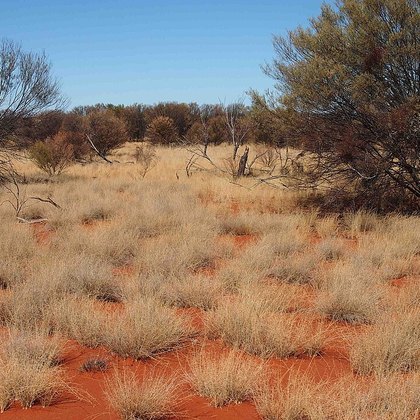
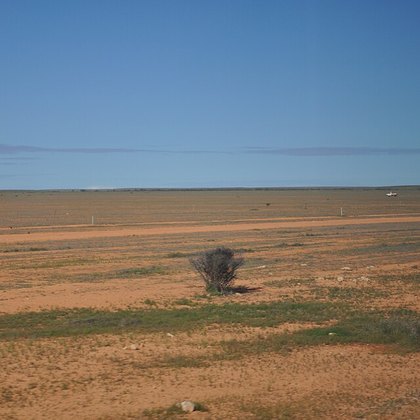
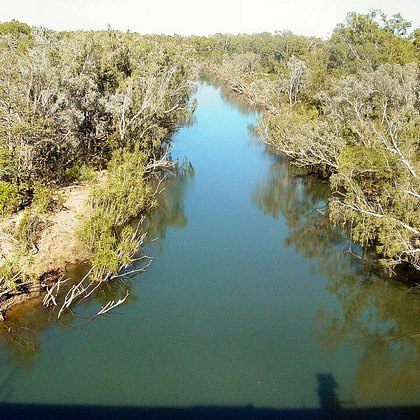
Mulga and acacia scrub on red sand, with open ground and bare patches between, and the edges of spinifex country and saltbush plain. It needs trees or tall shrubs to nest in and to shelter in by day, and water within reach: the species is closely tied to waterholes and stock troughs along creeks. It feeds on the bare ground between the bushes, on seeds of herbs and grasses.
Where the bird is most often found, arranged by main group and formation.

Range and movements
The arid interior of Australia, roughly in a band from central Western Australia through northern South Australia and the southern Northern Territory to western New South Wales and south-western Queensland, centred on the mulga belt. Numbers shift with the rain: after good years it spreads beyond the core, in dry years it pulls back to the creeks. It is absent from Tasmania, New Zealand and Norfolk Island; birds seen elsewhere in the world are cage birds, the species being a popular aviary parrot.
- Resident
- Winter
- dark = core range, pale = thinly spread
Where and when to look
Sit at a stock trough or a remnant pool in a mulga creek in the last half hour before sunset and wait. It comes late, often once the other parrots have fallen silent, in small parties and almost without a sound. By day it rarely gives itself away; the best chance then is a bird that flushes from underfoot and goes to the next bush with a blue rump and a slow, slightly fluttering flight.
Conservation
Least Concern (LC), and of the seven grass parrots the one with the widest margin: the range is enormous, the population stable, and the mulga scrub it lives in is mostly too dry to clear. It has also gained from the spread of stock troughs and bores, which brought permanent water to country that had none. Against that, overgrazing by stock, goats and rabbits strips the herb layer whose seed it eats, and feral cats at waterholes are a real risk. An early dip around 1900, when rabbits and stock ate out the interior, has since been made up in full.
Scientific name
Neopsephotus bourkii | (Gould, 1841)
Gould described the species in 1841 as Euphema bourkii, naming it for Sir Richard Bourke, Governor of New South Wales from 1831 to 1837, so author and year now stand in parentheses. The type locality is on the Bogan River in inland New South Wales, where Gould was travelling. The genus Neopsephotus was introduced by Mathews in 1912 and means 'the new Psephotus', after the genus of the Red-rumped Parrot; psephotos is Greek for 'inlaid with mosaic', a reference to bright plumage. It sits in a genus of its own rather than in Neophema because plumage and build stand clearly apart from the green grass parrots.