All species › Parrots › Old World parrots › Eastern Bluebonnet
Eastern Bluebonnet | Northiella haematogaster
Roodbuikparkiet | Perico cariazul
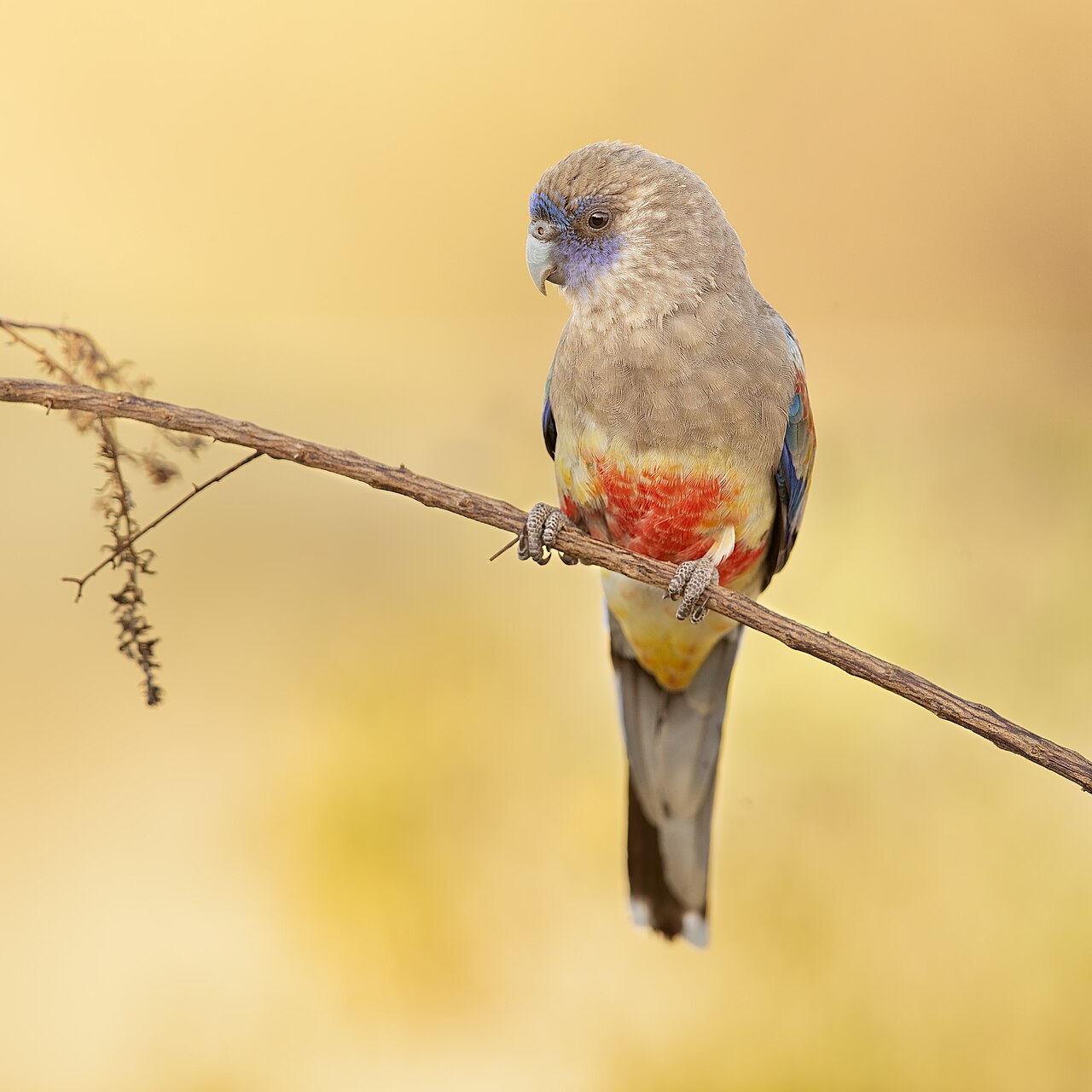
The Eastern Bluebonnet is a solid, long-tailed parrot of the dry interior that looks unremarkably olive-grey at distance, until it takes off: then a deep blue face, a dark blue leading edge to the wing and a red or yellow belly patch light up. It is a bird of half-open shrub plains, often along a quiet road, and it spends much of its time on the ground.
Voice
The usual call is a harsh clipped chack-chack or jak, jaka-jag, which in a party can run into a rattling yak-yak-yak. Besides that come clucking series, cluck-cluck … cluk-cluck, and at times a flute-like clear cloote. The harsh rattle is an identification mark in scrub where the bird stays out of sight.
Recording: Greg McLachlan — CC BY-NC-SA 4.0 · Euabalong, Cobar Shire Council, New South Wales, Australia · xeno-canto
Identification
A parrot of twenty-six to thirty-five centimetres — males are clearly bigger — with a long broad tail. Upperparts, foreneck and breast are olive-grey to grey-brown, which keeps it inconspicuous in shade. The forehead and the whole face back past the eye are bright cobalt blue; the primaries and the leading edge of the folded wing are deep dark blue. The underparts are mostly yellow, with a red patch on the lower belly that differs strongly between subspecies: in the red-vented form the whole vent and undertail-coverts are red and the shoulder patch is largely red, in the yellow-vented form the underside is yellow with a variable red belly patch and the shoulder patch is olive-yellow, and a third, pallid form is washed out throughout with little breast-to-belly contrast. The bill is pearl grey, the cere light grey, the feet dark grey. The female matches the male but is slightly duller.
Confusion species
It is distinctive enough to cause little trouble, but on the ground and against the light an olive-grey parrot in mulga country could as easily be a female Mulga Parrot (Psephotellus varius); that bird is smaller and olive-green rather than grey, lacks the blue face, and carries a yellow frontal band and a red nape patch. The Australian Ringneck (Barnardius zonarius) of the same country is green with a black head and a yellow collar. In the far south-east of Western Australia, around the Nullarbor, it is replaced by the very close western form Northiella narethae, now treated as a separate species — in this guide Naretha Bluebonnet, with its own page — which is smaller, with a pale blue face edged turquoise and an entirely yellow belly patch; so do not let a blue-faced parrot in that border country pass without a note of locality.
Habitat
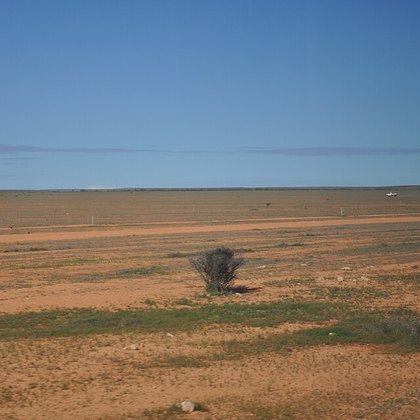
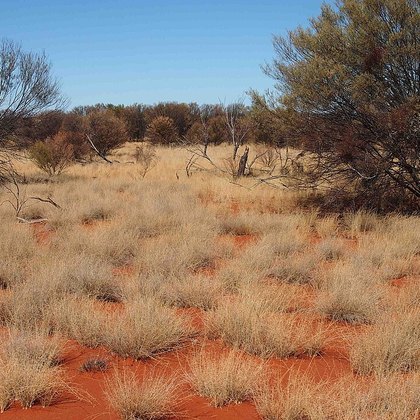
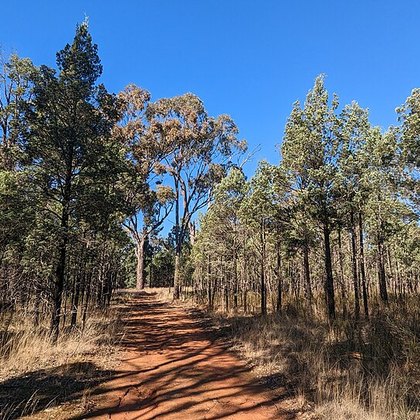
Open shrub plains and lightly wooded interior: groves of western myall and mulga (acacia scrub of the dry interior, dominated by Acacia aneura), belah, native pine and false sandalwood, with a chenopod shrub layer of saltbush (salt-tolerant dwarf shrubland of saline plains) and bluebush (blue-grey salt-tolerant shrubland of the semi-arid interior) beneath and mallee (low, multi-stemmed eucalypt scrub of dry southern Australia) patches here and there. It forages mostly on the ground, in pairs or small parties, on seeds, fruit, flowers and insects, and readily works roadsides and stock water. The nest is in a tree hollow with a narrow entrance, often low; the clutch is usually five eggs, at times up to nine.
Where the bird is most often found, arranged by main group and formation.

Range and movements
The interior of south-eastern and central-southern Australia: from southern Queensland through inland New South Wales and north-western Victoria far into South Australia, and west into south-eastern Western Australia. The three forms each hold their own part of that range. It avoids the humid east coast entirely and is absent from Tasmania, from New Zealand and from Norfolk Island.
- Resident
- dark = core range, pale = thinly spread
Where and when to look
Drive the inland highways of western New South Wales or South Australia slowly and watch the verges: it feeds there willingly and lifts off just ahead of the car, showing the deep blue wing panel and the red or yellow of the belly in one movement. On foot in myall or belah scrub the harsh yak-yak gives it away before the eye does. Always note how far the red runs down the underside, because that settles the subspecies on the spot.
Conservation
Least Concern (LC). It is widespread across a very large, thinly settled interior, and it has certainly gained from the thousands of artificial stock waters. Against that stand local losses: clearing of myall, belah and native pine scrub for crops and grazing has made whole districts unusable, heavy grazing by sheep, goats and rabbits strips the chenopod layer and the seeding herbs, and old hollow-bearing trees grow scarce. Because it favours roadside feeding, traffic is a conspicuous cause of death. In earlier years it was persecuted as an agricultural pest and trapped for aviculture; it now breeds readily in captivity, so that hardly matters any more.
Scientific name
Northiella haematogaster | (Gould, 1838)
Gould described the species in 1838 from material out of the interior of south-eastern Australia. The epithet is from Greek haima 'blood' and gastēr 'belly' — literally 'blood-belly', for the red patch on the lower belly, and that is exactly what the Dutch guide name roodbuikparkiet rests on. The English and Spanish names take the other side of the bird: the blue face. For a long time the species stood in Psephotus; the genus Northiella was introduced by Mathews in 1912, honouring the Australian ornithologist Alfred John North, and Christidis and Boles made its use standard in 1994. Author and year therefore stand in parentheses.