All species › Parrots › Old World parrots › Naretha Bluebonnet
Naretha Bluebonnet | Northiella narethae
Narethaparkiet | Perico naretha
The Naretha bluebonnet is the bird of the Nullarbor: a small, pale parrot with a blue face and a very long tail, living in the sparse myall groves on the Western Australia / South Australia border and rarely found far from water. Henry Luke White described it in 1921 after Naretha, a siding on the Trans-Australian Railway; it was then filed away for a century as a subspecies of the bluebonnet, until molecular work in 2015 showed it stands genetically apart. Seeing it means travelling to one of the emptiest corners of Australia — and even so, 288 records proved enough to earn it a place in this guide.
No freely licensed photograph of a living wild bird of this species exists. Do you have one that meets the rules? Send it in.
Voice
Observers agree strikingly that this bird's call resembles nothing else in Australia: a sharp, high, faintly metallic contact note, often given in pairs, thinner and more piercing than the harsh grating chatter of the bluebonnet. In flight there is a repeated clicking contact call by which a party keeps together, and when disturbed a harder chattering rattle. Since the species usually moves in pairs or in parties of up to twenty, the sound of an approaching group over the open plain is often the first sign of its presence.
No freely licensed recording has been found for this species yet; what to listen for is described below.
Identification
A slender parrot of 26 to 28 cm, more than half of it tail. The face is the mark: a pale green-blue band across forehead, lores and the area above the eye, cut sharply against the rest of the face, chin and fore-cheeks, which are deep lilac to purple-blue. Head, foreneck and breast are light grey-brown with pale shaft streaks and diffuse spots. Belly and thighs are uniform deep yellow; red is entirely absent there and confined to the undertail coverts. The wing shows blue lesser coverts and orange-red outer median coverts. The female is smaller, duller and less blue, with less colour on wing and tail.
Confusion species
The only serious confusion species is the bluebonnet (Northiella haematogaster), which has its own page in this guide and until recently included this bird as a subspecies. Three things separate them. First the face: the Naretha has a two-toned face, a pale green-blue rim across forehead and eye-region against a lilac to purple-blue mask, while the bluebonnet shows a more even, deeper blue face without that pale leading edge. Second the belly: in this species it is entirely yellow, with red restricted to beneath the tail, whereas the bluebonnet in most forms has a red belly patch. Third the size: 26–28 against 28–35 cm, in practice a noticeably smaller and finer bird. There is virtually no overlap — the ranges abut around the eastern edge of the Nullarbor but do not slide over one another — and precisely for that reason any blue-faced parrot in that border zone deserves a note of locality. From the region's other parrots it separates easily: the pale rosy Bourke's-type parrots and the Nullarbor ringnecks are predominantly green or grey-pink and lack the blue mask entirely.
Habitat
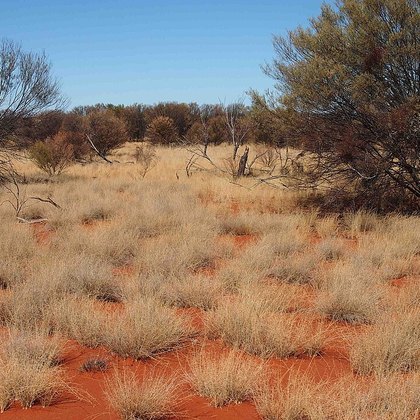
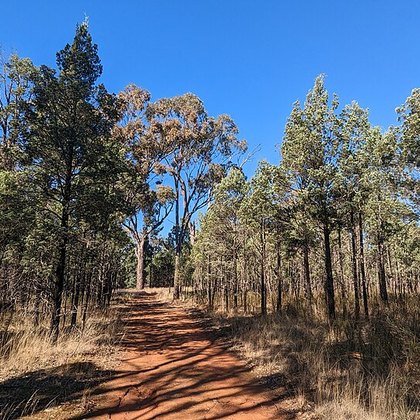
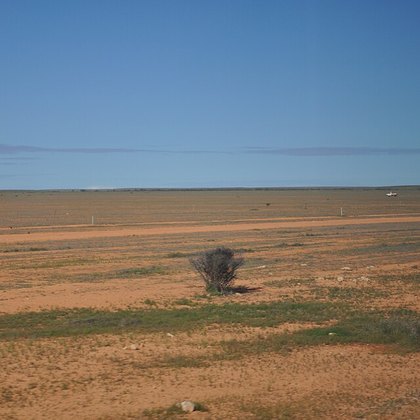
Western myall, Acacia papyrocarpa, is the key: sparse grey-green acacia groves on limestone, with open saltbush and bluebush plains between them. The species is also strongly tied to stands of black oak and other casuarinas, because these hold the hollows it nests in; laying starts early, by mid-July. At the edges of its range it touches mallee and sparse eucalypt scrub. Everywhere there is the additional condition of drinking water: in this landscape that means stock troughs, railway bores and a handful of natural soaks, and the birds come in to them daily at fixed times.
Where the bird is most often found, arranged by main group and formation.
Range and movements
Resident in a very small area around the Nullarbor, on and about the Western Australia / South Australia border, roughly from Zanthus and Rawlinna in the west into the far south-west of South Australia. Measurements for this guide gave eight qualifying years out of ten and only 288 records — exactly at the threshold for inclusion, and an honest reflection of how scarce and how little-visited this bird is. Two resident units were measured, both around the state border. Within that area it is local and mobile: the birds follow the rain and shift with the availability of water and seed, so a site that is good one year can be empty the next. This is a recent AviList split whose status GBIF's backbone taxonomy has not yet adopted; the figures above were therefore measured separately at subspecies level and should be read with corresponding caution.
- Resident
- dark = core range, pale = thinly spread
Where and when to look
Don't look for birds, look for water. Sit at a stock trough, a railway bore or a soak in the myall country during the first hour after sunrise and the last before sunset, and wait; the odds of a party coming in to drink are many times better than those of a chance meeting in the scrub. On every parrot check the tail length and the two-toned face, and record the exact locality — with this species that is part of the identification.
Conservation
The IUCN has not yet assessed the species separately (NE): it was only separated from the bluebonnet in 2015 and is still counted within that species on the Red List, where it rates Least Concern. That is misleadingly reassuring. The Naretha bluebonnet has a very small, strongly isolated range, is estimated at fewer than five thousand birds and its trend is described as decreasing; over the twentieth century it became clearly scarcer after a period when it was reported as common. It is on CITES Appendix II and historically suffered from trapping for the bird trade. The risks now are rather grazing and the loss of old myall and casuarina trees with hollows, browsing by rabbits and goats that stops the groves regenerating, and changes in the management of the stock troughs it has come to depend on. A dedicated assessment is more urgent for this bird than its present status suggests.
Scientific name
Northiella narethae | (White, 1921)
The name refers to Naretha, a hamlet and railway siding on the Trans-Australian line across the Nullarbor, some 120 km east of Zanthus, where Henry Luke White described the bird in 1921 as Psephotus narethae. The Dutch name takes that place name over untranslated, as the guide often does for species named after their type locality. In English it is also called the Little Bluebonnet, which expresses the difference from its sister species more neatly than the place name does. The genus Northiella was erected by Gregory Mathews in 1912 and honours the Australian ornithologist Alfred John North; the blue-faced parrots have stood apart from Psephotus ever since.