All species › Cranes, rails and allies › Rails, gallinules and coots › Buff-banded Rail
Buff-banded Rail | Gallirallus philippensis
Geelbandral | Rascón filipino
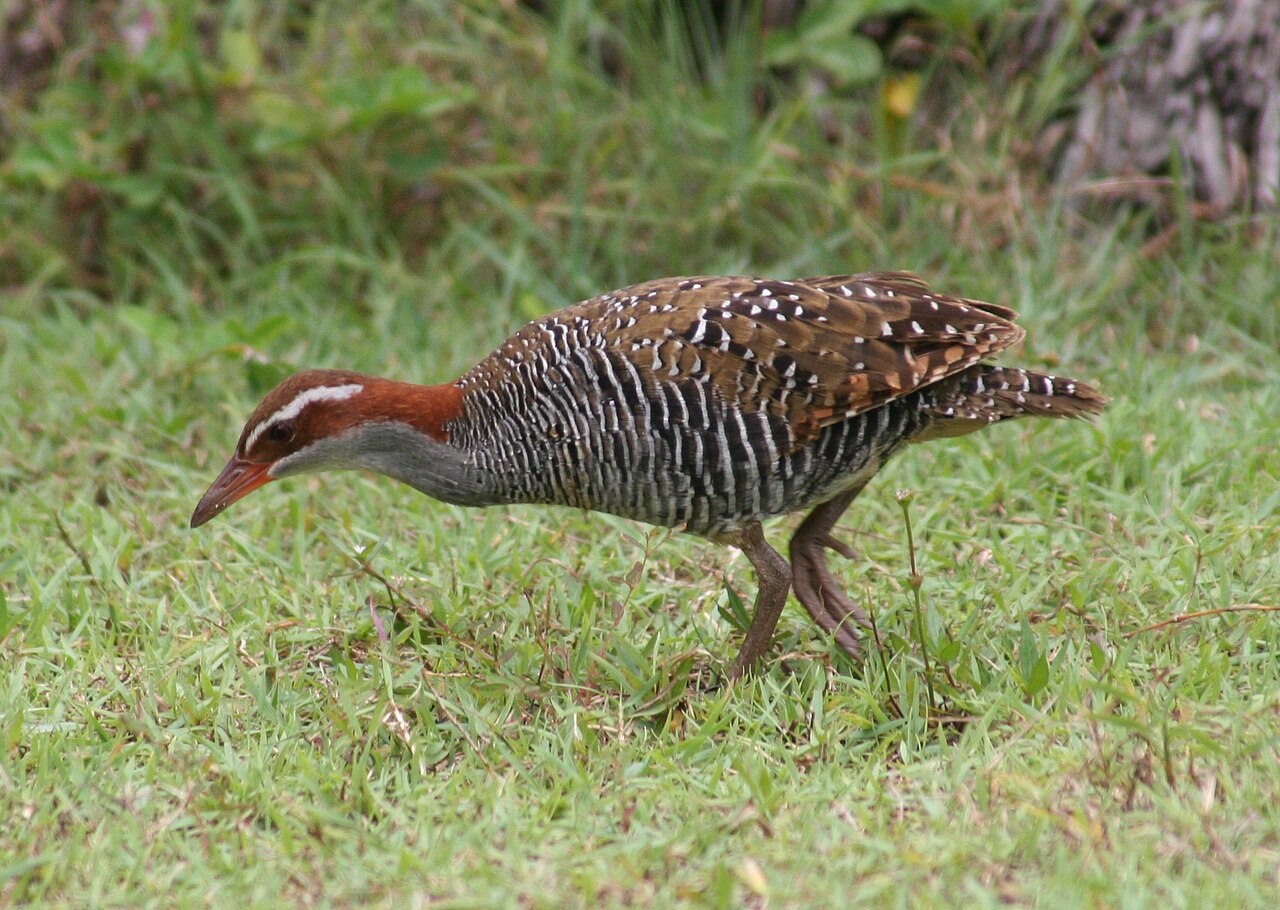
The Buff-banded Rail is the rail that does show itself: a medium-sized, streaked rail with a grey eyebrow, a chestnut band running from the bill round the nape, and an orange-brown band across the breast above sharply barred black-and-white underparts. It walks through campgrounds, along harbour walls and through mangroves, and so is the first rail many visitors ever see properly.
Voice
The contact note is a sharp, squeaking swit, often repeated, and at alarm a hard cackling rattle follows. In the breeding season it gives a creaking, squeaky call with something of a rusty hinge about it. It is heard most at first light and just after sunset, and outside the breeding season it may stay silent for days.
No freely licensed recording has been found for this species yet; what to listen for is described below.
Identification
A rail of twenty-eight to thirty-three centimetres and about a hundred and thirty grams. The upperparts are brown with black streaks and white specks, the chin and throat grey, and a chestnut band runs from the bill across cheek and nape. The white or grey eyebrow shows at a distance. The breast carries a broad orange-brown band, and below it the whole underside is finely barred black and white like a zebra. The bill is stout and reddish-brown, the legs pink, the eye red. Young birds are duller and all but lack the breast band; downy chicks are sooty black.
Confusion species
Lewin's Rail (Lewinia pectoralis) is smaller, lacks the orange-brown breast band, and has a longer, slightly decurved pink bill and a slate-grey breast. Lord Howe Woodhen (Gallirallus sylvestris) is flightless, plain olive-brown with no barring and no breast band, and occurs only on Lord Howe Island — where Buff-banded Rail also lives, so the two can be compared side by side there. Weka (Gallirallus australis) is far larger and heavier, flightless, and confined to New Zealand. Chestnut Rail (Gallirallus castaneoventris) is close to twice the length, chestnut below, and lives only in the mangroves of tropical northern Australia.
Habitat
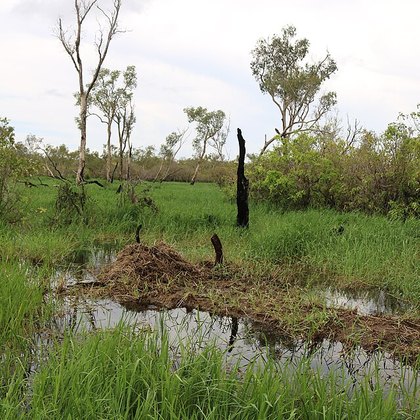
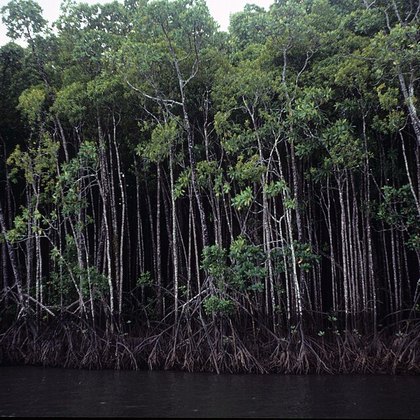
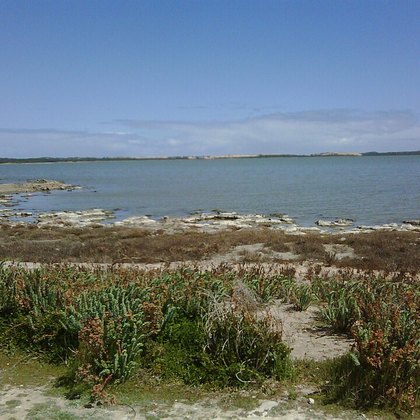
Damp ground with low, dense cover: reed fringes, sedgeland, saltmarsh, the landward edge of mangrove forest, tidal flats and estuary margins, drains and ditches beside crops. Alongside that, and unusually for a rail, gardens, parks, campgrounds and harbour walls, where it forages among the shrubs with people about. It works along edges and seams and crosses open ground at a run.
Where the bird is most often found, arranged by main group and formation.


Range and movements
Widespread across mainland Australia, above all along the east coast and on the coastal islands, and further on Norfolk Island and Lord Howe Island, where it established itself unaided. In New Zealand, where it is the moho-pererū, it is now largely restricted to coastal wetlands and mangroves of the northern North Island, with populations in Nelson and Marlborough and on Great Barrier Island. Macquarie Island held a subspecies of its own, now extinct.
- Resident
- dark = core range, pale = thinly spread
Where and when to look
Work the seam where grass meets cover — exactly where a track, a drain or a sea wall touches the vegetation — and look early in the morning. In campgrounds, coastal villages and around picnic areas in Queensland and on Norfolk Island it will often walk about a few metres away. Along a ditch the zebra barring of the belly gives it away sooner than its outline does.
Conservation
Least Concern (LC), with twenty subspecies over a huge area from the tropics to the subantarctic, and on mainland Australia more likely increasing than declining because it copes well with a human landscape. The island picture is bleaker: the Macquarie Island subspecies is extinct; in New Zealand the species counts as declining through drainage of coastal wetland and predation by cats, stoats and rats; and on Lord Howe Island it is itself a concern, because there it may compete with the rare Lord Howe Woodhen for food and ground.
Scientific name
Gallirallus philippensis | (Linnaeus, 1766)
Linnaeus described the species in 1766 as Rallus philippensis, from a bird Brisson had figured six years earlier from the Philippines; because it later moved to another genus, author and year stand in parentheses. The genus Gallirallus was introduced by Lafresnaye in 1841 and joins Latin gallus, 'cock', to rallus, 'rail'. philippensis means 'of the Philippines', which is the type locality — far outside the area of this guide, for the species has since been described across half the Pacific.