All species › Cranes, rails and allies › Rails, gallinules and coots › Chestnut Rail
Chestnut Rail | Gallirallus castaneoventris
Mangroveral | Cotara australiana
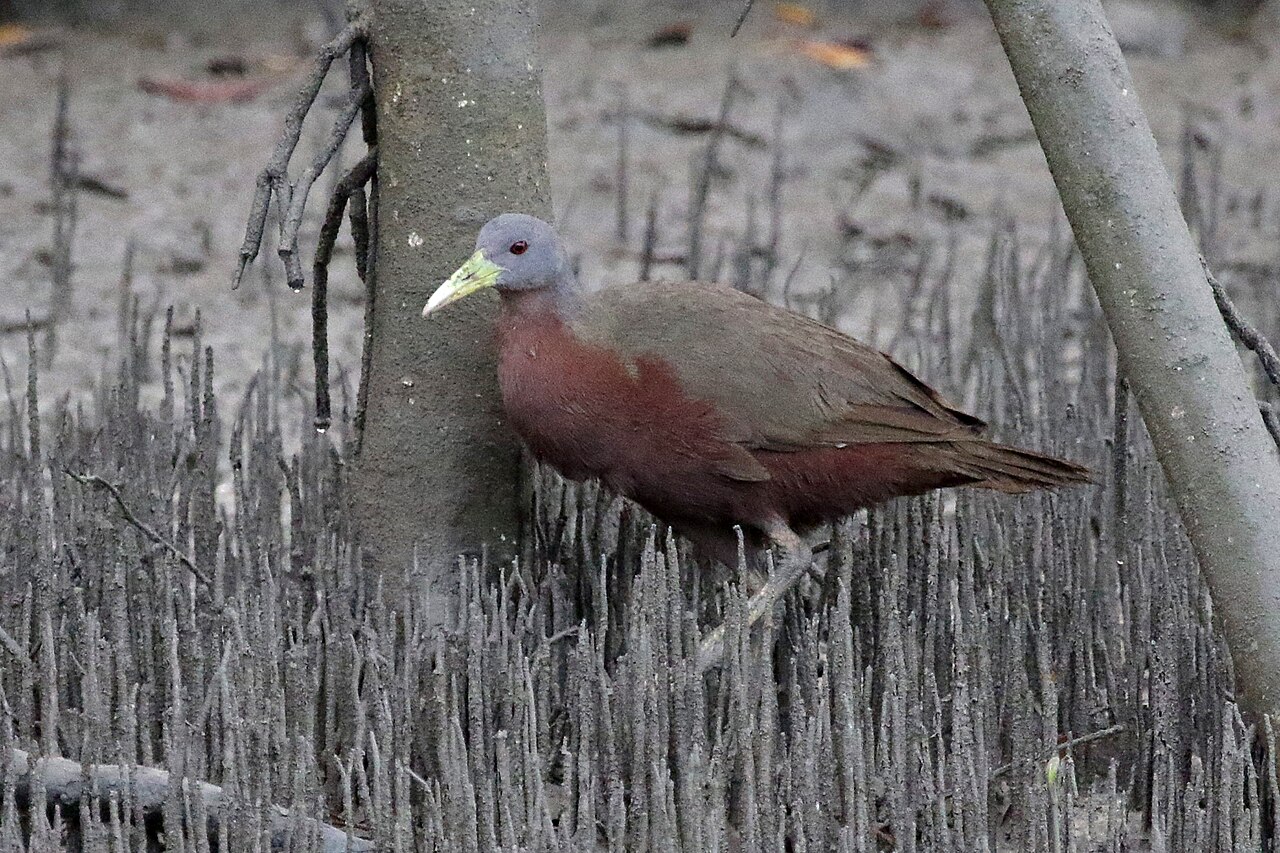
At forty-odd to fifty centimetres the Chestnut Rail is the largest rail in Australia, and it lives nowhere but in mangrove forest: chestnut below, olive-brown above, with a grey head, a long yellow-green bill and yellow legs. At low tide it steps out of the root tangle to work the exposed mud bank of a tidal creek.
Voice
A noisy bird for a rail: it gives low grunting notes that run on into wild honking squawks, loudest at dawn and dusk, with neighbours answering one another across the creek. The sound carries far over the water and is usually the first sign of the species; of the bird itself there is still nothing to see.
No freely licensed recording has been found for this species yet; what to listen for is described below.
Identification
A very large rail of forty-four to fifty-two centimetres and six to eight hundred grams — roughly the build of an Australasian swamphen. The underparts are deep chestnut, the upperparts olive-brown, and the head is grey with a pale grey chin patch. The bill is long, heavy and yellow-green to chalky yellow, the legs yellow, the iris red. Birds of the Top End are largely chestnut throughout, while those of the Kimberley coast have an olive-grey back. It rarely flies and climbs surprisingly well: birds are regularly found up on mangrove branches, and swimming has been recorded.
Confusion species
Within this area confusion is mostly a matter of size. Buff-banded Rail (Gallirallus philippensis) feeds on the landward side of the same mangrove forest, but is not two-thirds the length, carries a white eyebrow and an orange-brown breast band, and has sharply barred black-and-white underparts instead of plain chestnut. Dusky Moorhen (Gallinula tenebrosa) is dark with a red frontal shield and swims. Purple Swamphen (Porphyrio porphyrio) is as large but bright blue with a red bill. Lord Howe Woodhen (Gallirallus sylvestris) and Weka (Gallirallus australis) are the other big relatives in this guide, but both are flightless and thousands of kilometres away.
Habitat
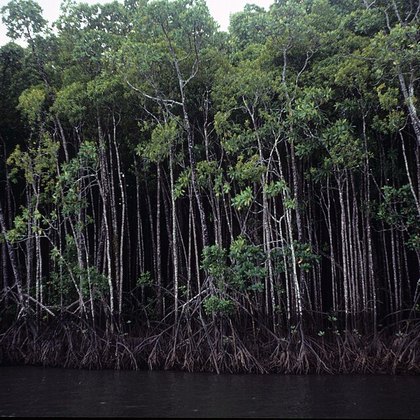
Mangrove forest and nothing else, and within it the densest, tallest stands along tidal creeks and estuaries. It forages in the mud and shallow water among the stilt roots for crabs, small fish and insects, and withdraws into the root tangle as the tide comes in. The nest is a solid stick structure one to three metres up in a fork or on stilt roots, reused year after year, with a platform some thirty-five to fifty centimetres across.
Where the bird is most often found, arranged by main group and formation.

Range and movements
The tropical north coast of Australia: from King Sound in the Kimberley east along the Western Australian coast, around the Top End and Arnhem Land of the Northern Territory, to the western part of the southern shore of the Gulf of Carpentaria; it was formerly recorded in northwestern Queensland. It occurs nowhere else in Australia, and certainly not in New Zealand; outside the map window only a subspecies of its own survives in the Aru Islands.
- Resident
- dark = core range, pale = thinly spread
Where and when to look
Take a mangrove tidal creek near Darwin at low water — Buffalo Creek at Lee Point is the classic spot — and move slowly along the bank as the mud flats come clear; the bird then comes out to feed and often walks in full view, untroubled. Come early, because the dawn calling places it, and let the sound choose which bend of the creek to work. At high tide there is no point looking.
Conservation
Least Concern (LC), with a large range and a habitat that is still largely intact across northern Australia; mangrove forest lies outside the farming zone there and much of it falls within protected or Indigenous-managed country. Port expansion and industry around Darwin, disturbance of tidal creeks and, over the longer run, the shifting of mangrove belts under sea-level rise and extreme heat events are the risks. No reliable estimate of Australian numbers exists, because the species is all but impossible to count inside its forest.
Scientific name
Gallirallus castaneoventris | (Gould, 1844)
Gould described the species in 1844 as Eulabeornis castaneoventris, in the Proceedings of the Zoological Society of London, from a bird taken on the north coast of Australia; the type locality was later fixed on the Flinders River on the Gulf of Carpentaria. Because it has since moved to Gallirallus, author and year stand in parentheses. Gould introduced the genus Eulabeornis in the same paper, for this one species; the name is formed from Greek eulabes, 'cautious', and ornis, 'bird'. castaneoventris means 'chestnut-bellied', from Latin castaneus and venter.