All species › Pigeons and doves › Doves and pigeons › Chestnut-quilled Rock Pigeon
Chestnut-quilled Rock Pigeon | Petrophassa rufipennis
Roodvleugelkwartelduif | Paloma roquera alirrufa
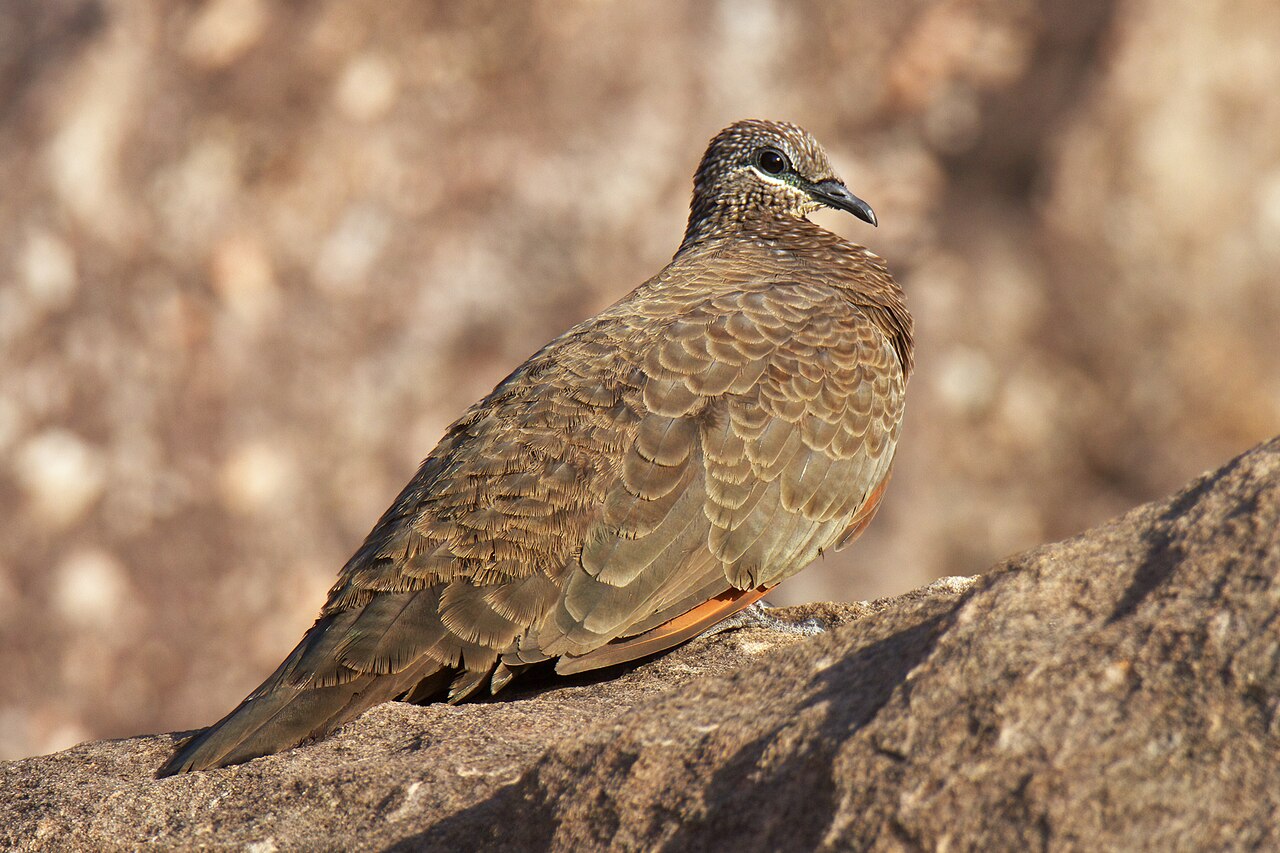
The Chestnut-quilled Rock Pigeon is a dark, thickset pigeon confined to the sandstone cliffs of Arnhem Land — one of the few Australian birds with a range this small and this sharply bounded. On rock it is all but invisible, but the moment it takes off the wings clatter loudly and a deep chestnut panel flares in the primaries.
Voice
A deep, short, muffled coo that hardly carries among the rocks and is easily missed; in practice the sound that names the bird is mechanical. On take-off the wings drum with a hard clattering roar, often straight up out of a gorge, and that is usually the first and only sign that a bird was there.
No freely licensed recording has been found for this species yet; what to listen for is described below.
Identification
A substantial, dark sooty-brown pigeon of around thirty centimetres, finely vermiculated in grey and brown over the whole body so that it disappears against weathered sandstone. A narrow pale line runs above and below the eye, the lore is black and there is a small off-white patch on the chin; bare grey warty skin surrounds the eye. The flight mark is the bright chestnut panel in the primaries, almost entirely hidden on a perched bird.
Confusion species
White-quilled Rock Pigeon (Petrophassa albipennis) is the only genuinely similar species — same build, same rock-bound life, same clattering flight — but it shows a white rather than chestnut wing panel and is usually redder brown in tone. Range settles it: the two do not meet. The Chestnut-quilled is confined to the sandstone plateau of western Arnhem Land and Kakadu, the White-quilled to the Kimberley and the Victoria River country further west and south-west. Spinifex Pigeon (Geophaps plumifera) shares the rocky ground inland but is far smaller, rufous with black barring, and carries a pointed crest and a red face mask.
Habitat
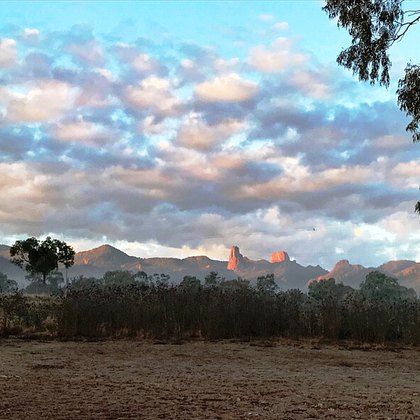
Tropical sandstone escarpments, gorges, ledges and boulder fields, with spinifex, grass and scattered low eucalypt woodland between them. It feeds walking on sandy patches and at the foot of the cliffs, mainly early and late in the day, and retreats to the rock faces when disturbed. Permanent pools in the gorges keep it in place through the dry season.
Where the bird is most often found, arranged by main group and formation.


Range and movements
Endemic to the Northern Territory and restricted to the sandstone plateau of western Arnhem Land and the adjoining escarpment in Kakadu National Park — a range of a few tens of thousands of square kilometres and nothing beyond it. Within that area it is locally common but strictly tied to the rock formations; on the surrounding plains it is absent altogether.
- Resident
- dark = core range, pale = thinly spread
Where and when to look
At the rock-art sites of Kakadu — Burrungkuy (Nourlangie) and Ubirr — work along the base of the walls early in the morning and scan the ledges patiently; the birds sit motionless and only show once you know what you are looking for. Move quietly: often you notice one only when a pair clatters straight up out of the gorge, and the chestnut wing panel is then your confirmation. Towards evening it comes down to sandy patches at the foot of the cliff to feed.
Conservation
Least Concern (LC) on the global list, but in the Northern Territory itself it is listed as Near Threatened, which fits a species with a range this small. The main worry is fire on the plateau burning too often and too hot, eating into the spinifex and the seed supply at the foot of the cliffs. Its inaccessible country at the same time shelters it from much of what troubles other Australian pigeons.
Scientific name
Petrophassa rufipennis | Collett, 1898
The German explorer Ludwig Leichhardt already saw the bird in 1845 near the South Alligator River, but the Norwegian zoologist Robert Collett only described it in 1898, from material gathered in the Northern Territory by the collector Knut Dahl; the type locality lies on the Alligator River. The genus Petrophassa was introduced by Gould in 1841 and is built from Greek petros, 'rock', and phassa, 'wild pigeon'. rufipennis is Latin: rufus, 'reddish', and penna, 'feather' — for the chestnut wing panel. Author and year carry no parentheses, since the species still stands in the genus it was placed in.