All species › Pigeons and doves › Doves and pigeons › White-quilled Rock Pigeon
White-quilled Rock Pigeon | Petrophassa albipennis
Witvleugelkwartelduif | Paloma roquera aliblanca
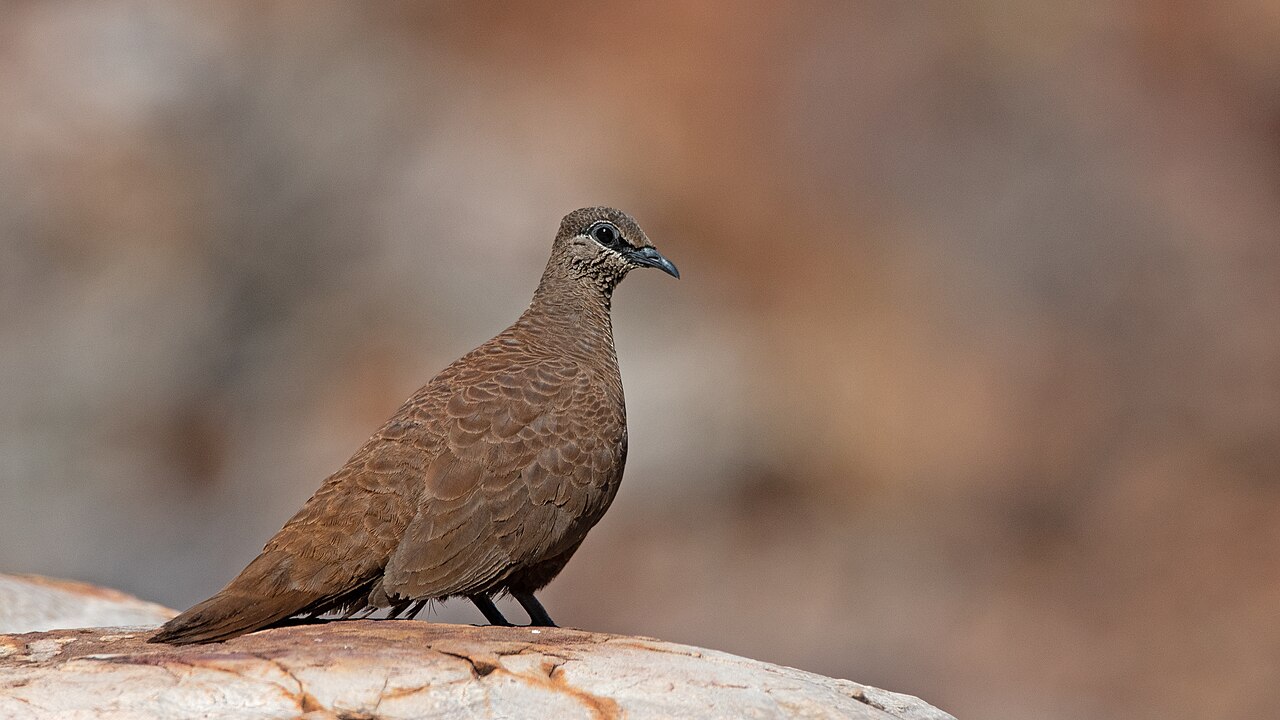
The White-quilled Rock Pigeon is the rock pigeon of the Kimberley: a thickset, earth-brown bird that vanishes completely against sandstone and gives itself away only when it clatters into the air and flashes a bright white panel in the wing. It walks over bare boulders with the body held low and the wings slightly drooped, more like a partridge than a pigeon.
Voice
A low, muffled cooing, usually in a short run and already inaudible at any distance. In flight the wings make a whirring, clattering sound that early observers compared to a partridge; that racket is the most useful field character, because it often comes before you see the bird.
No freely licensed recording has been found for this species yet; what to listen for is described below.
Identification
A solid pigeon of nearly thirty centimetres, mid-brown to reddish-brown and finely vermiculated all over, which camouflages it perfectly on weathered sandstone. A pale line runs across the face from the base of the bill and curves above and behind the eye; there are white spots on chin and forehead. The decisive mark appears only in flight: a large white panel in the primaries. Birds of the race boothi from the Stokes Range have that panel much reduced or lack it altogether.
Confusion species
Chestnut-quilled Rock Pigeon (Petrophassa rufipennis) is the mirror species: same build, same behaviour, same clattering flight, but darker sooty-brown and with a chestnut rather than white wing panel. Range separates them completely — this species holds the Kimberley and the Victoria River country, the other the Arnhem Land plateau and Kakadu, and there is no overlap. Watch for the race boothi, which shows hardly any white in the wing: a dark rock pigeon with no clear wing panel in the Stokes Range is still this species. Spinifex Pigeon (Geophaps plumifera) lives in the same rocky country but is smaller, brighter rufous and barred, with a crest and a red face.
Habitat
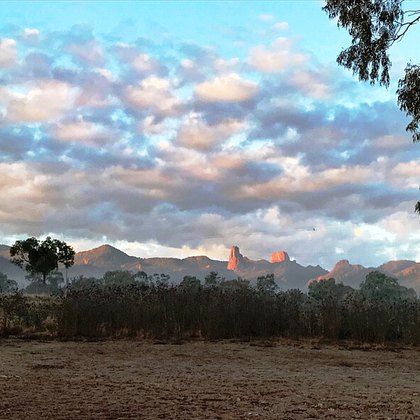
Rocky ground above all: sandstone gorges, escarpments and weathered boulder fields, with grass, spinifex and scattered shrubs between them. To feed it drops into grassy eucalypt woodland and onto sandy patches at the foot of the rocks, but at the least alarm it flies back up. Pools in the gorges supply the water it needs daily.
Where the bird is most often found, arranged by main group and formation.


Range and movements
Endemic to tropical northern Australia, from the Kimberley in Western Australia — roughly from Oobagooma and Derby to Kununurra and the Ord — east into the north-west of the Northern Territory, as far as the Victoria River country and the headwaters of the Flora River. The race boothi sits isolated to the south-east of that, from the Stokes Range to Waterloo Station. It occurs nowhere else.
- Resident
- dark = core range, pale = thinly spread
Where and when to look
The classic spot is the escarpment behind the Victoria River Roadhouse on the Victoria Highway: take the track up in the first light and scan the rock edges and the ledges beside the path. It often sits right on a projecting stone with the body held horizontal, and moves only when you come too close; the clattering take-off is then the signal. Windjana Gorge and the other gorges of the Kimberley give the same chance, always early in the day.
Conservation
Least Concern (LC) on the global list, with a wide range in thinly settled rock country; in the Northern Territory it is nevertheless regarded as Near Threatened. Its terrain is inaccessible and largely useless to stock, which protects it, but altered fire regimes and the spread of coarse introduced grasses such as gamba grass eat into the seed supply at the foot of the cliffs.
Scientific name
Petrophassa albipennis | Gould, 1841
Gould described the species in 1841 and placed it straight into a new genus, Petrophassa, of which it is the type species; author and year therefore carry no parentheses. The genus name comes from Greek petros, 'rock', and phassa, 'wild pigeon' — exactly what the bird is. albipennis is Latin: albus, 'white', and penna, 'feather', for the white wing panel. The type came from the north coast and is now referred to the mouth of the Victoria River; the second race boothi was named by Goodwin in 1969, after the Stokes Range.